Thursday 25 June 2026
Willpower won't get people moving: design the city instead
 By Astrid Groenewegen · 3 min read
I just came back from an hour of exercise and honestly: I am beat. It started me thinking about when I was a kid. When you are young you seem to have endless sources of energy. But I guess that's because as a kid we are moving constantly: running, cycling, roller-skating, bunny hopping, hula hooping. Movement was so natural, not a chore we needed to tick off. Most of my moving was out on the street, not in a gym or anything like it. So that made me think about an interesting design question:
How do you design a city where moving is the obvious choice again? And where else in our lives could the insights I would find apply?
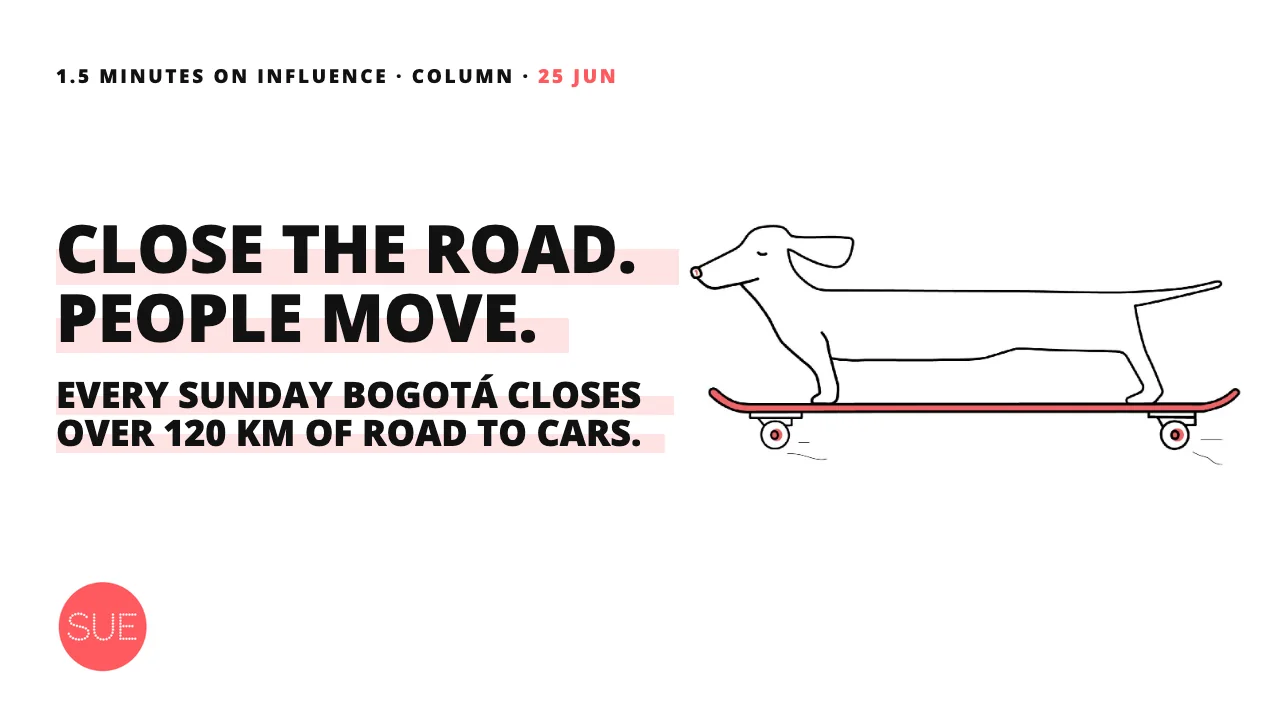
In searching for the answer I landed in Colombia. Well, metaphorically. I read about the Ciclovía programme. It is one of the clearest examples I know of designing behaviour rather than demanding it. In Bogotá, every Sunday, the city closes more than 120 kilometres of its main roads to cars. Thanks to the Ciclovía, between one and a half and two million people walk, cycle and skate on those roads each week. That is close to a quarter of the city, choosing to move, without a single poster telling them to. The behavioural science here is about the path of least resistance.
We take the easy, default option far more than we act on our intentions, because the brain treats effort as a cost to avoid.
On a closed road, moving is the effortless thing and driving is simply not available, so moving is what happens. There is a second effect of the Cicloviá programme too that is worth mentioning: people who take part report higher social capital, more trust and connection, than people using ordinary bike paths (Torres and colleagues, American Journal of Public Health, 2013).
What I find useful about this is the question it hands you. Not how do I get people to want a behaviour more, but how do I make that behaviour the easy default and the alternative slightly harder. That is Behavioural Design in one line. You do not raise the willpower. You lower the friction, and the behaviour follows the easier path.
So how do you put the path of least resistance to work? Here are three practical moves:
Remove a step from the behaviour you want. Every extra click, approval or hand-off is a tax people quietly avoid. Take the behaviour you want from a team or a customer, adopting a tool, finishing a sign-up, following a process, and strip one step out so it becomes the path of least resistance.
Add a little friction to the behaviour you want less. You rarely have to ban anything. Make the risky shortcut need one extra confirmation, make the safe option the default, add a small pause before the action you want less of. A modest obstacle is often enough to tip the choice.
Change the space, not the person. Before you write the reminder or give the pep talk, ask what the environment is currently making easy. When a team will not adopt something or a customer keeps dropping off, change the default, the workflow or the layout so the behaviour you want is simply what happens there.
Sources
Torres, A., Sarmiento, O. L., Stauber, C., and Zarama, R. (2013). The Ciclovia and Cicloruta programs: promising interventions to promote physical activity and social capital in Bogota, Colombia. American Journal of Public Health, 103(2), e23 to e30.