Damon Centola's theory of change: why behaviour spreads differently from news
You're responsible for a sustainability initiative, you've run campaigns, organised information sessions, put the facts on the table. People understand the problem and broadly agree with it, but very little actually changes.
The explanation lies in an assumption that almost every campaign, policy programme, and change initiative shares: that informing and persuading people leads to behaviour change on its own. That's how news spreads, but behaviour change, real change in daily habits and social norms, spreads fundamentally differently.
Damon Centola, network scientist at the University of Pennsylvania, discovered something that turned the field upside down. Something I've seen reflected in virtually every programme I've worked on since.
Damon Centola's theory of complex contagion shows that behaviour change doesn't spread via the shortest connections in a network, but via dense clusters of people who mutually reinforce each other. Unlike information, which requires just one contact, behaviour change requires multiple reinforcements from several people you know and trust. This has direct implications for how you design transition strategy. More on Behavioural Design for Change Management →
Simple contagion works differently from complex
In 1973, sociologist Mark Granovetter published a landmark paper: "The Strength of Weak Ties."[1] His argument: to find new jobs, discover new ideas, and reach new networks, your weak ties are more powerful than your strong ones. Your close friends know what you already know. The passing acquaintance at a conference has access to an entirely different network.
This was correct. And it became the foundation of social network strategy: find the hubs, the connectors, the influencers who bridge distant networks. Large reach. Long bridges. That was the model.
Only: for behaviour change, it doesn't hold.
In 2010, Centola published an experiment in Science.[2] He created an online health platform and divided participants into two types of networks. The first had many weak ties to distant people: the long bridges. The second had strong clustering connections, people who were each other's friends, in the same neighbourhood or professional group.
The outcome was surprising. Health behaviour, signing up for a new diet, joining an exercise programme, spread almost exclusively in the clustered network. Not via the long bridges to distant acquaintances, but via the wide bridges in tight-knit groups.
Information spreads via bridges. Behaviour spreads via clusters.
His conclusion: information is simple contagion. One contact is enough. But behaviour change is complex contagion. You need multiple reinforcements from people you trust.
What makes behaviour change complex? Three things work together. There's social cost: if you're the only one doing something that isn't yet normal, you risk social rejection, so you need confirmation that others are doing it too before you'll make the leap. There's cognitive uncertainty: you can hear news and use it later, but for behaviour change you need to see exactly how someone does something, how it feels, whether it actually works - and you learn that up close, not second-hand. And there's credibility: one person saying something works could be an exception, but four people from your immediate environment doing it is evidence.
Sustainability as complex contagion
Take the energy transition. The Netherlands has ambitious climate targets. There are subsidies. There are campaigns. Barely anyone doesn't know that solar panels exist.
Yet adoption lags behind virtually all projections.
The standard response: more information, better campaigns, higher subsidies, stricter regulations. But Centola's analysis points to a different bottleneck. The problem isn't a lack of knowledge. It's in the networks along which adoption spreads.
Do you know how people decide to get solar panels? Not via the government. Not via an advertising campaign. They do it after three neighbours have done it, those neighbours talk enthusiastically about it, and they can see for themselves what it looks like on a roof in the same street.
That's complex contagion. Multiple reinforcements. Social proof not from strangers, but from people you know, in a context that resembles your own context.
The mistake that policy and business consistently make: they look for influencers with large networks. They look for early adopters who serve as bridges to large masses. They look for long bridges.
Centola says: you need wide bridges. Not an influencer telling a thousand people that sustainability is good. But ten tight-knit clusters of people who take the step together, reinforce each other, and can tell their own cluster's success story to the adjacent cluster.
I see this in the programmes we support. Municipalities that tackle their sustainability ambitions neighbourhood by neighbourhood rather than island-wide see adoption spread faster. When your street collectively joins an energy storage scheme, the threshold is lower, the costs are shared, and the social confirmation is immediate. That's Centola in practice.
The health transition
The same mechanism explains why health policy so often fails.
Think about smoking. For decades the strategy was: inform people about the risks, show them how bad it is, put frightening images on the packets.
Smoking behaviour declined. But not because people suddenly understood the danger. It declined because smoking became socially unacceptable in an increasing number of circles. Offices became smoke-free. Restaurants. Terraces. And when three colleagues ask to move a meeting because they don't want to sit next to a smoker, that's social pressure that operates differently from information provision.
Centola describes in Change: How to Make Big Things Happen (2021)[3] how behaviour change that sticks is almost always socially anchored. Not imposed from outside via a campaign, but grown from a network of people who already display the behaviour and provide social proof of it.
Behaviour doesn't change when you explain it to people. It changes when their environment makes it normal.
For the current health transition, the movement towards preventive care, healthy food, more exercise, less screen time, this means: campaigns that inform people about health risks have limited effect when the social environment of those people normalises the unhealthy behaviour. An office where everyone eats a biscuit at half past two is more powerful than any campaign.
The interventions that do work are almost always social. Employers who reward walkers in group form so colleagues walk together. Schools that let parents participate as a group in food changes. Health insurers who encourage neighbourhood groups rather than individuals. Those are wide bridges, not long ones.
What the SUE Influence Framework adds
At SUE we use the SUE Influence Framework to understand why people do or don't do something. The four forces that determine behaviour are Pains (the problems that drive behaviour), Gains (the benefits that attract behaviour), Comforts (the habits that hold behaviour in place), and Anxieties (the fears that block behaviour).
Centola's work gives a more precise explanation for each of those forces in transition challenges.
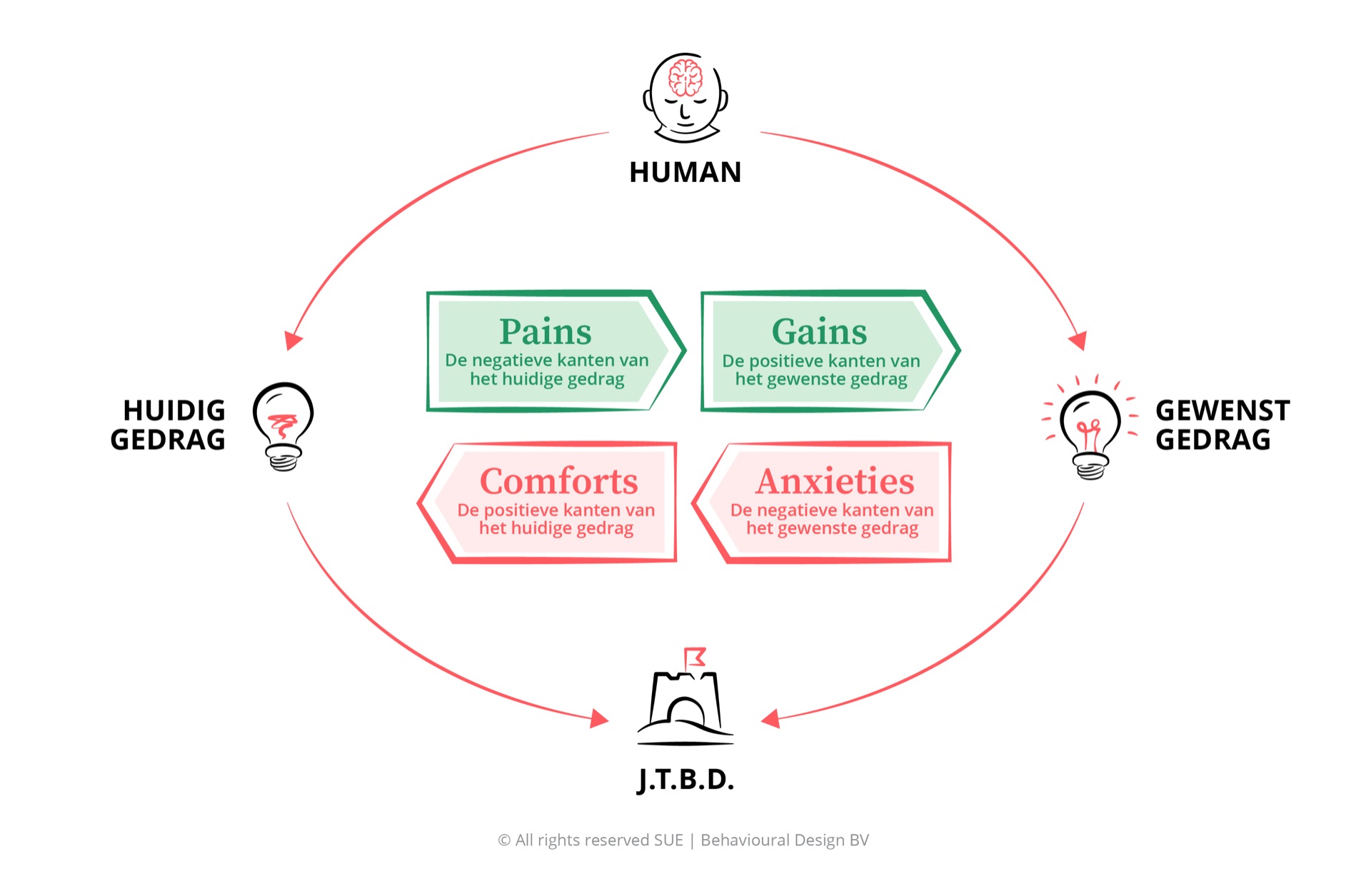
Pains: people in a sustainability programme experience real pains, higher energy costs, dependence on fossil fuels, a sense of little control. But those pains are only motivating when the person also has peers who acknowledge the same pain. If you're the only one experiencing this problem, it's a vulnerability. If your neighbourhood has the same issue, it's a shared problem you can tackle together.
Gains: the benefits of new behaviour are theoretically known. Lower energy bills, better health, less CO2. But people only truly believe in those gains when they can observe them in people who resemble them. A neighbour who says their energy bill has halved is more convincing than ten government campaigns combined.
Comforts: existing behaviour is maintained by social norms. When everyone around you drives a fossil fuel car, an electric car is socially awkward. When nobody at your workplace cycles, cycling feels inconvenient. You don't resolve these comforts with information. You resolve them by shifting the social norm, and that only works when enough people in your immediate environment make the switch.
Anxieties: the fear of being the first to move is large. What if it doesn't work? What if you're seen as a fanatic? Those anxieties disappear when you see people you know and respect having already taken the same step. Not one person on Instagram, but three people on your team, in your street, in your professional group.
Four design principles for transition strategy
What does Centola's theory mean concretely for those working on a transition challenge, whether that's sustainability, a health transition, or organisational change?
1. Look for clusters, not influencers. Stop looking for one person with a large reach. Look for tight-knit groups, a team, a neighbourhood, a trade union, a professional group, where enough people are ready to take the step together. Three people in the same neighbourhood doing it together are more powerful than thirty separate individuals hearing about it independently.
2. Create wide bridges, not long ones. Connect clusters to each other that already resemble each other. A group of sustainable farmers talking with a similar group of farmers in another region spreads behaviour. An influencer telling an anonymous audience spreads information. The difference isn't the message but the social structure along which that message travels.
3. Make the new behaviour socially observable. Solar panels on a roof are visible. An electric car on the driveway is visible. A vegan lunch in the company canteen is visible. Behaviour you can't see cannot become a social norm. Design visibility explicitly into your intervention, because it's not a by-product, it's the engine.
4. Measure social spread, not individual reach. The classic metric for campaigns is reach: how many people have seen the message. Centola's model calls for a different metric: how many clusters are already showing the desired behaviour, and in how many adjacent clusters has it begun? That's the measurement that makes real transition visible, not an impression count.
Frequently asked questions about Damon Centola and complex contagion
What is Damon Centola's core theory?
Damon Centola argues that behaviour change spreads via complex contagion: people need multiple reinforcements from people in their direct network before they adopt new behaviour. This differs fundamentally from simple contagion, where a single contact is sufficient. His research shows that behaviour change spreads via dense clusters, not via long bridges to distant networks.
What is the difference between simple and complex contagion?
Simple contagion (news, viruses) needs only one contact to spread, and long bridges to distant networks are effective. Complex contagion (behaviour change, norms) needs multiple reinforcements from trusted sources in your immediate environment. Weak ties don't help here. Dense clusters of people who know each other are far more powerful for behaviour spread.
Why do awareness campaigns about sustainability work so poorly?
Campaigns spread information, but behaviour change requires social reinforcement. People change their behaviour when they see neighbours, colleagues, or friends already doing the new behaviour, not when they hear about it from a campaign or an unknown influencer. Sustainability works better via neighbourhood approaches than national campaigns, because local clusters provide the social reinforcement that complex contagion requires.
How does Centola's approach differ from traditional change management?
Traditional change management focuses on persuading individuals through communication, training, and leadership. Centola's approach focuses on designing social networks: who needs to be in contact with whom so that behaviour can jump from person to person via mutual reinforcement? You don't communicate to people, you design the social context in which they reinforce each other's behaviour.
What is the role of visibility in complex contagion?
Behaviour that isn't visible to others cannot spread socially. Centola's research shows that behaviour people can observe in people who resemble them crosses the social threshold much faster. Design visibility into every behavioural intervention: solar panels on roofs, bike racks that are full, colleagues openly using the new work method.
Conclusion
The transition challenges of our time will not be solved with better campaigns. They will be solved when we understand the social architecture within which behaviour spreads.
Centola's contribution is that he gives us a more precise map. Not the map of information spread, where every reach is measurable and every connection counts. But a map of social networks, where the quality of connections in tight-knit clusters determines whether new behaviour sticks.
At SUE we see this daily in programmes for governments, healthcare institutions, and businesses grappling with transitions. Behaviour change that actually sticks happens when you design the conditions in which people bring their own network into the change, rather than trying to persuade them one by one.
That is Centola's fundamental insight. And it changes how you design transition strategy.
PS
I encounter Centola's insight increasingly often in practice, sometimes without the people applying it knowing his name. Municipalities that prefer neighbourhood initiatives over national campaigns. HR managers who build in group interventions rather than individual training. They're doing it right, but they lack the theoretical framework to scale it or defend it in a boardroom. If you want to learn how to apply this framework professionally, the Fundamentals programme is a good place to start.