Neuromarketing: what works and what is hype
A vendor shows you a slide. On it, a brain, and one small region glowing orange. Underneath, a sentence about desire. In the room, everyone nods. Nobody asks the only question that matters, which is: what would that orange patch have looked like if the advert had been terrible?
Neuromarketing has spent twenty years in that gap between an impressive picture and a defensible claim. Some of what the field has produced is genuinely useful and better than anything a focus group can give you. Some of it is a scanner sold as a mind-reading device. The two get marketed with the same slide deck, which is the actual problem.
So this piece splits them. Not what neuromarketing is, we cover that in what is neuromarketing, but what survives contact with the evidence.
The short verdict. Neuromarketing works well at one specific job: taking brain measures from a small sample to forecast how a large population will respond to an advert, a trailer or a song. It works badly at the job it is usually sold for, which is reading an individual buyer's hidden intention. There is no buy button. There is a decent forecasting instrument that most teams cannot afford and do not need. More on behavioural design for marketing →
What the evidence actually supports
Start with the strongest finding, because it is genuinely surprising.
Emily Falk, then at UCLA, scanned about thirty smokers while they watched three anti-smoking campaigns. She asked them which advert they thought would work. Then she compared both measures against what happened when the campaigns ran for real, tracking call volumes to a national quit line. Activity in the medial prefrontal cortex predicted the population-level ranking of the three campaigns. The participants' own stated preferences did not.[1]
Read that again, because the interesting part is easy to miss. The brain measure did not tell you what those thirty people wanted. It told you what a country would do. Gregory Berns and Sara Moore found the same shape of result with music: nucleus accumbens response while adolescents listened to unknown songs predicted the commercial sales of those songs years later, while the listeners' own ratings of how much they liked them barely predicted anything.[2] Maarten Boksem and Ale Smidts at Rotterdam School of Management showed it again with film trailers and box office takings.[3]
The scanner is not a lie detector for one shopper. It is a small, expensive telescope pointed at a crowd.
This is what researchers call neural forecasting, and it works because self-report is contaminated in a way brain response is not. When you ask someone which advert they prefer, you get their theory about themselves, filtered through what sounds reasonable to say to a researcher. The neural signal skips that step.
The second defensible finding concerns anticipation. Brian Knutson and colleagues at Stanford put people in a scanner and gave them real products at real prices to buy with real money. Nucleus accumbens activation, seen when the product appeared, predicted purchase. Insula activation, seen when the price appeared, predicted not purchasing. Together those signals predicted the choice above and beyond what participants said about the product.[4] Price registers as something close to pain. That finding has held up, and it explains a great deal about why payment design, instalments, subscriptions, prepaid credit, changes behaviour so reliably.
How much does it add on top of cheaper methods?
That is the question a marketing director should ask, and one study answers it directly. Vinod Venkatraman and colleagues ran the same set of television adverts through six methods: traditional survey measures, implicit response times, eye tracking, biometrics, EEG and fMRI. Then they checked which measures explained real advertising elasticity in the market. Every method contributed something. The fMRI measure of ventral striatum response added the most explanatory power on top of the traditional measures.[5]
So the honest summary is: yes, it adds. It also costs the most by a wide margin, and it added most on top of the traditional measures rather than replacing them. Which is a very different proposition from the one on the vendor's slide.
Eye tracking sits in a happier place on that curve. Milica Milosavljevic and colleagues showed that when people choose fast and care little, which describes most supermarket decisions, visual salience alone can push choice towards an option people would not otherwise pick, even against their stated preference.[6] That is a finding you can act on next week, with equipment that costs a fraction of an hour of scanner time.
What is hype, and why it sells anyway
Now the other column.
The buy button
The idea that a scanner can locate the spot where the decision to buy is made rests on a logical error with a name. Russell Poldrack called it reverse inference: concluding a mental state from an observed activation.[7] It fails because brain regions are not dedicated to single functions. The nucleus accumbens responds to money, food, music, drugs and social approval. Seeing it light up tells you something was anticipated as rewarding. It does not tell you the person wanted your product, and it certainly does not tell you they will buy it on Saturday.
The 95 per cent figure
Somewhere in nearly every neuromarketing deck sits the claim that 95 per cent of purchase decisions are unconscious. It traces back to Gerald Zaltman's book How Customers Think, where it appears as an estimate of how much cognition happens below awareness.[8] No experiment produced it. No study has since pinned it down, and it is not clear what an experiment establishing it would even look like. The underlying claim, that a great deal of buying runs on automatic processing, is well supported and worth building on. The decimal point is decoration.
The picture itself
Here is the part that should make marketers uncomfortable, because it is a finding about us rather than about consumers. Deena Weisberg and colleagues at Yale gave people good and bad explanations of psychological phenomena. Adding a sentence of irrelevant neuroscience made the bad explanations significantly more satisfying to non-experts, while experts were unaffected.[9] The seductive allure effect has replicated since.
A related claim, that brain images specifically make an argument more credible, has had a harder time: the original result did not replicate in later work, so the picture may matter less than the vocabulary around it. Either way, the mechanism running that boardroom is not the consumer's brain. It is yours.

The forces behind buying a brain scan
If the evidence is this mixed, why do marketing teams keep commissioning it? Map the forces and the answer stops being flattering, but it does become useful. The SUE | Influence Framework sorts them into pains, gains, anxieties and comforts.[10]
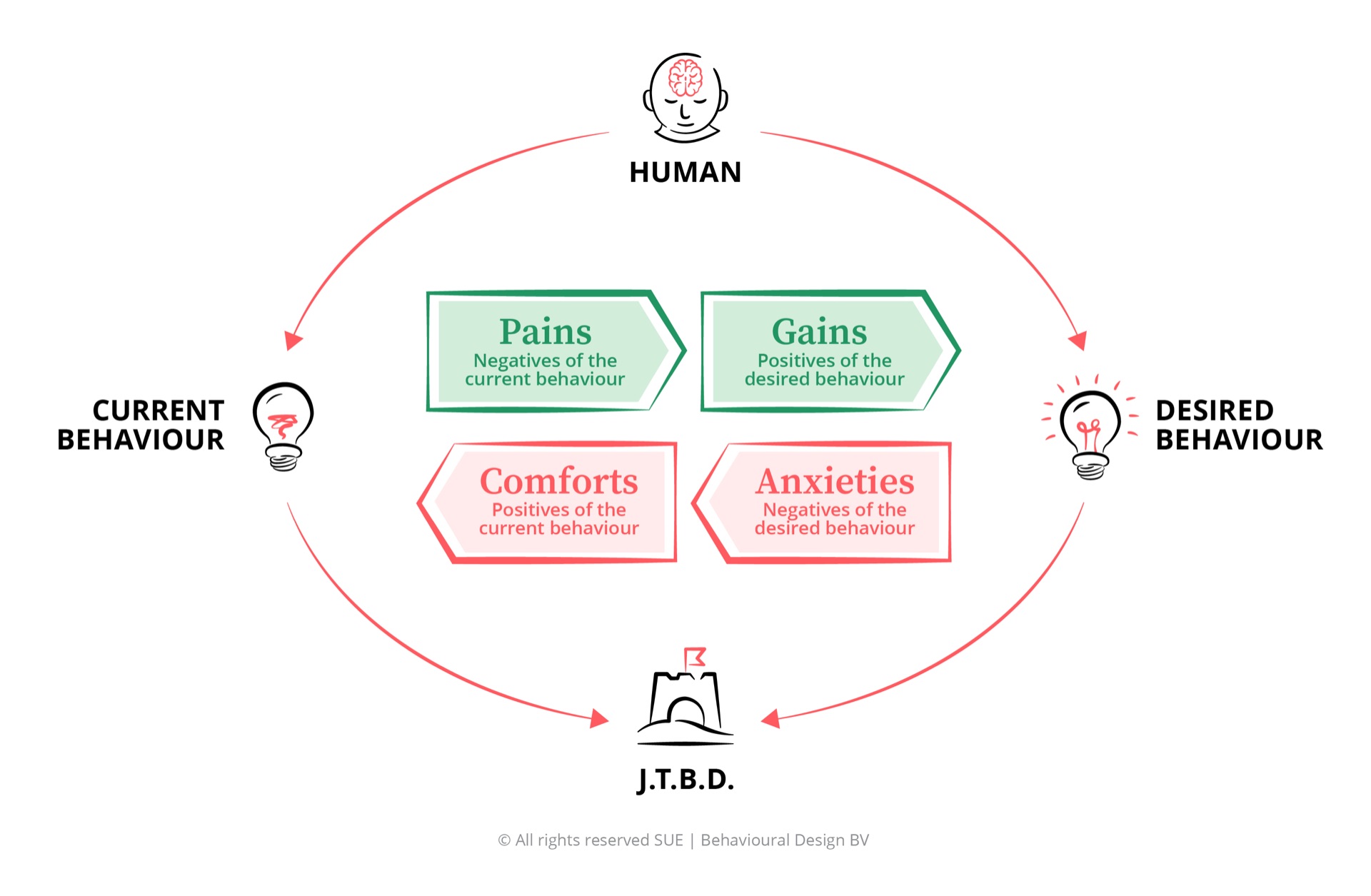
The pain is real and old. Customers cannot tell you why they chose what they chose, so every survey answer is a reconstruction. Anyone who has watched a focus group praise a concept that then died in the market knows exactly how expensive that pain is.
The gain on offer is certainty. A number from an instrument, produced by people in lab coats, that ends the argument between the creative director and the commercial director.
The anxiety is career-shaped. Signing off a large campaign on judgement alone leaves you exposed. Signing it off on neuroscience does not.
And the comfort is that a research budget feels like action while requiring no change in how anything is decided. You can commission a study for six months and touch nothing.
Which is why the honest question about neuromarketing is rarely "is it accurate?" It is "what decision will change because of this, and could I have changed it for a tenth of the cost?"
What to do with all this on Monday
Four practical positions, in ascending order of ambition.
1. Use the forecasting finding without buying the scanner
The transferable lesson from Falk and Berns is not "buy fMRI". It is that asking people to predict their own behaviour is the weakest measure you have. Replace stated preference with revealed preference wherever you can. A live test on a small audience segment, with an actual click or purchase as the outcome, gives you the same class of information at almost no cost.
2. Design the price experience, not the price
Knutson's insula finding is one of the few neuromarketing results with a direct design implication. If the anticipation of paying is aversive, then when and how a customer confronts the cost is a design variable, separate from the amount. Deferred payment, bundling, and showing the total after the value is established all trade on that.
3. Treat attention as a design surface
Visual salience shifts choice under exactly the conditions most purchases happen in: fast, low involvement, low stakes. Shelf position, contrast, the ordering of options on a page. This is cheap to test and, per the Milosavljevic work, capable of moving choice against a mild stated preference.
4. Analyse the decision before you measure the brain
Most marketing problems are not measurement problems. They are design problems, and they yield to a structured analysis of what your customer is trying to get done, what stands in the way, and which single moment decides the outcome. That analysis costs a workshop, not a scanner. It also produces something an fMRI study never will, which is a list of things to change.
Worth remembering too that the most reliably effective interventions in the advertising evidence base are not neurological at all. Les Binet and Peter Field's analysis of the IPA databank found that emotionally led campaigns outperform rationally led ones on long-term business effects by a wide margin.[11] That conclusion came from campaign results, not from cortex.
Frequently asked questions about neuromarketing
Does neuromarketing actually work?
For one job, yes. Brain measures taken from a small sample predict how a wider population will respond to an advert, a trailer or a song, often better than what that sample says out loud. Emily Falk (2012), Gregory Berns (2012) and Maarten Boksem with Ale Smidts (2015) all found this pattern. For the job most vendors sell, reading an individual buyer's hidden intent, there is no reliable evidence.
Is there a buy button in the brain?
No. The claim rests on reverse inference, which Russell Poldrack (2006) showed to be logically unsound: brain regions are not dedicated to single mental states, so you cannot read a motive back out of an activation. The nucleus accumbens lights up for money, food, music and social approval alike.
Where does the claim that 95 per cent of decisions are unconscious come from?
From Gerald Zaltman's book How Customers Think (2003), where it appears as an estimate of how much cognition happens outside awareness. It is not the result of a specific experiment and no study has since established the figure. The underlying point, that much of buying behaviour is automatic, is well supported. The number is not.
Is neuromarketing worth the money for a normal marketing team?
Usually not as a first step. An fMRI study costs more than most campaign budgets and answers a narrow question. Cheaper methods, a field experiment on a live audience, eye tracking, or a structured behavioural analysis of the decision you want to change, tend to give you more decisions per euro.
What is the difference between this and behavioural design?
Neuromarketing measures response. Behavioural design changes context. One tells you that an advert scored well in a ventral striatum; the other tells you which barrier to remove from the moment your customer decides. If you want the definitions and techniques laid out properly, start with what is neuromarketing.
Conclusion
Neuromarketing has one real achievement and one persistent myth, and they are almost opposites. The achievement is that a handful of brains can forecast a crowd. The myth is that one brain can be read.
Keep the achievement. It should permanently lower your confidence in what customers tell you about themselves. Drop the myth, along with the 95 per cent slide and the orange patch. What remains once you do is a design problem wearing the costume of a measurement problem. Which moment in your customer's decision are you actually going to change, and what will you change about it?
Want to learn how to answer that? The online Deep Dive Behavioural Marketing teaches you to map the forces behind a buying decision and design interventions that move it. Or learn the full method in The Art of Influence©, rated 9.3/10 by 10,000+ professionals.