Cognitive biases in marketing and advertising: the complete guide for marketers
A marketing team spends three weeks crafting a new campaign. The message has to 'rationally convince why our product is better'. Three months after launch the numbers are disappointing: high awareness, low conversion. The analysis: the audience understands the product. They just don't act on it. The campaign spoke to the conscious brain. Decisions get made by the unconscious.
Two floors away, in the same week, a direct competitor does exactly the opposite. No rational argument, but a pricing page with three tiers where the most expensive is explicitly designed for almost nobody to pick. A product photo with 'only 3 left in stock'. A review section where the first customer explains in his own words why he hesitated and eventually switched. Their conversion triples without spending a single extra euro on media.
This is what cognitive biases in marketing and advertising do when you deliberately design for them. It's not trickery. It's behavioural science applied to the one moment that matters: the second in which a consumer decides to click through, buy or leave.
Cognitive biases in marketing and advertising are the systematic, predictable ways the consumer brain makes decisions under uncertainty. They drive which advert is remembered, which price is seen as reasonable, which product is chosen and which experience is remembered positively. The six most impactful biases for marketers are anchoring bias, the framing effect, social proof, the scarcity principle, the decoy effect and the peak-end rule. Marketing that works with these biases converts structurally better than campaigns that assume rational consumers.
What are cognitive biases in marketing?
Marketing was long built on an implicit assumption: consumers process information rationally, compare alternatives and pick the best product. Daniel Kahneman definitively refuted that assumption in Thinking, Fast and Slow.[1] The brain has two modes. System 1 is fast, automatic, emotional and responsible for the vast majority of everyday decisions, including buying decisions. System 2 is slow, deliberate and almost never used for ordinary purchases.
Marketing that only addresses System 2 (rational arguments, feature comparisons, technical specs) is talking to the part of the brain that isn't making the decision. Marketing that understands System 1 and is deliberately designed for how it works actually moves people. The behavioural sciences call the mechanisms that drive System 1 cognitive biases. For marketers these are not thinking errors to correct. They are predictable patterns to leverage in ethically designed campaigns.
Robert Cialdini documented the six 'principles of persuasion' that later became the pillars of behavioural marketing.[2] Since then evidence on how biases drive decisions has grown exponentially. What once looked like a marketing trick (the 'most expensive option' nobody picks) now turns out to be a scientifically substantiated influence mechanism that can be deliberately designed.
This guide catalogues the mechanisms. If you are looking for the method that decides which mechanism applies to your buyer, start with marketing psychology, and with behavioural segmentation for choosing who you are designing for in the first place.
Why rational marketing doesn't convert and bias-aware marketing does
The most stubborn misconception in B2C and B2B marketing is that good content is enough. A strong product, clearly explained, compared with the competition, with measurable ROI: that should convert. In practice it rarely does. Not because the content is wrong, but because it addresses System 2 at a moment when System 1 has long since decided.
Bias-aware marketing works fundamentally differently. Instead of persuading, it designs the choice context. Instead of stacking arguments, it frames the message so the desired choice feels easiest. Instead of answering why-questions, it makes why-questions unnecessary. This is not manipulation when applied to products that genuinely serve the consumer. It's behavioural design that respects how the brain actually works.
The Behavioural Design line is clear: stop running campaigns that try to rationally convince. Start running campaigns that understand System 1 and are deliberately designed for it. The rest of this article shows how.

The six most impactful biases in marketing and advertising
At least fifty cognitive biases have been documented. In marketing, six of them do most of the work. They reinforce each other, they appear at different stages of the customer journey, and they can all be designed for measurable impact.
Anchoring bias in pricing and pricing-page design
The first number a consumer sees anchors all subsequent price perception. A pricing page that opens with a £299/month premium tier makes the £99/month standard tier feel naturally reasonable. That same £99/month tier would feel different if the page had opened with a £49/month budget tier. The anchor doesn't just determine what feels expensive or cheap, it determines which option is perceived as 'normal'.
For marketers this means: deliberately set the highest anchor first. In quotes: open with the premium option, not the basic version. In e-commerce: show the original price next to the discount (was £199, now £129) so the crossed-out price becomes the anchor. In SaaS pricing: the most expensive tier doesn't have to sell, it just needs to be present. For the full mechanism: anchoring bias at work.
Framing effect: how word choice in marketing messages makes or breaks conversion
The way a message is framed determines how consumers respond to it, regardless of the factual content. '95% of customers recommend us' frames positively. '5% don't recommend us' frames negatively. The content is identical. The impact differs fundamentally. Tversky and Kahneman showed that loss framing is systematically more powerful than gain framing: 'don't lose £200 a year' works more strongly than 'save £200 a year'.[3]
For marketing copy this means copy choices have measurable conversion impact. Loss frame for risk-averse products (insurance, security software). Gain frame for growth products (investment, fitness). Social frames for habit products ('40% of your neighbours already'). Test every key copy line in two frames and measure conversion. Deeper analysis: framing effect at work.
Social proof: how testimonials, reviews and numbers create trust
People look at the behaviour of others to decide what is right or valuable. The greater the uncertainty, the stronger this mechanism. In an unfamiliar city you go to the busy restaurant, not the empty one. In e-commerce you click on the product with 4.7 stars and 1,200 reviews, not the product with 5 stars and 3 reviews. Uncertainty + social information = behaviour.
For marketing, here's how to deploy social proof effectively: use specific reviews with name, photo and concrete outcome (more powerful than abstract numbers). Show real-time activity ('3 people viewing now', '12 sold in the past hour'). Match the social source to the audience (similar-to-me bias amplifies the effect). Avoid implausible numbers (10,000 testimonials is suspicious; 47 specific reviews is credible). For the full mechanism: social proof at work.
Scarcity principle: how limited availability changes value perception
What's scarce feels valuable. What's available everywhere feels replaceable. This mechanism is older than marketing itself and remains one of the most powerful conversion levers. 'Only 3 left in stock', 'offer ends in 6 hours', 'limited edition of 500': every variant activates the same cognitive response. Loss aversion (we experience not getting something scarce as a loss) makes the scarcity trigger more powerful than an equivalent abundance frame.
Marketing with scarcity is only ethical when the scarcity is real. False scarcity (the counter that perpetually reads '3 left in stock') is recognised by consumers and damages trust in the long term. Real scarcity (limited production runs, time-bound offers, real-time stock tracking) reinforces both conversion and brand trust. Deeper exploration: scarcity principle at work.
Decoy effect: why three pricing tiers always work better than two
When consumers choose between two options, they weigh both rationally. When a third 'inferior' option is added, they anchor their choice on the relative advantages between the three. The Economist used this in a famous test: with two options (web-only £59, web+print £125) 68% chose the cheaper. With three options (web-only £59, print-only £125, web+print £125) 84% chose the most expensive, because the combo now rationally felt like the best deal.[4] The print-only option was the decoy: meant for nobody to pick, designed to make the combo attractive.
For marketers this means: design pricing pages with three tiers, one of which is the decoy. Place the desired choice in the middle, anchored by a premium tier (anchoring) and a budget tier that just doesn't feel worth it. Full analysis: decoy effect at work.
Peak-end rule: why the high point and the end define the entire customer experience
People don't remember an experience as the average of all moments. They remember the emotional peak and the end, and average those.[5] A flight where the food was mediocre, the service slow, but the landing smooth and the bags first off the belt is remembered as 'good flight'. A flight where everything was fine except chaotic baggage handling is remembered as 'bad flight'.
For marketing and CX this means: invest disproportionately in the high point and end of the customer journey. An unexpected gift at delivery. A personal closing conversation after a service. An upgrade surprise in a SaaS onboarding. Small investments at the right moments shift how the entire experience is remembered, shared and repeated. For the full mechanism: peak-end rule at work.
How marketing biases connect through the SUE Influence Framework
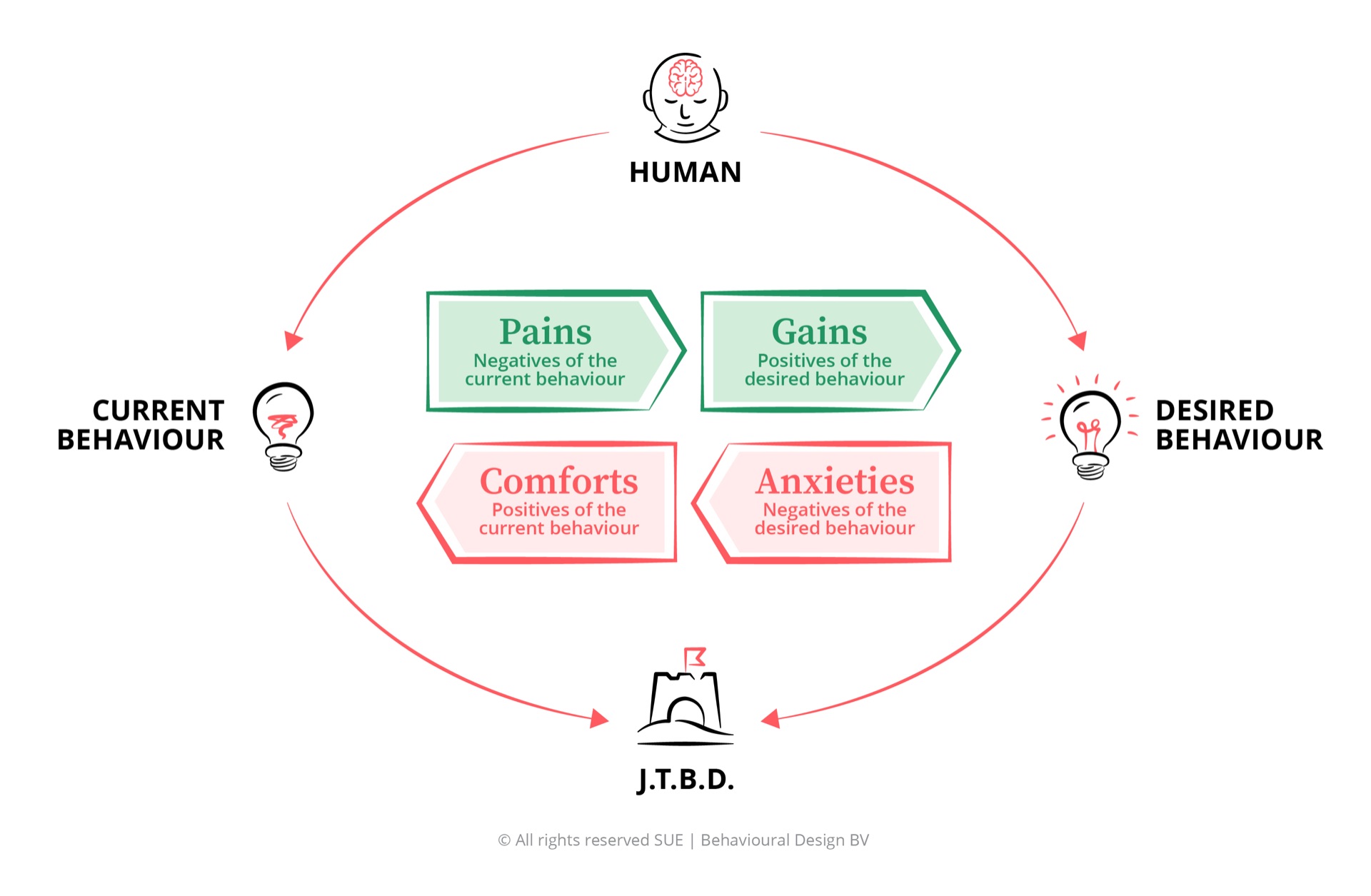
The six biases don't operate in isolation. They reinforce each other in a pattern made visible by the SUE Influence Framework. The Framework describes four forces that drive every behaviour: Pains, Gains, Anxieties and Comforts. In consumer marketing decisions, all four are in play, often simultaneously.
Comforts determine which choice feels easiest. A pricing page with a clear 'most popular' indicator reduces choice stress (decoy effect). A 1-click checkout reduces friction. A familiar brand environment reduces cognitive effort. Marketing that designs for Comforts beats marketing that tries to convince.
Anxieties determine why consumers drop off at the last moment. Doubt that the product will work. Fear of making the wrong choice. Worry that others will think it's a bad purchase. Social proof neutralises these anxieties directly. Guarantees, return policies and transparent reviews do too.
Pains drive the initial interest. The problem the product solves needs to be big and frequent enough to trigger search behaviour. Marketing that makes the pain clear and specific (rather than general) attracts more relevant attention.
Gains are the amplifiers. The concrete benefit, preferably in a loss frame ('without this you lose X'), reinforces the motivation to act.
Marketing campaigns that address all four forces consistently convert better than campaigns that only address one or two. The Influence Framework provides the structural check to do that systematically.
Eight interventions that make your marketing and advertising bias-aware and more effective
The Behavioural Design line is clear: design the choice context, not just the message. For marketing this means eight concrete interventions that each deliberately leverage a specific bias.
1. Design pricing pages with three tiers and a deliberate decoy. The middle tier should be the 'most popular' option. The premium tier anchors (anchoring). The budget tier should feel just not enough. The middle option then wins by itself without you actively promoting it.
2. Test every key copy line in gain frame and loss frame. Loss aversion is usually stronger than gain attraction. 'Save £200 a year' versus 'don't lose £200 a year'. Measure conversion, pick winner. The difference can be 20-40%.
3. Use specific social proof, not abstract numbers. '47 marketers used this platform last week, average time saved 4h/week' is more powerful than '10,000 happy customers'. Add photo, name and concrete outcome.
4. Make scarcity real and specific. 'Only 3 left in stock' only works if it's actually true. 'Limited edition of 500' works if the production run really is small. False scarcity erodes trust permanently.
5. Invest disproportionately in the end of the customer journey. An unexpected gift at first delivery. A personal closing email. An upgrade surprise in onboarding. Peak-end rule makes this investment 5-10x more impactful than the same investment earlier in the journey.
6. Reduce cognitive friction in checkout. Every extra click, every extra field, every extra decision costs conversion. Default choices (pre-checked) systematically yield higher opt-ins than opt-in without default.
7. Frame the marketing message around the Job-To-Be-Done, not around features. Consumers don't buy features; they 'hire' products to do a job in their lives. A drill is 'hired' to make holes in walls. Marketing that addresses the job rather than describing the drill converts better.
8. Test bias mechanisms via A/B experiments. Behavioural Design experiments are usually inexpensive to run and disproportionately valuable in insight. One well-designed test per month yields more insight than a complete persona update.
Cognitive biases in marketing and the ethics of behavioural marketing
The six biases this article lays out are powerful mechanisms to influence consumer decisions. With that power comes responsibility. The difference between persuading and manipulating doesn't lie in the technique, but in the intent and the transparency.
Marketing that uses biases to help consumers make a choice that genuinely serves them (a fitting SaaS package, a healthier option in a supermarket, a better long-term decision) is persuasive in the positive sense. Marketing that uses biases to make consumers buy something they don't need, that harms them, or that they will regret afterwards, is manipulative.
For marketers applying Behavioural Design for marketing, this means an ethical compass: would I want to apply this technique to my own parents? Would the consumer, with full information after the fact, have made the same choice? Does this technique make the product genuinely better, or only easier to sell? Behavioural Design is about enabling behaviour that consumers genuinely want, not pulling them into something.

Frequently asked questions about cognitive biases in marketing and advertising
What are cognitive biases in marketing?
Cognitive biases in marketing are the systematic, predictable ways consumers make decisions under uncertainty. They drive which advert is remembered, which price is seen as reasonable, which product is chosen and which experience is remembered positively. The six most impactful for marketers are anchoring bias, the framing effect, social proof, the scarcity principle, the decoy effect and the peak-end rule.
Which bias is most powerful in pricing?
Anchoring bias and the decoy effect together dominate price perception. The first number a consumer sees anchors all subsequent price perception. A 'most expensive option' that almost nobody picks makes the middle option feel like a bargain. By deliberately designing these two, you can significantly steer consumer choice without changing actual product value.
Is using biases in marketing manipulative?
The difference between persuading and manipulating lies in intent and transparency. Marketing that uses biases to help consumers make a choice that genuinely serves them (a fitting product, a better habit) is persuasive. Marketing that uses biases to make consumers buy something they don't need or that harms them is manipulative. Behavioural Design is about ethical influence.
How do you use social proof effectively in marketing?
Specifically and credibly. '10,000 happy customers' is more abstract and therefore less powerful than a concrete review with name, photo and specific outcome. Social proof works more strongly when the source resembles the target audience (similar-to-me). Real-time social proof ('three people viewing this now') is more powerful than historical data. Combine with scarcity for maximum impact.
What is the peak-end rule and how do you apply it in marketing?
People don't remember an experience as the average of all moments, but as a combination of the emotional peak moment and the final moment. For marketing and customer experience this means: invest disproportionately in the high point and the end of the customer journey. An unexpected gift at delivery, a personal closing email, an upgrade surprise: small investments at the right moments shift how the entire experience is remembered.
How do you measure the effect of bias-driven marketing?
Through A/B tests where you isolate one bias mechanism. For example, test a pricing page with and without a decoy. Test a product page with and without reviews. Test a promotion with and without scarcity. The difference in conversion shows the actual impact. Behavioural Design experiments are usually inexpensive to run and disproportionately valuable in insight.
Conclusion: from marketing tricks to bias-aware design
The six biases this article lays out are not marketing tricks. They are predictable patterns in how the consumer brain makes decisions under uncertainty. Marketing that understands these patterns and is deliberately designed for them converts structurally better than marketing that assumes rational consumers who make feature comparisons.
The Behavioural Design line is clear. Stop running campaigns that try to rationally convince. Start running campaigns that understand System 1 and are deliberately designed for it. Pricing pages with deliberately designed decoys. Copy in loss frame where it works. Specific and credible social proof. Real, not false, scarcity. Disproportionate investment in peak and end of the customer journey. Reduced cognitive friction in checkout. And an ethical compass that distinguishes persuading from manipulating.
Want to learn how to apply this fully in your marketing? In the Behavioural Design Fundamentals Course you learn to apply the Influence Framework and the SWAC Tool to diagnose and redesign campaigns. Rated 9.3 by 10,000+ alumni from 45 countries, including hundreds of marketers who apply the same Framework daily to their campaigns and pricing.