Situational leadership theory: the four styles and the situation around them
You have two people in your team. One wants to know exactly what you expect and when it is due. The other finds that stifling and would rather work it out alone. Give them both the same briefing and one is lost while the other is irritated.
Situational leadership theory starts from that observation. There is no single best way to lead. What works depends on who is in front of you and what you are asking them to do.
It is one of the best-known leadership models, and it is about influence: how do you get someone to do the work well, and more and more often without you? First the model as Paul Hersey and Ken Blanchard designed it: the four styles, when each one fits and what research found. Then the word in the name that gets the least attention. The situation.
Situational leadership theory is a model by Paul Hersey and Ken Blanchard, first published in 1969. It holds that there is no single best leadership style: you choose your style to fit what an employee can and wants to do for a specific task. The four styles are telling, selling, participating and delegating. More on Behavioural Design for managers →
What is situational leadership theory?
Situational leadership theory says: fit the way you lead to the employee and the task. Someone doing something for the first time needs clear instructions. Someone who has done it well for years mostly needs room. The same manager therefore behaves differently in those two cases, and that is the whole idea.
The model looks at two kinds of leader behaviour. The first is task behaviour, or direction: saying what needs to happen, how, and when it is finished. The second is relationship behaviour, or support: listening, explaining why, encouraging and thinking along. A lot or a little of the one, combined with a lot or a little of the other, gives four styles.
Which of the four fits depends on the employee. How well do they know this task, and how willing and confident are they in taking it on? The model calls that readiness. It sounds like a verdict on a person, but it always refers to one task. Your experienced project lead can be fully self-reliant in planning and a beginner at delivering bad news.
The Hersey and Blanchard model in brief
Paul Hersey and Ken Blanchard developed the model in the late 1960s, while working together on the textbook Management of Organizational Behavior. They first published it in 1969 in the Training and Development Journal, under the name life cycle theory of leadership.[1] The name situational leadership followed in the 1970s.
After that the two authors each took the model their own way. Hersey continued with his own version. Blanchard and his colleagues developed a version he called SLII, described in 1985 in Leadership and the One Minute Manager. The two versions are very alike. They use different words, which is why you will find several names for the same style.
The core is the same in both. There is no best style. You look per task at what someone can and wants to do. And you move along as they grow: from a lot of direction towards more and more room.
The four styles: telling, selling, participating and delegating
The four styles of situational leadership theory are telling (S1), selling (S2), participating (S3) and delegating (S4). They differ in how much direction and how much support you give.
| Style | Name in SLII | Direction | Support | Fits someone who |
|---|---|---|---|---|
| S1 Telling | directing | high | low | cannot do the task yet and is insecure |
| S2 Selling | coaching | high | high | cannot do the task yet but is willing |
| S3 Participating | supporting | low | high | can do the task but has doubts |
| S4 Delegating | delegating | low | low | is able and willing |
Telling (S1)
You say what needs to happen, how and by when, and you stay close. It sounds strict. For someone doing something for the first time it is mostly a relief, because they do not have to guess.
Selling (S2)
You still direct, but now you also explain why and ask what the other person thinks. The decision stays with you. Blanchard's version calls this style coaching. What that looks like in practice is in the article on coaching leadership.
Participating (S3)
You decide together, and you leave more and more of how the work gets done to the other person. You are there to think along, listen and build confidence. The employee already has the skill. What is missing is certainty or appetite, and more instructions will not supply either.
Delegating (S4)
You hand over the task and the decisions and stay available at a distance. It goes wrong more often than you would expect, usually in the handover itself. I wrote about that separately: delegation fails at the handover.
Readiness: how do you know which style fits?
Readiness is the extent to which someone is able and willing to do a specific task. The model distinguishes four levels, and one style goes with each.
- R1: cannot do the task yet and is insecure or unwilling. Style: telling.
- R2: cannot do the task yet but is willing and confident. Style: selling.
- R3: can do the task but is insecure or less willing. Style: participating.
- R4: is able and willing. Style: delegating.
The early editions called this maturity, M1 to M4, and you will still see those codes. Blanchard speaks of development levels, D1 to D4, and looks at competence and commitment. His first level is the enthusiastic beginner: little skill, plenty of appetite. The second is the disillusioned learner, who is finding out that it is harder than expected. That is a useful addition. Motivation can dip along the way while skill is going up.
Watch two things when you assess it. Attach the level to the task and not to the person, so "she is self-reliant in this task" and not "she is an R4". And assess it again when the work changes. The model asks you to keep looking.
Situational leadership in practice: three examples
Three situations you will probably recognise. They illustrate how the model is meant to work; they are not case studies.
A new colleague in their first week
Your new colleague is keen and knows nothing yet about your systems, clients and agreements. According to the model that calls for telling: show how things work, agree what needs to be finished this week and check in every day. That quickly feels patronising, so you say: have a look around, and ask if anything is unclear. For someone who does not yet know what they do not know, that mostly means searching.
An experienced colleague with a new task
Your best adviser is about to lead a team of three for the first time. In her advisory work you leave her completely free, and rightly so. But leading is a new task for her. The model then says: more direction, for this task. Talk through how she will run her first meeting and what she does when someone misses a deadline. It feels odd with someone you have trusted for years. It is still what the model means by looking per task.
Someone who can do it and still holds back
A colleague has produced the quarterly report for three years. He can do it. Yet lately he delivers later, asks more often whether it is all right and no longer takes a decision without you. In the model this is the third level: able, but doubting. The style that goes with it is participating. Less explanation of how to do it, more questions about what is on his mind.
The model tells you which style fits doubt. Where the doubt comes from is a different question. It comes back further down.
What does research say about the theory?
Research finds partial support for the theory. Two studies show what that means.
Robert Vecchio tested it in 1987 with 303 teachers from 14 high schools. He measured the style of their supervisor, the maturity of the teachers, their performance and their satisfaction with supervision. He concluded that the theory "may hold only for certain types of employees". Teachers who had been hired more recently seemed to need more task structuring from their supervisor, and to appreciate it.[2] That matches the first style in the model.
In 2009 Geir Thompson and Robert Vecchio put three versions of the theory side by side. The original from 1972, the revised one from 2007, and a variant of their own that looks at how much autonomy a leader gives, set against the employee's job experience. They used data from 357 bank employees and 80 supervisors at ten Norwegian financial institutions. The revised version predicted employee performance and attitudes less well than the original. They call the third variant promising for further study, although it too explained little extra.[3]
What do you do with that as a manager? The starting point holds: people do not all need the same from you, and someone who is new gains from structure. That exactly one right style goes with each level is less well established. So use the model as a way of looking, and as shared language with your team. It is not a formula.
The situation is bigger than the employee
In the model the situation consists of two things: the employee and the task. Behavioural science counts more. The time pressure. What happened the last time someone reported a mistake. How much is on someone's plate at once. And you.
How strongly circumstances steer behaviour was shown in 1973 by psychologists John Darley and Daniel Batson, with forty theology students. The students had to walk to another building to give a short talk, some of them on the parable of the Good Samaritan. On the way, a person sat slumped by the side of the road. Those in a hurry were more likely to walk past. The topic of the talk made no significant difference, and how religious someone was did not predict whether they stopped.[4]
So the same student helps or walks on, depending on how much time he thinks he has. At SUE that is the starting point of all our work.
Behaviour is a property of the situation, not of the person.
Put that next to readiness. You assess what someone can and wants to do by watching what they do. But what they do comes partly from the situation. Take the colleague with the quarterly report. Perhaps he has doubted himself since his figures were corrected in a meeting with everyone present. Perhaps he has been given two extra tasks. You then see "able, but less willing" and choose the participating style. That helps. The cause just stays where it is.
And part of that situation is you. How you respond to a mistake affects whether the next one gets reported to you. Whether you treat a question as a question or as a sign of weakness affects how many questions you still get. That is what psychological safety is about. So your style is not a response to a situation that exists apart from you. You help make that situation every day.
That is why I put one more question before choosing a style: what makes this behaviour logical in this situation? The SUE | Influence Framework© was built to answer that question. It sets out which forces pull someone towards new behaviour and which keep them with the old.[5]
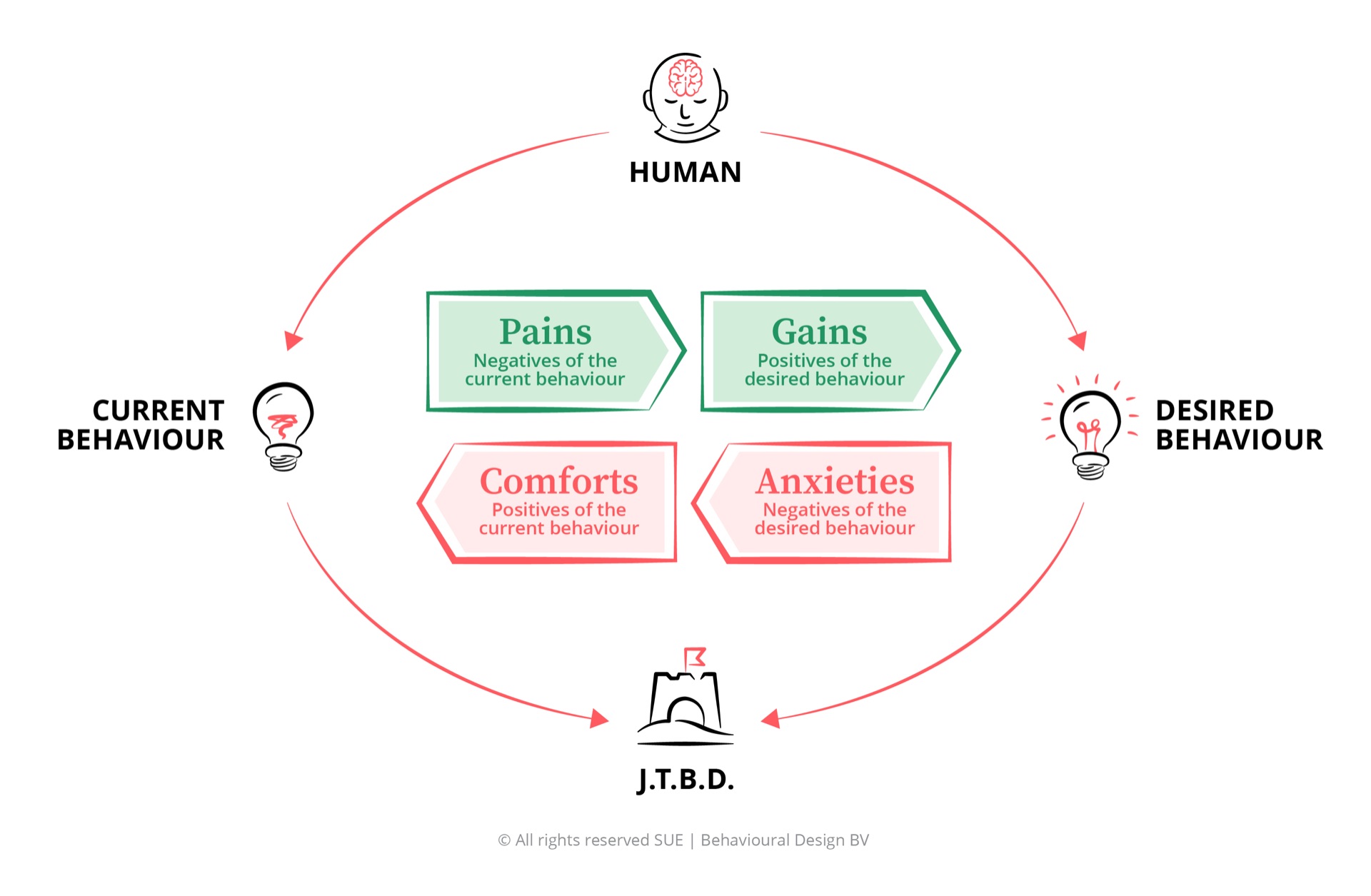
Two of those forces keep someone in place. Comforts are what is pleasant about how things go now: if you run everything past your manager first, you can never be blamed. Anxieties are what stops someone from doing it differently: deciding for yourself also means being the one who got it wrong. The other two pull someone towards different behaviour. Pains are what is not working now, gains are what it brings them when things change.
That gives you more to adjust as a manager than your own style. Give corrections one to one from now on, or take a task off his plate. And agree which decisions he takes without you. In practice, influence is often exactly that: removing what holds someone back.
This sits alongside the model and does not replace it. The four styles help you choose how to act. The forces show what needs to change around that one person. The same goes for managers themselves, by the way: their behaviour also depends on context, which explains when leadership training works and when it does not.
Which style do you use most? Four questions to ask yourself
This is not a validated test and it does not produce a score. It is four questions for ten honest minutes with your own week.
1. Which style do you use when you are in a hurry?
Under pressure you fall back on what comes easiest. For one person that is explaining everything, for another it is letting everything go. That is your preferred style, and you probably also use it where it does not fit.
2. Who are you still telling how to do it, long after they know?
Well-meant explanation to someone who has already mastered the task lands as distrust. Look at who has grown quieter in meetings with you.
3. Who have you let go of while they are still finding their way?
Letting go feels like giving trust. For someone who has not mastered the task yet, it is mostly being left alone.
4. What in the situation makes the behaviour you see logical?
Take one person who, in your view, shows too little initiative. Write down what happened the last time they did.
Frequently asked questions about situational leadership theory
What are the 4 styles of situational leadership theory?
The four styles are telling, selling, participating and delegating. In telling you give a lot of direction and little support. In selling you give a lot of both. In participating you give little direction and a lot of support. In delegating you hand over the task and the decisions and stay available at a distance.
What are the 4 stages of situational leadership theory?
The four stages are the readiness levels an employee moves through for a task. First they cannot do the task yet and are insecure (R1). Then they cannot do it yet but are willing (R2). Next they can do it but have doubts (R3). Finally they are able and willing (R4). One style goes with each stage.
What do S1, S2, S3 and S4 mean?
S1 to S4 are the codes for the four styles. S1 is telling, S2 is selling, S3 is participating and S4 is delegating. They run in step with the employee's level: R1 to R4 in Hersey's version (M1 to M4 in the early editions), D1 to D4 in Blanchard's. The further along the employee is, the less direction you give.
What is follower readiness?
Follower readiness is the extent to which someone is able and willing to do a specific task. It has two parts: ability (knowledge and skill) and willingness (motivation and confidence). It applies per task, not per person. Early editions of the theory called it maturity. The same employee can be self-reliant in one task and a beginner in another.
What is the Hersey-Blanchard model?
The Hersey-Blanchard model is another name for situational leadership theory. Paul Hersey and Ken Blanchard published it in 1969 as the life cycle theory of leadership. The model links four leadership styles to four levels of follower readiness. The two authors later each developed their own version.
What is the difference between situational leadership theory and SLII?
SLII is Ken Blanchard's later version of the theory, described in 1985 in Leadership and the One Minute Manager. It keeps the four styles but calls them directing, coaching, supporting and delegating, and it replaces readiness with four development levels based on competence and commitment. Hersey continued with his own version, which uses the readiness levels R1 to R4.
The style and the situation
Situational leadership theory gives you a simple and useful question: what does this person need from me for this task? Put a second question next to it: what in the situation makes the behaviour I see logical?
How to answer that second question systematically is what you learn in The Art of Influence©, the online course by SUE.
You choose your style to fit the situation. And a large part of that situation is you.