Thursday 1 October 2026
Employee wellbeing: design the week, not just the person
 By Astrid Groenewegen · 3 min read
I absolutely love my work and what I get to do every day. Well, almost. This week, I noticed how tired I was. So, I started thinking about what I actually did this week, and I realised how much of my own week was eaten by meetings, and how little of the exhaustion had anything to do with the actual work. It made me think about an interesting design question:
How do you design a working week that does not exhaust people? And what if the way to get more done is to give people less time, not more?
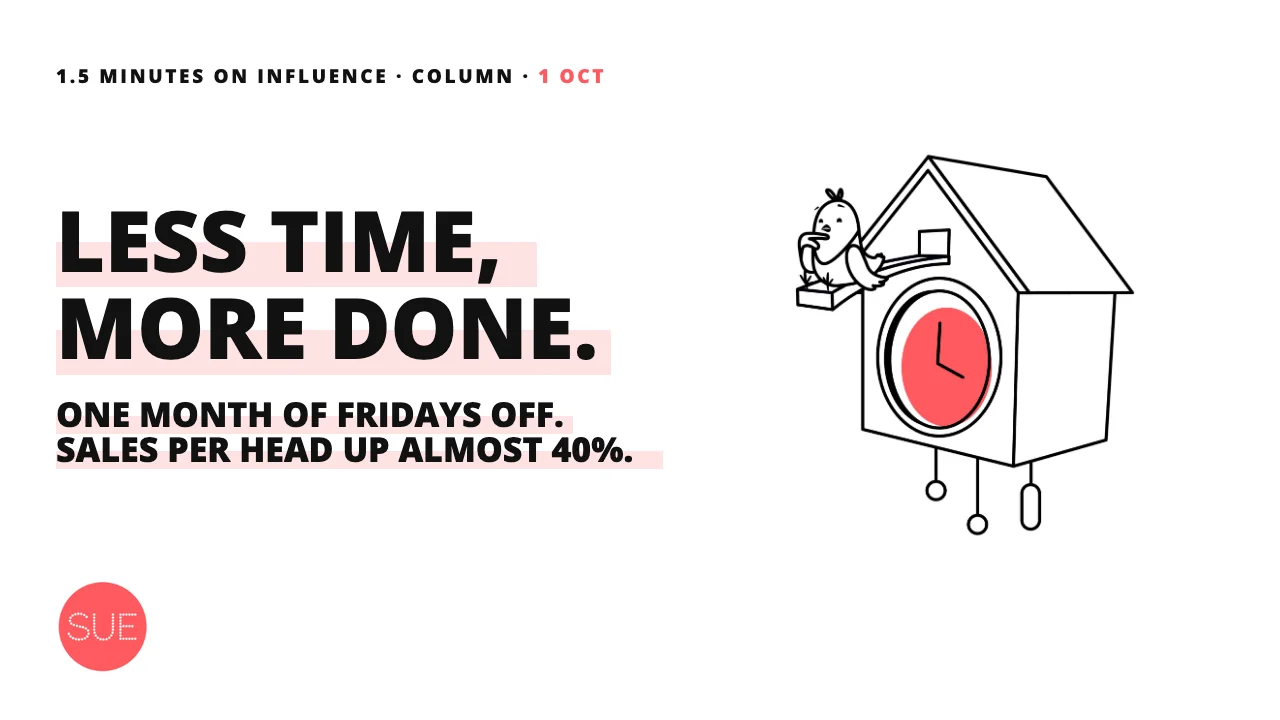
This challenge brought me to Microsoft Japan. The conventional approach to overwork is to manage time better: prioritisation training, wellness programmes, encouragement to switch off, all aimed at the individual. Microsoft Japan ran a structural experiment instead. For one month in the summer of 2019, in a trial, it called the Work-Life Choice Challenge, it closed its offices every Friday and gave all 2,300 employees a three-day weekend on full pay.
The prediction was that output would fall. Instead, sales per employee rose by almost forty per cent compared with the same month the year before, while electricity use and printing dropped sharply, and most employees said they preferred the new rhythm. It is worth being precise: this was one month, one office, measured as sales per head against the previous year, not a guaranteed law. But the direction is striking, and the reason is the useful part. The behavioural science here is about how the quality of our decisions and work degrades as demands pile up.
Across a long, overloaded week, the mind accumulates load, and the quality of our attention and decisions quietly drops, a drift we rarely notice in ourselves. A genuine structural break resets it.
What disappeared at Microsoft Japan when the week got shorter was not useful work but the inefficiency: the meeting that bred more meetings, the email that generated more email. The shorter week forced the noise out and left the work that mattered. This is Behavioural Design applied to the shape of the week itself.
You do not fix exhaustion by teaching individuals to cope better with an overloaded structure. You change the structure, and the better behaviour, sharper focus, less waste, follows from it.
So how do you put this to work, even without a four-day-week? Here are three practical moves:
Cut the structure, not just the stress. Before you offer another resilience workshop, ask what in the structure of the week is generating the exhaustion. Often, a recurring meeting or a default process is the real culprit, and removing it does more than any wellness perk.
Use a hard limit to force the waste out. Microsoft Japan capped meetings at thirty minutes, and the constraint did the work. A firm limit on time forces people to drop the low-value activity they would otherwise drift into, leaving room for what matters.
Protect a genuine reset, and mean it. The quality of decisions recovers with real breaks, not with a switch-off email no one believes. Build a true structural pause into the week, and defend it, because a rested team makes better decisions than a depleted one.
For me, the third move especially hit home. I am a notorious ‘push-through person’. So I am trying to build more pauses into my workday. In fact, I am going to take a break right now. Oh, wait, let me first write the second part of this newsletter. And then I will take a break. Promise!
Sources
Microsoft Japan (2019). Work-Life Choice Challenge Summer 2019 (productivity measured as sales per employee versus August 2018; one month, one office). Underlying science on cumulative cognitive load and decision quality.