Thursday 22 October 2026
Your team lost its drive
 By Astrid Groenewegen · 3 min read
 1:27
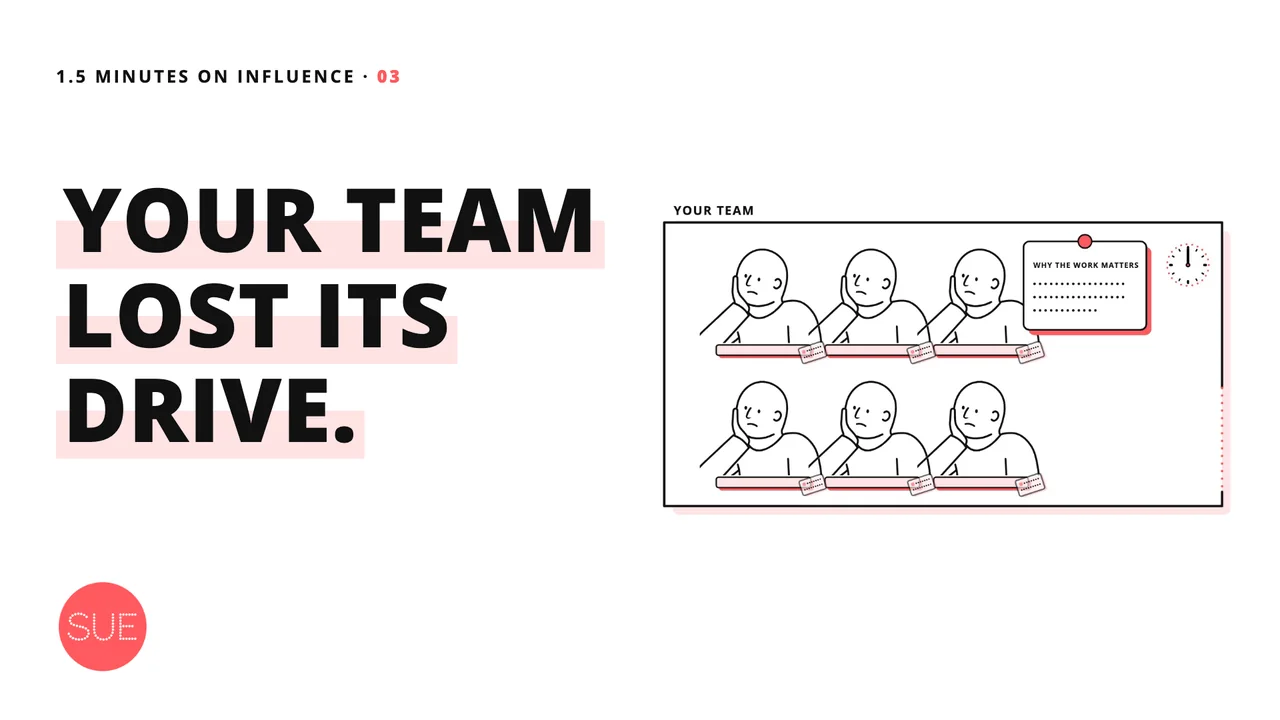
Film 1:27. Voice: an AI clone of Astrid Groenewegen’s own voice.
Read the text of the film
Your team lost its drive. Double their effort in five minutes. Most managers try words first. Another message about why the work matters. And nothing changes. Psychologist Adam Grant’s team worked with callers raising scholarship money for a university. One group read a letter from a student their calls had helped fund. Another read the letter, and then met him for about five minutes.
A month on, callers who met him raised more than two and a half times as much a week as before. They spent more than twice as long on the phone. The letter alone changed nothing. Follow-up experiments showed why: seeing what your work does for a real person. In our Influence Framework, that’s the job to be done. The motivation underneath is recognition, and meeting him gave it.
Now picture your team. The analyst whose report goes to a board she never meets. The support desk that never hears how the case ended. So give your team that recognition. Bring in one person their work helps, and let them ask questions. Five minutes with one real person did more than any letter. My name is Astrid Groenewegen, from Sue Behavioural Design, and this was 1.5 Minutes on Influence.
Subscribe for the next one. And if this was useful, give it a thumbs up or share it.
I'm fascinated by leaders whose teams flourish. You know the type: people grow under them. For years I couldn't quite put my finger on what made these leaders different. They weren't always the most charismatic. They didn't all have the corner office or the impressive title.
Adam Grant's call centre experiment gave me the clearest answer I know.
Grant, then at the University of Michigan, and his colleagues worked with a university fundraising call centre in the US. Thirty-nine callers phoned alumni to ask for donations. Part of that money paid for student scholarships, but the callers never met the students. It's the kind of job where motivation is hard to keep: repetitive, with a lot of rejection.
The researchers split the callers into three groups. The first carried on as usual. The second read a one-page letter from a student whose scholarship their calls had helped fund, and then discussed it among themselves for five minutes. The third read the same letter, and then the student himself came into the room. For about five minutes they asked him questions: which classes he was taking, how he got the scholarship, what he wanted to do after graduating.
That's all. Ten minutes in a break room.
A month later, the callers who had met him spent 142 per cent more time on the phone than before, and raised 171 per cent more money. On average, their weekly total went from about $186 to $503. The callers who only read the letter didn't change. Neither did the group that carried on as usual.
The letter is what stays with me. Same student, same story, same manager, same ten minutes in the break room. If knowing about your impact were enough, the letter should have worked. It didn't.
In a follow-up lab experiment, the effect of meeting a beneficiary ran through perceived impact: the sense that your effort changes something for a real person. In the SUE | Influence Framework© that's the job to be done, and the motivation underneath it is recognition. And recognition only lands when people can feel it. In a letter it stays abstract. With a face and a name, you feel it.
This is where a lot of organisations get stuck when motivation drops. They add a bonus, start a competition, or send another message about purpose. All of that is information about why the work matters. The callers already had that information. What they lacked was the person.
The leaders I described at the start do something simple. They show people who their work is for. Before they hand over a task, they can say who it serves and what changes for them. And whenever they can, they bring that person into the room. I've seen quiet, introverted leaders build fiercely loyal teams this way, while charismatic leaders burned people out with empty inspiration.
Skill is rarely the problem when motivation drops. Your people can do the work. Whether they give it more depends on whether they can see who it's for. That part you can design, by giving your team that recognition.
Find one person who benefits from what your team does. A client who acted on the advice. A patient. The colleague in the next department who builds on your team's analysis. Invite them for five minutes and let your people ask the questions. Keep it a conversation rather than a presentation. The callers' questions were simple, and that was enough.
Grant measured the effect a month later. I wouldn't assume it lasts forever, so make it a habit rather than an event.
Five minutes with one real person did more than any letter.
Sources
- Grant, A. M., Campbell, E. M., Chen, G., Cottone, K., Lapedis, D., & Lee, K. (2007). Impact and the art of motivation maintenance: The effects of contact with beneficiaries on persistence behavior. Organizational Behavior and Human Decision Processes, 103(1), 53–67. https://doi.org/10.1016/j.obhdp.2006.05.004