Saturday 31 October 2026
You worked on your plan for weeks. And it gets almost no support
 By Astrid Groenewegen · 3 min read
 1:29
Film 1:29. Voice: an AI clone of Astrid Groenewegen’s own voice.
Read the text of the film
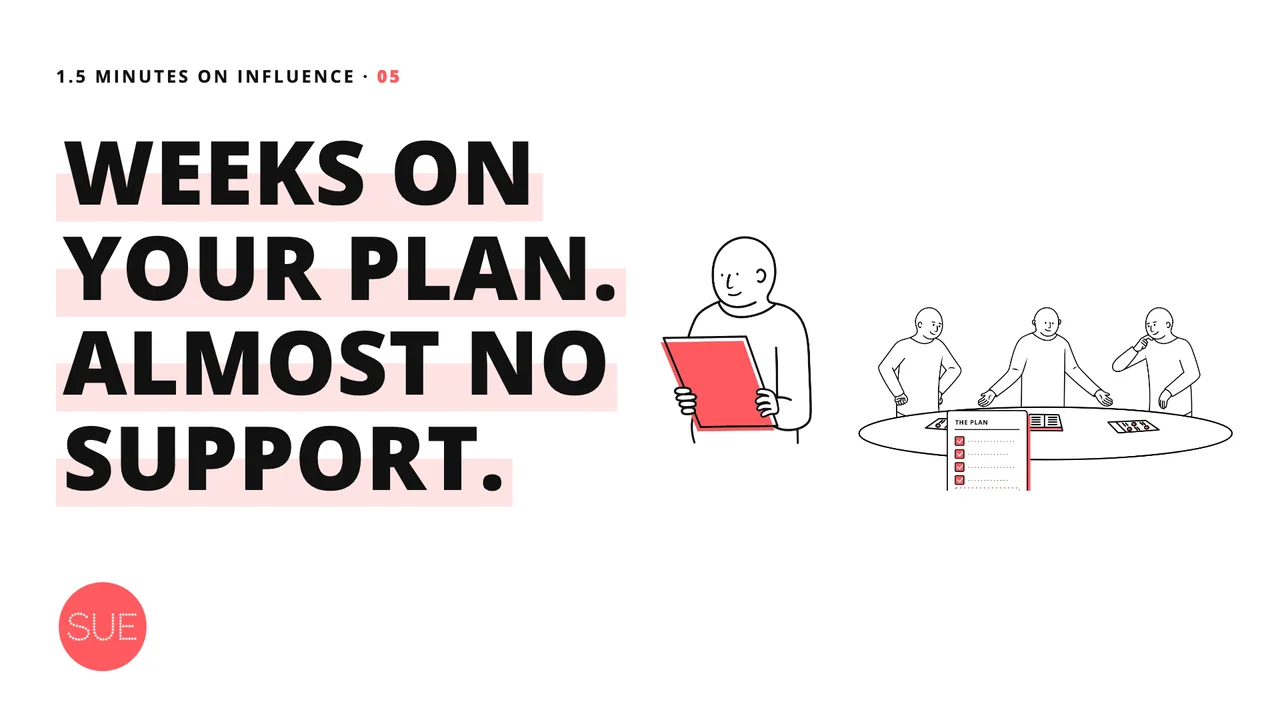
You worked on your plan for weeks. And it gets almost no support. This is the psychology behind it. You present it with every slide done. The room nods, and nothing moves. Michael Norton and colleagues asked people at an American university to fold an origami frog or crane. Then the makers could bid to keep it. Others bid on the same amateur origami.
A third group bid on origami folded by experts. The makers bid twenty-three cents for their own work. Others offered five. The expert origami got twenty-seven cents. Hardly more than the makers bid for their own. Making something makes it worth more in your own eyes. That’s a gain in our Influence Framework: the feeling that this is mine.
And it only works if you finish it. People who built something and then took it apart lost the effect. Take your strategy, presented finished at a town hall. Or the change announced in a Monday memo. Leave a real part of the plan open, like the rollout or the first pilot. Let your people build it and finish it themselves. Hand them a finished plan, and it stays yours.
My name is Astrid Groenewegen, from Sue Behavioural Design, and this was 1.5 Minutes on Influence. Subscribe for the next one. And if this was useful, give it a thumbs up or share it.
I've seen brilliant campaigns fail because the people behind them were so taken with their memorable message that they forgot to check whether the basics worked. Most of us know the feeling. Put enough work into an idea and it starts to look better every day.
There's a name for that, and a lovely experiment behind it. Michael Norton and colleagues called it the IKEA effect: people value things more when they've made them themselves.
Their first study used about the most boring object you can imagine: a plain black IKEA storage box. People who assembled it themselves bid 78 cents for it. People who were handed the same box ready-made bid 48 cents. Then the researchers tried something more personal.
In the next study, 106 people at an American university took part. Some of them got a sheet of origami paper and an instruction sheet, and folded a frog or a crane. Then they could bid to take their creation home. A second group, who hadn't folded anything, bid on the same amateur frogs and cranes. A third group bid on origami made by two research assistants with a great deal of folding experience.
The makers bid 23 cents for their own work. The outsiders offered 5 cents for exactly the same pieces. To them it was crumpled paper. The expert origami, neat and crisp, went for 27 cents, statistically no different from what the makers bid for their own. In the makers' eyes, their clumsy frog was close to expert work. And, in a small follow-up, they expected others to see it the same way.
That last detail matters for anyone who needs support for a plan.
When you've worked on a plan for weeks, you are the maker. Every page carries your effort, and the IKEA effect does its work. The plan looks better to you than it might to anyone else, and you expect the room to see what you see. They didn't fold it. To them it's somebody else's frog.
So the usual way of winning support works against you. You finish the plan, polish it and present it. The more finished it is, the less there is for anyone else to make.
In the SUE | Influence Framework© the IKEA effect is a gain: a positive of the behaviour you want. Building something yourself adds value to it, in your own eyes. That gain is available to your audience too, but only if you leave them something to build.
The researchers found one important limit. The effect needed completion. People who built a Lego set and then took it apart lost the extra value. So did people who had to stop before their IKEA box was finished. Labour led to love only when it led somewhere.
The research used boxes, origami and Lego; the step to the workplace is mine. That gives you two design rules for participation.
Give people a part they can finish. A vague invitation to share input won't do it. Give them a real piece with an end: the rollout plan for their own team, the first three steps, the way success will be measured.
And keep what they build. If their part gets rewritten by a steering group a week later, you've recreated something close to the Lego condition: they built it, and it came apart again.
Both rules protect the same gain: authorship. You can't hand that over in a presentation. You can only leave people a real part to make.
It's a humbling thought. The plan you love most may be the one you should present least finished.
Hand them a finished plan, and it stays yours.
Sources
- Norton, M. I., Mochon, D., & Ariely, D. (2012). The IKEA effect: When labor leads to love. Journal of Consumer Psychology, 22(3), 453–460. https://doi.org/10.1016/j.jcps.2011.08.002