Saturday 31 October 2026
You’ve explained the change three times. And they still resist
 By Astrid Groenewegen · 3 min read
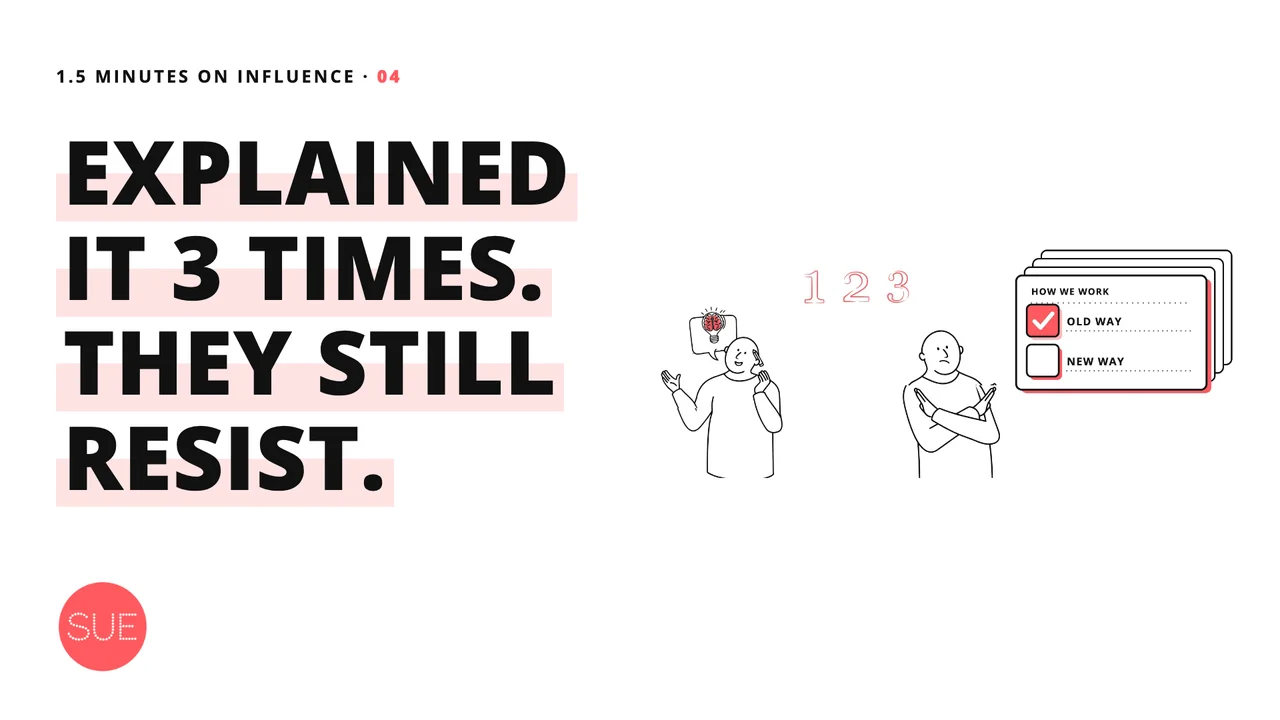 1:32
Film 1:32. Voice: an AI clone of Astrid Groenewegen’s own voice.
Read the text of the film
You’ve explained the change three times. And they still resist. There’s a reason. Most managers explain it a fourth time, with better arguments for why the old way has to go. Economists William Samuelson and Richard Zeckhauser gave four hundred and eighty-six students a set of choices. Some got a choice with one option already in place.
Others got the same choice with nothing in place. Then they looked at real health plan choices at Harvard. Whatever was already in place usually won. At Harvard, staff who already had the old health plan mostly stayed on it. New staff chose from scratch. They picked that plan two to four times less often. The researchers list several reasons.
One is simple. Switching takes effort, and staying takes none. That’s what our Influence Framework calls a comfort. And a comfort wins without a single argument. Think of your own change. The old template everyone still fills in. The supplier nobody has compared in years. Make the new way the default. Send the new template out already filled in, so the old way is the one that takes effort.
The old way wins because it’s already there. My name is Astrid Groenewegen, from Sue Behavioural Design, and this was 1.5 Minutes on Influence. Subscribe for the next one. And if this was useful, give it a thumbs up or share it.
We've been giving a lot of Leading with Influence© training lately. In my experience, even the most experienced boards aren't immune to biases, and one shows up again and again: the preference for keeping things as they are.
Imagine a company that has worked with the same supplier for years. The relationship is fine. A new board member suggests comparing alternatives, to see whether better terms or quality are available. Nobody says no. The current supplier is familiar, change feels risky, and comparing takes effort. So the comparison never happens.
William Samuelson and Richard Zeckhauser gave this tendency a name in 1988: status quo bias. I keep coming back to their paper whenever someone tells me about resistance, because it shows how little that resistance may have to do with your arguments.
They started with 486 students in economics classes at Boston University and Harvard. Each student answered a series of decision problems. In one, you've inherited money and must decide how to invest it. Some students saw the options on an equal footing. Others saw exactly the same options, with one of them already in place: a significant portion of your great-uncle's portfolio is in company A, do you keep it or change it? Every option took a turn in that position. And for most options the same pattern appeared. An option did best when it was the status quo, less well when it was neutral, and worst when it was the alternative to the status quo.
You could argue that's students and hypothetical money. So they looked at real decisions. During the 1980s Harvard University added several new health plans for its staff. New staff chose from the full menu. Staff who had been there longer could switch, and few did: an earlier study by Neipp and Zeckhauser had found that only about 3 per cent of Harvard employees switched plans in a year. In every age group, long-serving staff were two to four times as likely to be on the old plan as new staff of the same age were to choose it. Among staff aged 32 to 41, that was 33 per cent against 12.
Pensions showed the same pattern. Participants in the TIAA-CREF retirement funds could change how their contributions were split every year, at no cost. A 1986 survey that the authors cite found that only 28 per cent had ever done so.
The researchers don't settle on one cause. They discuss several possible explanations: the cost of switching, uncertainty about the new option, the wish to avoid regret, the pull to stay consistent with an earlier choice. One of them is especially useful in organisations, because it's the one you can design. Staying asks for nothing.
In the SUE | Influence Framework© that's a comfort. Comforts are the positives of the current behaviour. The old way is easy, and it's already arranged. They're easy to overlook because nobody defends them out loud. The board member who prefers the current supplier rarely says that comparing suppliers is a hassle. They say the relationship works.
That's why a fourth explanation rarely helps. You push harder on the gains of your plan, while the comfort of the current way stays exactly where it was.
So move the comfort instead. Make the new way the easy one. Better still, make it the default: the template that opens when someone starts a report, the meeting that's already in the calendar, the supplier comparison that's already done and on the agenda. Then the old way becomes the one that needs a decision, and status quo bias starts working for you.
The old way wins because it's already there.
Sources
- Samuelson, W., & Zeckhauser, R. (1988). Status quo bias in decision making. Journal of Risk and Uncertainty, 1(1), 7–59. https://doi.org/10.1007/BF00055564