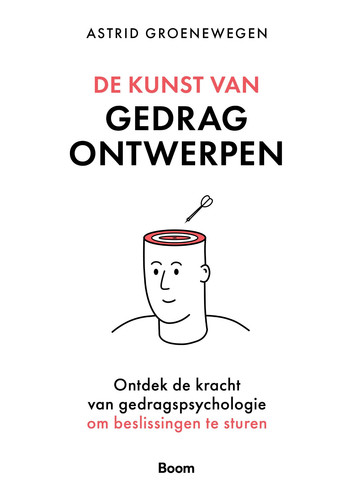
Welcome to our blog, where you’ll find hundreds of articles, each offering a new lens on how people actually make decisions, how preferences and behaviour come to be, and how you can shape them. Always grounded in behavioural science, always made practical. You can browse articles by subject or by theme. Happy reading!
We make hundreds of decisions every day. Most happen automatically, and that leads to suboptimal choices more often than we realise.
SUE NewsTom de Bruyne's book Gamechangers has been shortlisted for the Dutch Management Book of the Year 2026. On chain reactions of positive change.
NewsWatch the webinar where Tom de Bruyne explains why AI adoption is a behavioural challenge and why craftsmanship is the new coding.
AI & Behavioural DesignAI writes quickly but rarely persuades on its own. Learn how to build behavioural science into your prompts to create copy that genuinely moves people.
Behavioural DesignAround 95% of our decisions are made by System 1. The five cognitive biases that sabotage decision making and proven approaches for better decisions.
Behaviour & NudgingMost behavioural interventions don't work. If behavioural designers won't admit that, they have a problem.
Change ManagementWhy does 70% of all change fail? The behavioural science approach that addresses the comforts and anxieties that actually drive behaviour.
Persuasion & InfluenceArguments don’t persuade. People decide via System 1 and justify afterwards. The behavioural science behind effective influence without manipulation.
Behaviour & Nudging70% of behaviour change programmes fail. Not because of lack of motivation, but because the behavioural layer is missing. The science behind lasting behaviour change.
LeadershipEffective leadership isn’t about charisma — it’s about designing context. What behavioural science teaches you about motivation, ownership and behaviour change as a leader.
Behaviour & NudgingWhat is nudging, why does it work psychologically, and how do you apply it? The complete guide to nudge theory, libertarian paternalism and choice architecture.
AI & Behaviour88% of employees use AI - 6% see measurable results. AI adoption fails because of the behavioural layer, not the technology. How to actually make it work.
Change ManagementMost culture programmes change what people think, not what they do. Behavioural science bridges the gap from intention to consistent, visible behaviour.
Customer ExperienceCustomer-centricity doesn’t start with customers - it starts with employees. Why customer-centric transformations fail without behavioural design.
Change Management70% of change initiatives fail. Not because of poor plans, but because they were not designed around how people actually make decisions and change behaviour.
LeadershipOwnership cannot be demanded or trained into people - it has to be designed. How managers use behavioural insights to create genuine autonomy and engagement.
Work HappinessWork happiness doesn’t just happen - it’s designed. How to create structural conditions for work happiness at the task, team and organisational level.
AI & BehaviourAI generates patterns at scale, behavioural science explains why people act the way they do. How to combine both disciplines into a more powerful approach.
Persuasion & InfluenceAnchoring is one of the most powerful and least visible cognitive biases in organisations. How to use it deliberately - and how to protect yourself from it.
Behaviour & NudgingRobert Cialdini identified six universal principles that drive human compliance. How each principle works and how to apply them ethically in your organisation.
Behaviour & NudgingMost conversion optimisation focuses on surface-level tweaks. Behavioural Design addresses the real reason people don’t convert: psychological friction and missing motivation.
Work HappinessDeci and Ryan’s Self-Determination Theory explains why people engage deeply with some tasks and disengage from others. The three universal psychological needs every manager should understand.
AI & BehaviourAI can produce copy fast. But persuasive copy requires behavioural science, not just fluency. How to combine AI tools with the principles that actually change behaviour.
AI & BehaviourThe quality of AI output depends entirely on the quality of your prompts. A practical guide to prompting for communication professionals who want behavioural results, not just readable text.
Behaviour & NudgingAfter years of research into what makes people flourish, Astrid Groenewegen presents The Happiness Code - a practical framework for designing well-being in organisations and daily life.
Work HappinessBonuses and KPIs motivate in the short term. Intrinsic motivation sustains performance over years. What the science says about designing work environments where people genuinely want to perform.
Behaviour & NudgingEvery drop-off point in a customer journey is a behavioural problem in disguise. How to use the SUE Influence Framework to identify hidden friction and design journeys people actually complete.
Behaviour & NudgingWhy does one complaint weigh more than ten compliments? The negativity bias explains why teams get stuck in problems and how to break through it.
Behaviour & Nudging“I saw that coming.” No, you didn’t. The hindsight bias distorts evaluations, undermines innovation and protects poor decision-makers.
Behaviour & NudgingThe more you know, the worse you communicate. The curse of knowledge explains why brilliant experts fail to transfer their knowledge.
Change ManagementChange programmes fail not because of bad plans, but because people don’t feel ownership. Five principles from behavioural science that do work.
Change ManagementResistance to change is not irrational. It’s a predictable response to loss, uncertainty and threatened autonomy. Here’s how to work with it, not against it.
Change ManagementBuy-in isn’t something you get through better arguments. It’s something you design. The Influence Framework shows you how.
Persuasion & InfluenceMost CTAs fail. Not because the copy is bad, but because they ignore how people actually make decisions. Five behavioural principles that fix this.
Persuasion & InfluencePersuasion has a bad reputation. But ethical persuasion is about removing barriers and making the right choice easier. Here’s how.
Persuasion & InfluenceNudging is one of the most powerful tools for communication professionals. How to apply choice architecture concretely in your communication strategy.
Persuasion & InfluenceEmail is the most widely used communication tool, yet the most ignored. How framing, loss aversion and social proof make your emails actually lead to action.
Persuasion & InfluenceInforming is not the same as influencing. Why your messages are read but don’t change behaviour, and what you can do about it.
Persuasion & InfluenceAI writes fast. But fast isn’t persuasive. How to combine AI tools with behavioural science to create communication that actually changes behaviour.
Persuasion & InfluenceMost copy informs but doesn’t persuade. Three common pitfalls and six behavioural science principles for writing that actually moves people to action.
Persuasion & InfluenceThe same information, framed differently, leads to completely different decisions. Five framing techniques you can apply immediately.
Persuasion & InfluenceInformation alone never changes behaviour. The knowledge-behaviour gap explained - and four principles from behavioural science that actually work.
Persuasion & InfluenceMost change communication fails because it explains why change is needed. Five principles from behavioural science for communication that actually drives adoption.
Work HappinessWhy employee satisfaction surveys don’t improve wellbeing - and how to design the four happiness contexts that actually do.
Work HappinessFruit baskets, yoga sessions, mindfulness apps - why most wellbeing programmes backfire. The three misconceptions you need to know.
Work HappinessIt takes 23 minutes to regain deep focus after an interruption. How to design a work environment where deep work is the norm.
Behaviour & NudgingDaniel Kahneman proved that 96% of our thinking is automatic and unconscious. Learn how System 1, System 2 and cognitive biases apply to behavioural design and everyday decisions.
Behaviour & Nudging50% of patients don’t follow treatment plans. The problem isn’t information. It’s behaviour. How to redesign patient journeys to work with human psychology.
Behaviour & NudgingCustomers know they should save more. They don’t. How loss aversion, present bias and status quo bias shape financial behaviour more than any product.
Behaviour & NudgingPolicies designed for rational citizens fail. How behavioural design transforms citizen participation, energy transition and public service delivery.
Behaviour & Nudging70% of online carts are abandoned. Loyalty programmes reward but don’t retain. How to design retail experiences that change what customers actually do.
Behaviour & NudgingTraining completion is high. Behaviour transfer is near zero. Why knowledge doesn’t change behaviour and how environment design does.
Behaviour & NudgingUsers sign up, explore for a week, and quietly disappear. Feature adoption stalls. The gap between product value and user action.
Behaviour & NudgingCustomers underinsure their most valuable assets and churn at renewal. The product is fine. How people perceive risk is the problem.
Behaviour & NudgingCustomers who rate you 8 out of 10 switch to a competitor next month. Churn is not a pricing problem. It is a behavioural one.
Behaviour & NudgingYour product wins blind taste tests. Market share does not move. Habit and shelf-level defaults beat product quality every time.
Behaviour & NudgingUsers sign up for your savings app enthusiastically. Three months later, 70% of accounts have a balance of zero. The intent-action gap in fintech.
Leadership23% of employees worldwide are engaged. Billions spent on surveys and programmes. The scores barely move. The missing layer is always the same.
Change Management70% of software rollouts fail to deliver ROI. Only 49% of features are used. The problem is not the software, it is the old workflow living in System 1.
Behaviour & NudgingPeople judge experiences by the most intense moment and the ending. How that shapes onboarding, meetings, and feedback conversations.
Persuasion & InfluenceA third option nobody picks that systematically strengthens your preference for another. How it works in pricing, hiring, and strategy.
Behaviour & NudgingYou know you should write that strategy, but you answer your email first. Present bias sabotages long-term goals in every organisation.
Persuasion & InfluenceThe urge to return favours drives teams, negotiations, and collaborations. How to use reciprocity ethically in organisations.
Behaviour & NudgingOnce something is yours, it becomes more valuable. This effect sabotages reorganisations, feedback, and innovation.
Behaviour & NudgingEvery project takes longer than planned. Not because of bad planning, but because of a systematic overestimation of chances.
Persuasion & InfluenceLimited availability increases perceived value. How scarcity influences hiring, urgency, and strategic choices.
Behaviour & NudgingThe quality of your decisions measurably drops after a day full of choices. How to redesign decision environments.
Behaviour & NudgingTeams choose the same direction en masse, not because it's best, but because everyone else is doing it.
Behaviour & NudgingWhat you experienced recently disproportionately shapes your risk assessment and priorities at work.
Change ManagementTeams cling to existing processes, even when better alternatives are available. The bias that sabotages every change initiative.
Persuasion & InfluenceThe same information leads to opposite decisions depending on how you present it. How to design better frames.
Persuasion & InfluenceThe first number in any negotiation, salary discussion, or estimate shapes every subsequent judgement.
Persuasion & InfluenceFrom meeting dynamics to willingness to innovate: social proof determines what teams do.
Behaviour & NudgingA good first impression colours your entire judgement of a candidate, colleague, or idea.
Behaviour & NudgingThe fear of losing weighs twice as heavy as the joy of winning. How loss aversion shapes every organisational decision.
Behaviour & NudgingOrganisations keep investing in failing projects because stopping feels like waste. The most expensive thinking error in business.
Behaviour & NudgingHow overestimation of competence distorts hiring, performance conversations, and decisions at every level.
Behaviour & NudgingEmployees defend choices that don't work because course-correcting hurts too much. How to design a safe environment for change.
Behaviour & NudgingKahneman's two thinking systems form the foundation of all cognitive biases. What each system does and why it matters.
Behaviour & NudgingEverything about nudging: from Thaler and Sunstein's theory to practical applications in organisations.
Behaviour & NudgingSludge is the opposite of a nudge: unnecessary friction that prevents people from doing what's good for them.
Behaviour & NudgingPeter Gollwitzer's simple technique bridges the gap between intention and action.
Behaviour & NudgingThe philosophy behind nudging: how to encourage better choices without restricting freedom.
Behaviour & NudgingEvery choice has a designer. Choice architecture shows how context determines the outcome of decisions.
Behaviour & NudgingFrom hidden unsubscribe buttons to misleading cookie banners. The dark side of behavioural design.
Behaviour & NudgingMost people choose what's already ticked. Defaults are the most powerful nudge there is.
Behaviour & NudgingSometimes you remove friction, sometimes you add it. The difference determines whether your intervention works.
Behaviour & NudgingCialdini's research on descriptive and injunctive norms. The most powerful lever for behaviour change at scale.
Behaviour & NudgingFrom Odysseus at the mast to modern savings programmes. How to design upfront commitment that holds.
Behaviour & NudgingFrom Kahneman to Thaler: the field that proves people don't decide rationally, and what you can do about it.
Behaviour & NudgingFrom Herbert Simon to Gary Klein: the science studying how real-world decisions are actually made.
Behaviour & NudgingBoth methods are human-centred, but they solve fundamentally different problems. When do you use which?
Behaviour & NudgingChange management focuses on processes, Behavioural Design on the behaviour those processes need to carry.
Behaviour & NudgingUX Research discovers what users want. Behavioural Design designs for why they don't do it.
Behaviour & NudgingBehavioural economics focuses on economic decisions, psychology on all human behaviour. Where do they overlap?
Behaviour & NudgingNudging preserves freedom of choice, gamification motivates through game mechanics. Two approaches, different situations.
Behaviour & Nudging55 cognitive biases are systematically distorting your hiring, strategy, and team decisions. The complete guide to understanding them - and how to design around them.
Change ManagementAI adoption, change management, digital transformation: 70% fail. The reason is always the same missing layer - the behavioural layer that standard change management ignores.
AI & Behaviour88% of organisations use AI. 6% see results. The technology isn’t the problem - the missing behavioural layer is. The SUE Influence Framework diagnoses the real blockers.
Change Management70% of change initiatives fail - not because of poor planning, but because the behavioural layer is always missing. The SUE Influence Framework reveals what is actually blocking change.
LeadershipOnly 16% of digital transformations fully succeed. The failure isn’t in the technology or budget - it’s in the missing behavioural layer every roadmap leaves out.
Behaviour & NudgingConfirmation bias sabotages your hiring, strategy and team decisions. Discover how it works - and how to redesign decision-making processes that protect you.
Behaviour & NudgingThe step-by-step method SUE uses to analyse and change behaviour. From identifying barriers to designing effective interventions.
Behaviour & NudgingEverything about the discipline that combines behavioural science and design thinking to understand and change human behaviour.