How do you design an airport where calm is the most logical response?
Think about the last time you walked through an airport. The signs hurrying you along, the queues that shrink you down to a number, the announcements keeping you on edge, the long march from security to gate with your shoulders somewhere up around your ears. And then, at the end of all that, the airline emails you a survey asking how stressed you felt. It is almost funny. The whole place was built to process you like livestock, and then it asks why you did not enjoy the experience.
So here is a question worth sitting with. What would it take to design an airport where the natural, easiest response was not stress but calm? Singapore's Changi Airport went and answered it, and the answer is more useful than it first appears, because the same thinking applies to any space you put people in and then wonder why they behave the way they do.
What Changi did
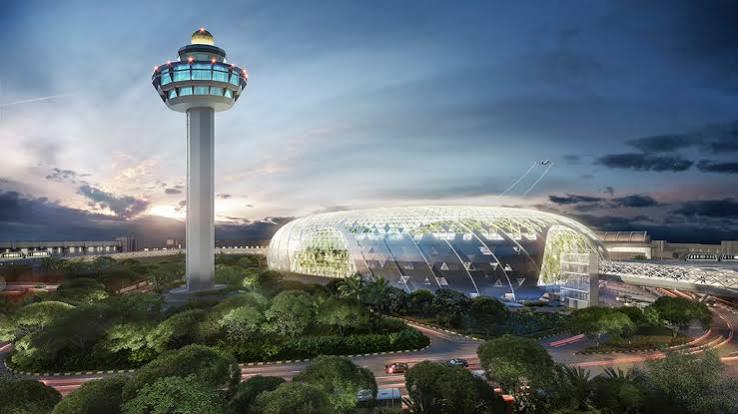
In late 2023, Changi reopened Terminal 2 after a five-year redesign by the Paris firm BOIFFILS Architectures. The brief they set themselves was unusual.[1] Most airport projects optimise the flow of passengers, how to move the maximum number of bodies through the building per hour. BOIFFILS deliberately did the opposite, putting the traveller's experience ahead of the logistics of processing them. The terminal that came out the other side does not look like an airport at all.
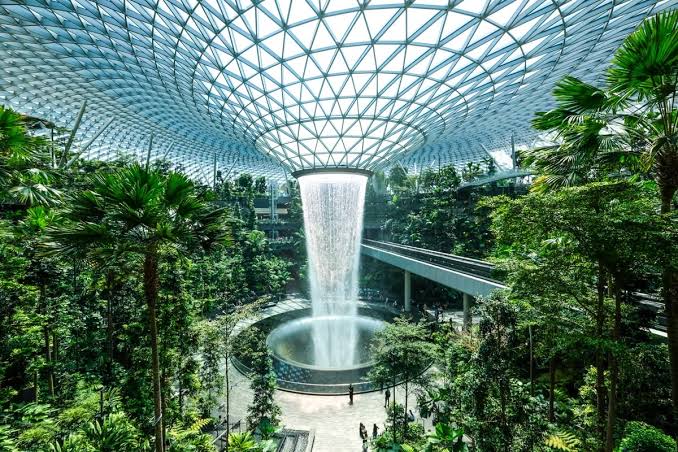
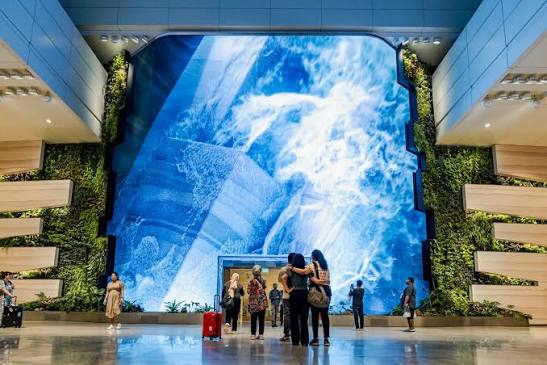
At the centre of the departure hall stands the Wonderfall, a digital waterfall fourteen metres high, set into a vertical garden. Several times an hour the water reverses and climbs, a three-and-a-half-minute show set to music written for the space by the pianist Jean-Michel Blais. Around it, more than twenty thousand real plants from over a hundred species. Green columns instead of bare pillars. Ceilings and walls that echo natural landforms. Check-in is gathered into open islands rather than the usual long wall of desks. Where a normal terminal hits you with hard lines, queues and signs telling you to hurry, this one does the opposite. It tells your nervous system that here, you are allowed to breathe.
Why this is design, not a personality test
It would be easy to assume the calmer travellers at Changi are simply calmer people, the sort who have time to admire a waterfall. That gets it backwards. The same harried business traveller who tenses up in one terminal relaxes a little in this one, and nothing about them has changed between the two. What changed is the building. The environment is doing the work, and the person is responding to it, usually without noticing they are being influenced at all.
This is the move worth taking out of the airport and into your own world. When people are stressed, distracted or short with each other in a space you are responsible for, the instinct is to treat it as a problem with the people. Changi is a reminder that the room is very often the thing talking.
The science: attention, restored
There is solid behavioural science underneath the waterfall, and it is not decoration. Stephen and Rachel Kaplan, environmental psychologists at the University of Michigan, developed what they called Attention Restoration Theory. Their finding, built up over years of studies, is that the kind of attention we use to push through a demanding environment, the effortful, directed focus that airports drain out of you, is a limited resource that gets depleted.[2] Exposure to nature, even modest exposure, even an image of it, lets that depleted attention recover, and measurably lowers physiological markers of stress.
There is a second principle in the layout. The psychologist William Hick showed, back in the 1950s, that the time it takes a person to make a decision grows with the number of options in front of them, a relationship now known as Hick's Law.[3] A wall of identical desks and competing signs forces a tired traveller to process too many choices at once. Breaking check-in into clear islands cuts the number of decisions you face at any one moment, and lowers the mental load that comes with them. The calm is engineered, decision by decision, plant by plant.
Through a Behavioural Design lens: shaping the autopilot
It is worth naming the discipline here, because Changi is a clean example of how behavioural design actually works. Most attempts to change how people feel or behave aim at the conscious, deliberate mind: the announcement, the instruction, the survey, the sign asking you to be patient. That conscious mind is what the psychologist Daniel Kahneman called System 2, and it is slow, easily tired, and not in charge of nearly as much as we like to think. Most of what we do runs on System 1, the fast, automatic part that simply responds to whatever the environment puts in front of it.
A stressful airport hammers System 2 with demands while quietly winding up System 1 with every harsh light and hurrying sign. Changi went the other way. It left the instructions aside and redesigned what System 1 was responding to: water instead of noise, greenery instead of glare, open islands instead of walls. Nobody reads a sign telling them to relax and then relaxes. They just find themselves calmer, because the autopilot is responding to a calmer set of signals. That is the heart of behavioural design. You do not lecture the conscious mind into compliance. You change what the automatic mind is reacting to, and let the behaviour follow. At SUE, the Influence Framework and SWAC are the methods we teach in the Behavioural Design Fundamentals Course to systematically analyse how the built environment triggers behaviour and where you can redesign the path.
What this means in practice
Start with your own surroundings, because this works at the scale of a single desk before it works at the scale of a terminal. If you spend your day in a space that is all hard light, noise and visual clutter, you are paying a quiet tax on your attention and your mood, and willpower will not cover it. The useful response is not to try harder to focus. It is to change what your nervous system is soaking up all day: get some daylight, put something green in your eyeline, cut the number of things competing for your attention at once.
For anyone who leads people, this reframes a responsibility that is easy to overlook. You put effort into motivation, feedback and targets, all of it aimed at the conscious mind, while the physical space your team sits in is shaping their stress and focus every hour beneath anyone's awareness. The cramped, windowless room where you hold hard conversations is making its own argument. A leader who takes this seriously treats the environment as part of how people perform and feel, not as something to leave to whoever orders the furniture.
And at the level of the organisation and its customers, Changi is proof that experience is designable rather than left to chance. Whatever space, shop, app or service your customers move through is making them calmer or more anxious, more trusting or more guarded, before a single word of yours is read. The skill this points to, and it is one you can build, is to stop asking how to tell people to feel something, and start asking what the environment is already making them feel, and how to design that on purpose.
Learn to apply this yourself
What makes Changi's approach powerful is that it works on System 1 directly, shaping the automatic responses of everyone in the space before they are even aware of being influenced. In the Behavioural Design Fundamentals Course you learn to use the Influence Framework and SWAC to map which environmental signals drive behaviour in any space, and to identify where redesigning the path is more effective than asking people to behave differently.
View the online Fundamentals Course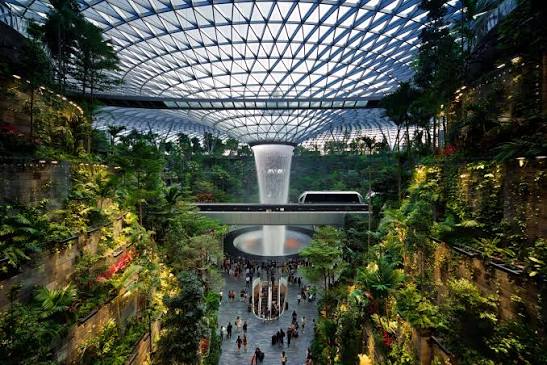
What you can design this week
You cannot install a waterfall, but the underlying move scales down to almost any space you influence. Three ways to start:
Subtract before you add. Changi removed queues and hard lines before it added greenery. Look at the space your people or customers move through and take away the harshest stressors first: the clutter, the noise, the unnecessary decisions stacked on top of each other.
Put nature in the line of sight. A plant, a window, a view of something living is not decoration; the Kaplans showed it restores depleted attention. Where people need to recover or concentrate, give them something natural to rest their eyes on.
Cut the decisions you force on people at once. Hick's Law is working against you wherever choices pile up. Break a daunting wall of options into clearer, smaller steps, so the automatic mind is not overwhelmed before it begins.
Changi did not ask anyone to relax. It built a terminal where relaxing was the easiest thing left to do, and got out of the way. That is the difference between demanding a feeling and designing for it, and it is just as available to a meeting room or a shopfloor as it is to one of the most admired airports in the world.
Want to learn to read a space for what it does to the people inside it, and design it on purpose? That is the heart of our Behavioural Design training. Details on the SUE website.
Frequently asked questions
Why does a waterfall actually reduce stress in an airport?
Stephen and Rachel Kaplan's Attention Restoration Theory explains it. The directed, effortful attention you burn navigating an airport is a finite resource, and it depletes quickly under demanding conditions. Exposure to nature, even a brief glance at something living or flowing, lets that attention recover, while simultaneously lowering measurable physiological markers of stress. The Wonderfall works not because it is beautiful but because the automatic part of the brain registers it as a safe, restorative signal rather than another demand on an already depleted system.
How does Hick's Law apply to a space I control?
William Hick showed in the 1950s that decision time grows in proportion to the number of options in front of a person. In practice, this means that wherever choices pile up simultaneously, whether that is a wall of check-in desks, a cluttered meeting agenda, or an onboarding screen packed with options, you are adding cognitive load before the person has done anything. The fix is to break the decision landscape into smaller, sequential steps so the automatic mind is never overwhelmed all at once. Start by counting how many things compete for attention at the moment your user, customer or colleague first encounters your space or process, then reduce that number.
Why couldn't Changi just put up signs asking people to relax?
Because signs address the conscious, deliberate mind, what Kahneman called System 2, while stress is already running on System 1, the fast automatic system that responds to the environment before any instruction is read. Nobody processes the words "please remain calm" and then actually calms down; the instruction arrives too late and targets the wrong system. Changi worked on what System 1 was actually receiving: the quality of light, the presence of greenery, the structure of the layout. Change what the autopilot is reacting to, and the conscious mind never needs to be asked.
Does this only work at the scale of a terminal, or can a single room do the same?
The Kaplans' research showed that even modest exposure to nature, including photographs of natural scenes, produced measurable recovery of depleted attention. The mechanism does not require fourteen metres of digital waterfall; a plant in the eyeline, a window with a view of something living, or simply removing the harshest visual clutter will move the needle. Changi is the clearest available proof of principle, but the same logic applies to the room where your team holds its hardest conversations, and that is the more uncomfortable implication: most organisations pour effort into motivation and feedback while the room itself is quietly working against them every hour of the day.
If you want to learn how to design for behaviour rather than trying to motivate it, that's exactly what the Behavioural Design Fundamentals Course covers. View upcoming dates →