Employee retention strategies: design the moments, not the mood
Your engagement scores are fine. Not spectacular, but fine, and roughly the same as last year. And in the past quarter you lost three people you would have fought to keep.
That combination is not a measurement error. It is the whole problem with how retention is usually approached.
Most retention strategies try to lift a mood. Better pay, clearer career paths, more recognition, a survey to check whether the mood went up. All reasonable, and all aimed at an average that almost nobody actually experiences.
Employee retention strategies are the deliberate choices you make to keep the people you want to keep. The ones that work do not raise satisfaction in general. They find the specific moments at which someone starts looking elsewhere, and redesign those. More on behavioural design for HR →
What are employee retention strategies?
Ask ten HR teams and you get roughly the same list: competitive pay, career development, recognition, flexibility, good management, a sense of purpose. It is not a wrong list. It is a list of conditions, and conditions are not decisions.
Somebody who resigns has made a decision, on a particular day, after something happened. Conditions form the backdrop to that decision. They rarely cause it.
The useful version of a retention strategy starts from the opposite end. Not "how do we make this a better place to work", which nobody can act on, but "at which moments do people here start looking, and what happens at those moments".
People do not leave a job. They leave a Tuesday.
Why satisfaction is the wrong thing to measure
Frederick Herzberg made the point in 1968 and it still gets ignored: the things that make people dissatisfied and the things that make them committed are not the same things.[3] Pay, conditions and policy are what he called hygiene factors. Fix them and dissatisfaction goes away. Commitment does not appear. It comes from the work itself: what you get to decide, what you get better at, what you are trusted with.
That distinction explains a pattern most HR teams recognise. You raise salaries and the complaints stop, and a year later the same people leave anyway. The complaints were never the reason. They were the thing that was easy to say out loud.
There is a measurement problem underneath it too. A satisfaction score is an average over a period, collected at a random moment. Departures are caused by specific events at specific times. Averaging over a year is exactly the wrong instrument for catching an event in March.
What behavioural science says about how people actually leave
The most useful research here is nearly three decades old and still barely applied. Thomas Lee and Terence Mitchell proposed what they called the unfolding model of voluntary turnover: most people do not slide gradually from content to gone.[1] They get hit by a shock, a specific, jarring event, and that shock starts a script. A colleague resigns. A reorganisation moves your project. Someone else gets the role you were promised. A recruiter calls on precisely the wrong afternoon.
What matters is that the shock does not have to be negative, and it often has nothing to do with satisfaction. It is an interruption that makes someone ask a question they were not asking the day before.
The companion finding is just as practical. Terence Mitchell and colleagues showed that whether people stay is predicted better by what they called job embeddedness than by satisfaction: the links they have to other people, how well the job fits the rest of their life, and what they would have to give up by leaving.[2] Someone with three close working relationships, a project they care about and a commute that works is hard to dislodge, even on a bad month. Someone with none of that is one recruiter call away.
And what keeps people engaged once they are staying is not mysterious either. Edward Deci and Richard Ryan's work points consistently at three things: autonomy over how you work, growing competence, and genuine connection to the people around you.[4] Notice that none of the three is a benefit you can add to a package. All three are properties of how the work is arranged.

The forces behind staying and going
Before you change anything, map what someone is weighing up. The SUE | Influence Framework sorts those forces into pains, gains, anxieties and comforts.[6]
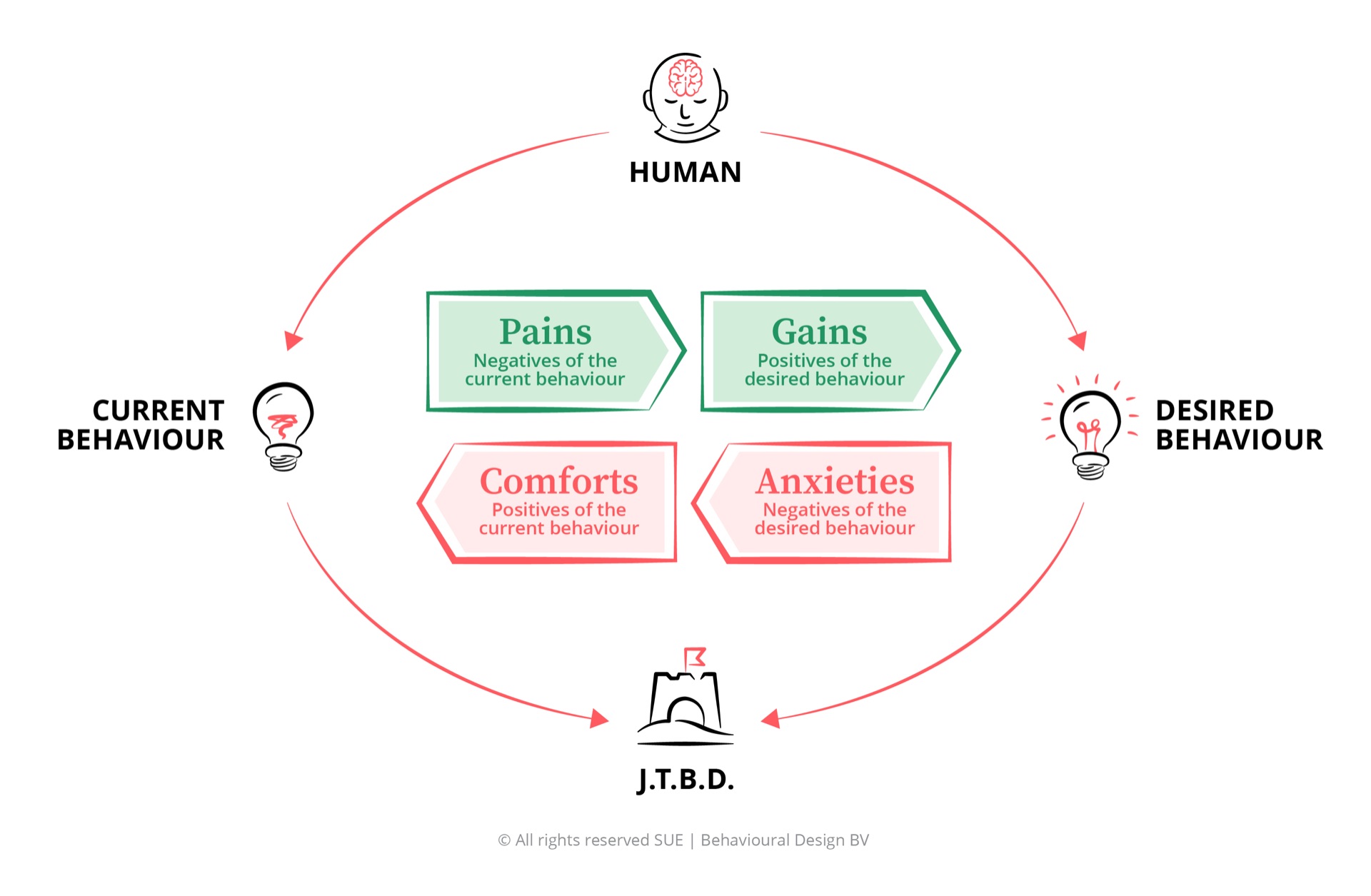
The pains are rarely dramatic. Work that is never quite finished before the next priority lands. A manager who is fair but absent. The slow realisation that the interesting projects go to the same two people.
The gains of leaving are vivid and specific, because a recruiter has described them in detail. More money, a better title, a fresh start where nobody knows about the project that went wrong.
The anxieties about leaving are what actually keep most people in place: a new team is a gamble, the last person who left came back within a year, and starting over means being the junior one again for six months.
And the comforts of staying are the ones you can design deliberately: knowing how things work, the colleague who covers for you at school pick-up, the meeting where your opinion carries weight. This is job embeddedness in plain language.
Look at that balance and the strategy changes shape. You are not trying to make people happier. You are trying to lower the anxieties that make change feel impossible for the people you want to lose, and raise the comforts for the people you want to keep.
The six moments worth redesigning
Chip and Dan Heath argue that a small number of moments carry disproportionate weight in how people remember an experience.[5] In an employment relationship, six show up again and again.
1. The first two weeks
The cheapest moment to design and the most commonly wasted. Most onboarding spends it on systems and information. What actually determines whether someone embeds is who they meet, what they get to do that matters, and whether anyone notices they did it.
2. The first mistake
How the organisation reacts the first time someone gets something wrong teaches them, in one afternoon, whether it is safe to take initiative here. Nothing you say at the kick-off outweighs that one reaction.
3. The promotion round they did not win
This is the classic shock. Almost everyone who is passed over updates their beliefs about their future here, and almost nobody is spoken to about it properly afterwards. A conversation within the week, with something concrete in it, is worth more than a year of engagement initiatives.
4. A change of manager
The relationship that held someone in place is gone, and the new one has not been built. This is the single most under-managed moment on the list, and it is entirely predictable, which makes it designable.
5. The return from long leave
After parental leave or illness, people come back to a team that has moved on without them. What happens in the first fortnight decides whether they re-embed or start looking.
6. The end of the second year
The learning curve has flattened, the job is now known, and the question shifts from "can I do this" to "is this what I want to be doing". If nothing changes about the work around that point, the answer tends to be no.
How to find your own moments
The six above are common, not universal. Your organisation has its own, and you can find them with an afternoon of work.
Take everyone who left voluntarily in the past year and ask one question of the record: when did they first start looking, and what happened that week? If you do not know, that is itself the finding, and the exit interview is where to fix it. Then list the events, not the themes. Culture cannot be redesigned. "The month after the team split in two" can.
Look for the same event appearing more than twice. That is your moment. Then design one specific intervention at that point, name an owner, and count departures around that moment for the next two quarters. One redesigned moment beats five simultaneous initiatives, because you can actually tell whether it worked.
Frequently asked questions about employee retention
What is the most effective employee retention strategy?
Finding the moments at which your own people start looking, and redesigning those. Generic strategies raise conditions for everyone, including the people who were never going to leave. A specific intervention at a specific moment, such as a proper conversation within a week of a missed promotion, changes the decision at the point where it is actually made.
Does higher pay improve retention?
It removes a reason to complain rather than a reason to leave. Frederick Herzberg showed that pay and conditions are hygiene factors: fixing them ends dissatisfaction but does not create commitment. Pay below the market costs you people. Pay above it buys less loyalty than most budgets assume.
Why do people leave when engagement scores are good?
Because engagement scores average a year of experience collected at a random moment, and departures are triggered by specific events. Thomas Lee and Terence Mitchell described this as a shock that starts a script: a reorganisation, a passed-over promotion, a colleague resigning. Averages cannot catch that.
What is job embeddedness?
A concept from Terence Mitchell and colleagues describing how tied someone is to their current situation: the links they have to other people, how well the job fits the rest of their life, and what they would sacrifice by leaving. It predicts staying better than satisfaction does, and unlike satisfaction, you can design it directly.
How do you measure whether a retention strategy works?
Not with a satisfaction survey. Pick one moment you have redesigned, count departures connected to that moment before and after, and give it two quarters. If you change five things at once you will know your turnover moved, but not which change moved it.
Conclusion
Retention is treated as a mood to be lifted and it behaves like a set of moments to be designed. That is why the surveys stay flat while good people keep leaving: you are measuring the backdrop and the decision is being made in the foreground.
So stop asking how satisfied people are. Ask when they started looking, and what happened that week. Then pick the moment that comes up most often and redesign that one properly.
You will lose people anyway. You will just stop losing them at the same predictable point.
Want to apply this across the whole employee journey? The online Deep Dive The Behavioural Advantage in Talent Management shows you how to design hiring, onboarding and retention with behavioural science.