Exit interview questions that get honest answers
Open the last ten exit interviews in your HR system and read only the answer to "why are you leaving". You will find some version of the same sentence ten times: a great opportunity came along, the timing was right, nothing negative to report.
Now count how many of those ten people you were genuinely surprised to lose.
The distance between those two numbers is the whole problem. Not because people lied to you. Because you asked them a question almost nobody can answer accurately, in a room where the accurate answer costs them something.
Exit interview questions are the questions you put to an employee who has resigned, to learn why they left and what would have kept them. Questions that ask for motives produce unreliable answers, because people reconstruct their reasons after the fact and because candour carries a professional cost. Questions that reconstruct specific moments produce answers you can act on. More on behavioural design for HR →
What are exit interview questions?
Exit interview questions are the structured part of the conversation an organisation holds with someone who is leaving voluntarily. The standard set has been stable for decades. Why are you leaving. How would you rate your manager. Did you feel supported in your development. Would you recommend us as an employer. Is there anything we could have done differently.
Read that list again with one question in mind: what is it designed to produce? Every item asks for a judgement or a motive, on a scale, at a moment of maximum social awkwardness. It is a form built for reporting, not for learning. It yields a tidy dashboard and almost no information about what actually happened.
The useful version asks something different. It reconstructs a sequence of events: when did this start, what happened that week, what did you do next, who did you tell. Those questions are harder to dodge, because they ask for memories instead of opinions.
Ask for a reason and you get a story. Ask for a moment and you get a fact.
Why the standard exit interview tells you so little
Three things go wrong at once, and none of them is about the leaver's character.
The first is that people do not have reliable access to their own motives. In 1977 Richard Nisbett and Timothy Wilson reviewed a long line of experiments in which participants confidently explained decisions that had demonstrably been caused by something else, a position in a row, a word they had been exposed to earlier. The explanations were fluent, plausible and wrong.[1] When you ask someone why they resigned, you are not opening a file. You are commissioning an essay, written on the spot, by an author who wants it to make sense.
The second is that the situation quietly rewards a safe answer. Douglas Crowne and David Marlowe demonstrated in 1960 how strongly people shade their self-reports towards what looks socially acceptable, even when nothing is at stake.[2] In an exit interview something very much is at stake: a reference, a reputation in a small industry, the chance of coming back in three years. "I had a great time, I just got a fantastic offer" costs nothing. "My manager takes credit for other people's work" costs a lot, and it is the sentence that would have been useful to you.
The third is timing. The conversation happens at the emotional end of the story, and endings distort memory. Donald Redelmeier and Daniel Kahneman showed that people judge an entire experience largely by its peak and its final moments rather than by its duration or average.[3] Baruch Fischhoff had already shown something related: once we know the outcome, we rewrite our sense of how likely it always was.[4] By the time someone hands in their notice they have a settled story in which leaving was obviously right all along, and the last bad month has coloured the previous four good years.
And then there is what happens to the answers. Everett Spain and Boris Groysberg examined exit interview practice across 210 organisations and found the same gap almost everywhere: companies collect the data diligently and have no reliable process for turning it into a decision. Nobody owns it, so nothing changes, so the next round of interviews finds the same thing.[5]
What behavioural science says about getting an honest answer
If honesty is expensive, appealing to it will not work. You have to make it cheaper. Three shifts do most of the work.
Ask about behaviour instead of motives. "Why did you leave" asks for an interpretation. "What did you do the day after that meeting" asks for an event. People are far more accurate about what they did than about why they did it, and events can be compared across leavers in a way that opinions cannot.
Ask about dated moments instead of overall periods. A question about "your time here" invites the peak-end summary. A question about a specific week pulls a specific memory, including the ones that do not fit the tidy story the person has settled on.
Remove the person with power over the reference from the room. This is the single largest change most organisations can make, and it costs nothing but a diary entry. As long as the interviewer influences what a future employer will hear, every answer is filtered through that risk.
The forces behind a candid answer
Before you rewrite your question list, map what the leaver is weighing up. The SUE | Influence Framework sorts those forces into pains, gains, anxieties and comforts.[6]
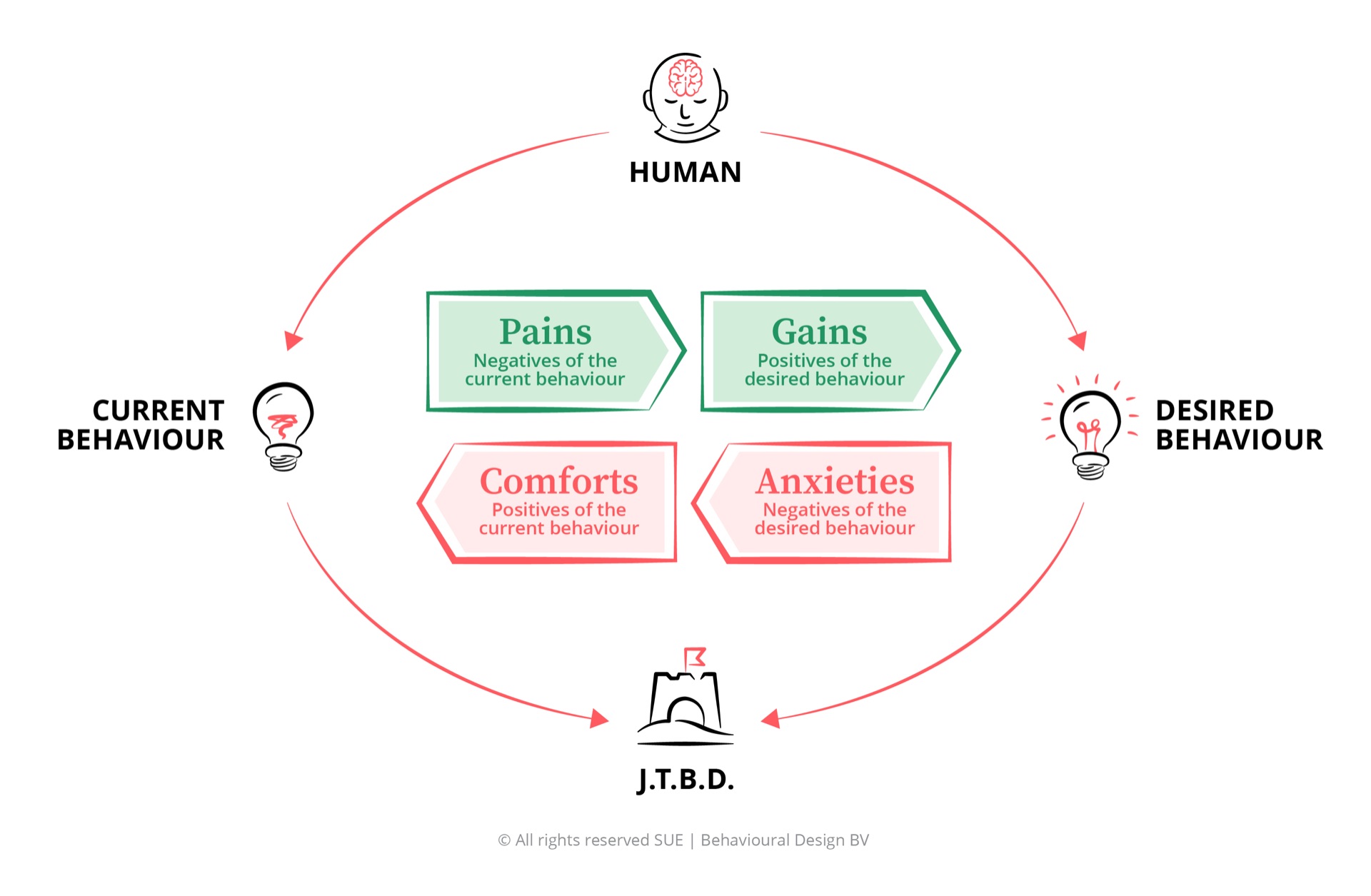
The pains are what pushes someone towards saying it: the frustration of having raised something twice and watched it go nowhere, the wish that the next person will not walk into the same wall.
The gains are thin and abstract. Something might improve here, for people they will no longer work with. That is a weak reward, arriving late, for someone whose attention has already moved to Monday at a new desk.
The anxieties are concrete and immediate. The reference. The industry that turns out to be four people wide. The manager who will hear a paraphrased version by Thursday, and who is at the same conference next spring.
And the comforts are considerable. The polite answer takes four minutes, hurts nobody, ends the meeting warmly, and gets you a good leaving card. The candid answer takes forty minutes and an argument.
Look at that balance and the mystery disappears. Nobody is hiding anything. The design of the conversation makes the useless answer the obvious one.
The exit interview questions that actually work
Eight questions, in the order that works best. They take about forty minutes and replace the whole standard form.
1. When did you first start thinking about leaving? What was going on that week?
Always the opening question. It dates the decision, and the date is usually a surprise: months, sometimes a year, before the resignation. It also produces a trigger, an event, rather than a theme. "Culture" cannot be fixed. "The reorganisation in March, when my project moved without anyone telling me" can be.
2. What did you do first?
Updated a CV, replied to a recruiter, phoned a former colleague, said yes to a coffee. This is behaviour, so the answer is reliable, and the sequence tells you whether the person was pushed out or pulled away. Someone who answers a recruiter they had ignored for two years was already gone.
3. What would have had to be different for you to still be here?
The counterfactual is the closest thing to a retention brief you will ever get. Push for something concrete. If the answer is "more appreciation", ask what that would have looked like on a Tuesday.
4. Did you tell anyone here that you were unhappy? What happened?
This tests your organisation, not the leaver. Most people raise it at least once. What you want to know is what the system did with it: whether it was heard, parked, or quietly held against them. If the answer is "I mentioned it, and then it went quiet", you have found something more actionable than any engagement score.
5. Which part of the job turned out differently from what you expected when you joined?
Retention problems are often recruitment problems with a nine-month delay. This question audits the promise your hiring process made.
6. If a friend applied for your old job, what would you tell them to check?
The third-person framing does real work. It gives the leaver a legitimate reason to say the difficult thing, because they are protecting a friend rather than criticising you. Expect the most useful sentence of the conversation here.
7. What did you spend time on that nobody noticed?
This surfaces invisible work, which is one of the more common and least recorded reasons for leaving. It also tells you what will quietly stop happening next month.
8. If we can only change one thing, what should it be?
Forced prioritisation. A list of five grievances gets filed. One named change gets an owner.
Two rules make the difference between asking these questions and getting answers to them. First, someone outside the leaver's reporting line asks them, ideally two levels up or from another part of the organisation. Second, hold a shorter follow-up conversation four to eight weeks after the last working day. The new job has started by then, the reference has been given, and the price of candour has dropped considerably. What people say in that second conversation rarely matches what they said in the first.
What to do with the answers
Counting themes is what makes exit data useless. Every answer gets coded into culture, growth or pay, the categories confirm what everyone already assumed, and the report goes into a folder.
Count triggers instead. Take the answer to question one from every leaver in the past year and list the events, not the labels. You are looking for the same moment appearing more than twice: a specific reorganisation, a promotion round, the month after a particular manager took over a team, the point at which a project handover happens. Repeated moments are designable. Repeated adjectives are not.
And close the loop, which is the step Spain and Groysberg found missing almost everywhere. One person owns the finding, one change gets made, and the change gets named to the team it affects. The next leaver will already know whether saying something here does anything, because their colleagues told them.

Frequently asked questions about exit interview questions
What questions should you not ask in an exit interview?
Avoid questions that ask people to explain their own motives in general terms, such as why are you leaving, or how would you rate the culture. They invite a summary rather than a memory, and the safest summary is a flattering one. Avoid questions about named colleagues too, because they force the leaver to choose between honesty and burning a bridge.
Should the line manager conduct the exit interview?
No. In many resignations the relationship with the manager is part of the reason for leaving, and the manager also writes the reference. Everett Spain and Boris Groysberg recommend a skilled interviewer outside the leaver's chain of command, typically two levels up or from another part of the organisation.
When is the best time to hold an exit interview?
Hold a short conversation in the final week to capture practical handover detail, and a second one four to eight weeks after the last working day. By then the new job has started, the reference has usually been given, and the cost of a candid answer has dropped.
Are stay interviews better than exit interviews?
They answer a different question at a more useful moment. A stay interview, a term popularised by Richard Finnegan, asks people who are still employed what keeps them and what would make them look elsewhere.[7] The exit interview tells you what already went wrong. The stay interview tells you what is going wrong now, while you can still do something about it.
How do you get honest answers in an exit interview?
Lower the cost of honesty rather than appealing to it. Use an interviewer with no influence over the reference, be explicit about what gets reported and how, ask about specific dated moments instead of overall judgements, and report findings as aggregated patterns so that no answer can be traced back to one person.
Conclusion
The exit interview has a bad reputation it did not entirely earn. The instrument is not broken. It is pointed at the wrong thing: it asks for reasons, from people who cannot reliably supply them, in a setting that makes the honest version expensive.
Change three things and it becomes one of the sharpest sources of information you have. Ask about moments rather than motives. Let someone without power over the reference do the asking, and ask again a month later. Then count the triggers instead of the themes.
You will still lose people. You will just stop being surprised by it, which is the only part you can design.
Want to apply this across the whole employee journey? The online Deep Dive The Behavioural Advantage in Talent Management shows you how to design hiring, onboarding and retention with behavioural science.