Essential skills for first-time managers
Last week you were the best at your craft. You delivered the sharpest work, you knew the detail, you were the person colleagues came to when something had to be right. That is why you got the promotion. And from Monday your success is no longer measured by what you make, but by what you get others to make.
That is an uncomfortable truth. The skills that brought you here are not the skills that take you further. In fact, several of them now become your biggest trap.
Most first-time leaders are handed a list. Communicate clearly, give feedback, motivate your team, set goals. All true. And all useless as long as nobody explains why those things turn out to be so hard in practice. The answer lives in behaviour, and in the context that drives that behaviour.
A first-time leader is someone leading other people for the first time, usually after a promotion based on technical performance. The core of the transition: the skills that made you successful as a professional no longer determine your success as a leader. You learn to lead well not by knowing more, but by designing and embedding different behaviour. More about Behavioural Design for managers →
What is a first-time leader and why is the transition so hard?
A first-time leader is someone making the move from individual professional to manager. The transition feels like a promotion, but behaviourally it is a change of job. You are not moving up a level within the same work. You are trading one type of work for a completely different one.
Here is the first trap. You were promoted because you excelled at execution. Your brain has spent years learning that doing it yourself gets rewarded. That pattern does not disappear on your first day as a leader. Under pressure you reach back for what you know: you take on the task yourself, because it feels faster, safer and more productive.
The numbers show how often this goes wrong. According to Gallup (2015), organisations fail to choose the candidate with the right talent for the management role in 82% of cases.[1] And the same research shows that managers account for 70% of the variance in a team's engagement.[2] In other words: the person most often chosen wrongly has the greatest influence on how a team functions.
Motivation is rarely the problem. Almost every new manager wants to do well. The real challenge is unlearning, and unlearning is psychologically heavier than learning, because the old behaviour gives concrete, immediate rewards (a finished task, a feeling of control) while the new behaviour promises abstract rewards somewhere in the future.
So the trick is not to try harder. The trick is to make the right behaviour easier than the old one. More on that later. First, the skills themselves.
The 5 essential skills for a first-time leader
Forget the long competency lists. For the first hundred days it comes down to five behaviours. Not because the rest does not count, but because these five form the foundation everything else rests on.
1. Letting go and delegating
This is the hardest and the most important. Delegating is not just handing over work, it is accepting that someone else does it differently, and sometimes less well, than you would. For someone promoted on quality, that feels like a step backwards.
Yet letting go is the only way to scale. A leader who keeps controlling everything becomes a bottleneck: nothing moves faster than you personally can handle. Delegating does not mean looking away. It means giving responsibility and leaving room for the other person to learn from it.
2. Making expectations explicit
Many new managers assume their team will sense what they mean. It rarely does. What is obvious to you after years in the craft is guesswork for someone else.
Good leaders make the implicit explicit. What is good enough? When is something finished? Who decides what? By saying that out loud you lower the cognitive load on your team. People no longer have to guess, and guessing costs energy they could spend on the work itself. In behavioural terms: you change the default from uncertainty to clarity.
3. Giving feedback that changes behaviour
Most feedback training teaches you a conversation model: name the behaviour, the effect, and what you want differently. Useful, but incomplete. Feedback only changes behaviour when it is specific, arrives quickly and is about something the other person can influence.
Vague praise ("well done") and delayed criticism ("I wanted to raise that in your appraisal") change nothing. What does work: name the concrete behaviour, do it shortly after the moment, and make clear what it gained or cost. A well-timed reinforcement right after desired behaviour is one of the most powerful instruments a leader has.
4. Creating psychological safety
Psychological safety is the shared belief in a team that you can take a risk, admit a mistake or ask a silly question without being punished. According to research by Amy Edmondson (1999), it is the strongest predictor of whether a team learns from its mistakes.[3]
For a first-time leader this is tricky, because your reaction to the first mistake sets the tone for months. React with irritation and your team learns that mistakes must be hidden. React with curiosity ("what can we learn from this?") and your team learns it is safe to be honest. You create safety not by declaring it, but by consistently showing how you handle bad news.
5. Prioritising by saying no
As a professional your calendar was filled with your own work. As a leader everyone fills your calendar: your team, your own manager, other departments. Without clear priorities you get pulled in every direction and the urgency of the day decides where your attention goes.
Prioritising is 80% saying no. No to tasks you should delegate, no to meetings that add nothing, no to the reflex to solve every problem yourself. Every no protects the time you need for the work only you can do: giving direction and developing people.
Why skills training for new managers often fails
You can know these five skills by heart and still not apply them. That is not a sign of weakness. It is the predictable outcome of training that only works on knowledge and changes nothing about the context.
Most leadership programmes are willingness interventions. They work on your motivation and insight ("I want to be a good leader") without changing anything about the environment in which you have to deliver. And context almost always beats intention.
The SUE Influence Framework makes clear why. Every new behaviour faces forces pushing toward change and forces pulling back to the old way.
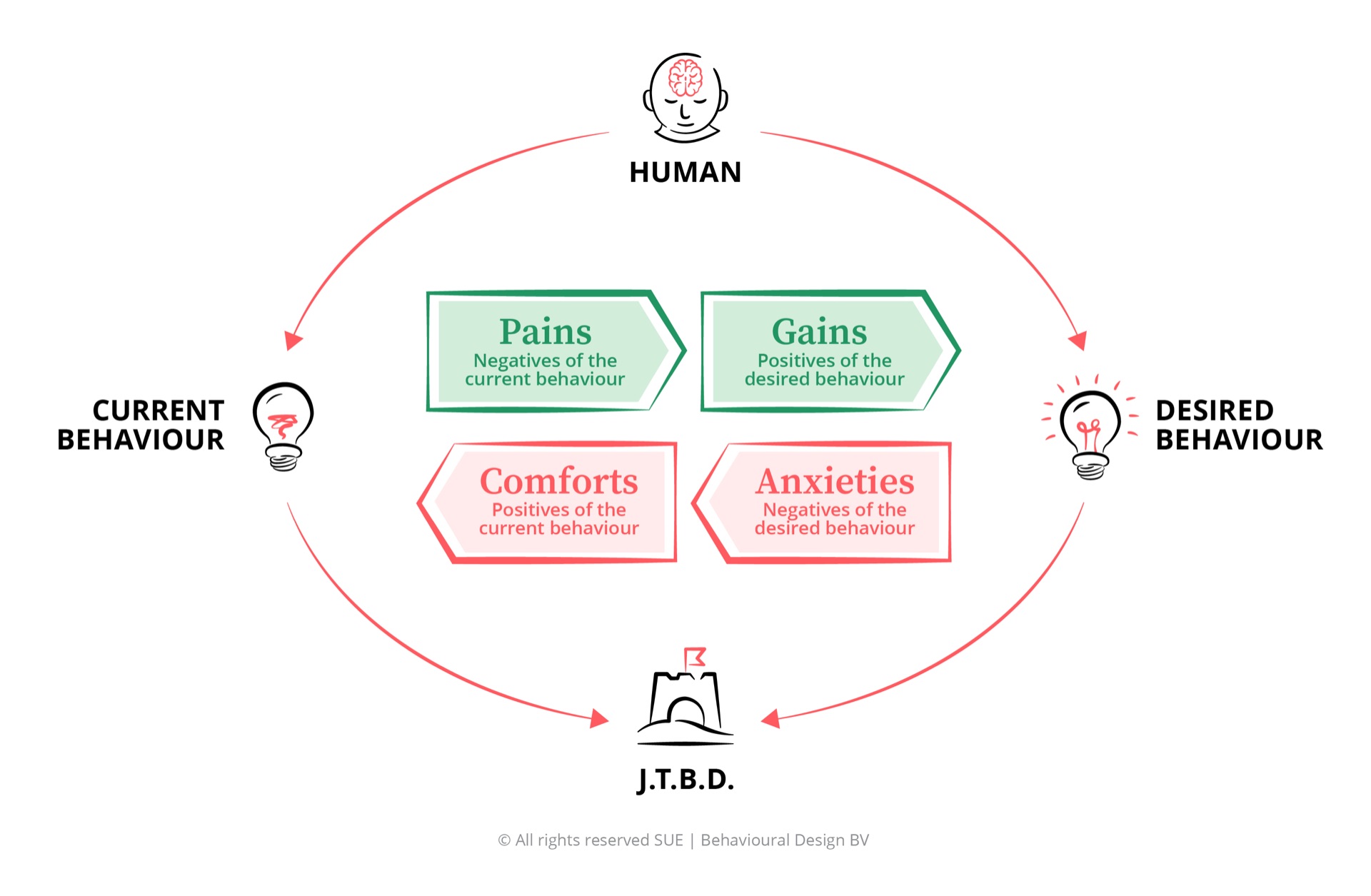
The comforts of doing it yourself are tangible and immediate: it is faster, you keep control, you know it will be done right, it feels productive. The gains of delegating are abstract and lie in the future: an independent team, more room for you, better decisions. Comforts almost always beat gains, because they are there every single day and they are certain.
On top of that comes the Fundamental Attribution Error: the tendency to attribute behaviour to the person rather than the situation.[4] A first-time leader who falls back into micromanaging is not "just a control freak". That person is responding to a context that rewards doing it yourself and punishes letting go. No training compensates for an environment that makes the wrong behaviour easy.
Skills decide what you can do. Context decides what you actually do. And under pressure, ability always loses to environment.

How do you develop these skills?
The solution is not to want it more, but to design the context so that the new behaviour becomes the easiest option. Five steps that make the difference.
1. Make your new role explicit
Write down in two columns the behaviour that made you valuable as a professional, and the behaviour your role now requires. "Solve it quickly myself" becomes "let someone solve it". "Be the expert" becomes "develop experts". By making the contrast visible, you know exactly which behaviour to unlearn. You cannot break a habit you have not named.
2. Start with two minutes
James Clear describes the two-minute rule in Atomic Habits: every new behaviour should take less than two minutes to start.[5] Applied to leading: don't start with a complete transformation of your style. Start with one question. At the end of every one-on-one, ask: "What do you need from me to be able to do this yourself?" That takes two minutes and installs a pattern of delegating instead of taking over.
3. Design your context
Change the structure that triggers your old behaviour. Block time for your team each week so development does not become an afterthought. Change the opening of your team meeting into a fixed question to someone other than you. Make delegation the default by assigning tasks to someone else as standard, unless there is a good reason to do it yourself. Defaults are the most powerful behavioural instrument that exists: the difference between 15% and almost 90% participation in organ donation lies entirely in the default.[6]
4. Ask for feedback on your behaviour
You don't know how you come across until you ask. Ask your team every two weeks three things: what should I keep doing, what should I stop, what should I start? It makes your own development visible and signals to your team that feedback here runs both ways. That is psychological safety in practice, not as a poster but as behaviour.
5. Build up step by step
Only add a new behaviour once the previous one has become routine. First the closing question in your one-on-ones. Then the fixed round in your meeting. Then the weekly feedback moment. Whoever tries to change everything at once changes nothing. Whoever stacks small habits builds a completely different leadership repertoire within a few months without it ever feeling heavy.
Frequently asked questions about first-time leadership
What is the most important skill for a first-time leader?
Letting go. Stopping doing the work yourself and starting to let others do it. Most first-time leaders are promoted because they excelled at execution, and that exact behaviour now becomes their trap. Whoever keeps doing what earned them the promotion becomes a bottleneck instead of a leader.
What skills does a new manager need?
Five behaviours form the foundation: letting go and delegating, making expectations explicit, giving feedback that changes behaviour, creating psychological safety, and prioritising by saying no. These are not innate traits but behaviours you design and practise.
Why is the move from professional to leader so hard?
Because it is not a knowledge problem but a behaviour problem. You have been rewarded for years for being the best at the work and now have to unlearn it. Unlearning is harder than learning: the old behaviour feels safe, fast and productive. Without a context that makes the new behaviour easy, you fall back under pressure to what you know.
Can leadership skills be learned or are leaders born?
You can learn them. Leadership is not a trait you either have or don't, but behaviour you show depending on the situation and the environment. That makes it designable: you shape the context so that good leadership behaviour becomes the easiest option.
How do I start as a first-time leader without feeling overwhelmed?
Start with one behaviour instead of a whole list of good intentions. Ask the same question at the end of every one-on-one: "What do you need from me to be able to do this yourself?" That takes two minutes and installs a pattern. Only add a new behaviour once the previous one is routine. Small habits that stick beat big intentions that fade.
Conclusion
Becoming a first-time leader is not a knowledge upgrade or a personality test. It is a behaviour change, and a demanding one, because you have to unlearn the very behaviour that earned you the role. The standard approach, handing new managers a list of skills, works on willingness but ignores the context that decides what they actually do.
That means: making your new role explicit, starting so small that failure is impossible, designing the structures around you, and asking for feedback on how you lead. Not because you lack the will to lead well, but because the context has to support the behaviour you are trying to adopt.
Want to learn how to apply behavioural science to leadership challenges? In The Art of Influence© you learn to apply the Influence Framework and SWAC Tool to delegation, feedback, team dynamics, and any behaviour challenge you face. Rated 9.3/10 by 10,000+ professionals.