Marketing psychology: what actually changes buying behaviour
Search for marketing psychology and you get lists. Twenty-five principles, seventeen triggers, nine biases every marketer must know. Reciprocity, anchoring, scarcity, loss aversion, all of it true, all of it useless on a Tuesday morning when you are staring at a campaign brief.
Because the list never tells you the one thing you need: which of those principles applies to your buyer, in this moment, for this decision. So the principle gets picked the way a tie gets picked. Something red, something urgent, ship it.
That is not marketing psychology. That is decoration with a scientific accent.
Marketing psychology is the applied study of how people actually decide to notice, consider and buy, and the use of those findings to design marketing. It works from evidence about attention, memory and context rather than from what buyers say about their reasons. Its unit of analysis is a decision moment, not a persona. More on Behavioural Design for marketing →
What is marketing psychology?
Classical marketing describes buyers. Age, income, attitudes, a stock photo and a name like Sophie, 34, urban professional. Marketing psychology studies what buyers do and what conditions make them do it.
The difference is not cosmetic. It changes what counts as an insight. In classical marketing an insight is a statement about a person. In marketing psychology an insight is a statement about a situation: at this point, this buyer faces this friction, feels this doubt and takes this shortcut.
That focus on situation comes from a body of work that predates the current interest by decades. Daniel Kahneman and Amos Tversky spent the 1970s showing that human judgement runs on shortcuts, and that those shortcuts are systematic enough to predict.[1] Kahneman later described the architecture as two systems: fast, automatic, effortless processing on one side, slow and deliberate reasoning on the other.[2] Almost everything marketing touches lands in the fast system first.
A buyer does not evaluate your message. A buyer glances at it, in a state you did not design, with attention you did not earn.
Once you accept that, a lot of standard marketing practice looks strange. We write arguments for a reader who is not reading. We optimise a value proposition for a decision that is being made in four seconds on a phone, in a queue.
Why most marketing psychology advice fails
The failure has a shape, and it repeats. Advice is written tactic-first. Here is the principle, here is a famous example, go and apply it. But a principle is a mechanism, and a mechanism only produces an effect when the conditions are right.
Scarcity is the clearest case. It shifts behaviour when the shortage is real and relevant to something the buyer already wanted. Bolt a countdown timer onto a product nobody wanted and you have not created urgency. You have created a reason to distrust the page.
There is a second failure, subtler and more expensive: asking buyers why. Adrian North, David Hargreaves and Jennifer McKendrick ran a study in a British supermarket where French and German music was played on alternate days above the wine display. French music days sold more French wine, German music days more German wine. When shoppers were asked afterwards whether the music had influenced their choice, the great majority said no.[3]
Read that again as a research budget line. The people in that aisle were not lying. They genuinely did not have access to the reason. Which means every focus group question that starts with "why did you choose" is collecting a story, not a cause. Marketing psychology exists precisely to work around that gap: observe behaviour, change the context, measure what moves.
The three layers marketing psychology actually works on
Useful marketing psychology separates three questions that lists tend to blur. Getting them in the right order saves most of the wasted work.
1. Memory: are you even in the running?
Long before persuasion, there is availability. Robert Zajonc demonstrated in 1968 that simple repeated exposure to a stimulus increases liking for it, with no argument and no reward attached.[4] Familiarity itself feels like quality, because processing something easily is experienced as a good sign.
Byron Sharp and the Ehrenberg-Bass Institute built a marketing model on top of that logic: brands grow mainly by being easy to think of and easy to buy, across a broad base of light buyers, rather than by deepening the loyalty of a small core.[5] It is an uncomfortable finding for anyone selling narrow targeting, and it has held up across categories.
2. Motivation: what job is this purchase doing?
Then comes the question of why anyone would move at all. People do not buy products, they hire them to make progress on something. That is the core of Jobs to be Done, and it is the difference between describing a product and describing the situation it resolves.
3. Moment: what happens in the four seconds that matter?
Only here do the famous principles apply. Anchoring, framing, defaults, social proof, friction. These are execution-level decisions about a specific screen, shelf or conversation. They are powerful and they are last. Applying them without layers one and two is why so much "psychology-driven" marketing produces a lift of nothing.
What the evidence says about persuasion at scale
If you want one finding that reorganises a marketing plan, take this one. Les Binet and Peter Field analysed hundreds of campaigns in the IPA effectiveness databank and found that emotionally led campaigns outperform rationally led ones on business effects over the long term, and that budget split matters: roughly 60 per cent to long-term brand building and 40 per cent to short-term activation is where effectiveness peaks for most brands.[6]
That is marketing psychology at portfolio level. Emotional work builds the memory structures that make later activation cheap. Activation-only marketing looks efficient in a dashboard and slowly makes every future click more expensive.
Zoom back in and the same logic governs a single page. Robert Cialdini catalogued the principles that make compliance more likely, from social proof to commitment and consistency, and the value of his work is not the list but the insistence that these are conditions you arrange rather than words you write.[7] Details on how the individual principles behave sit in our guide to cognitive biases in marketing and advertising.
One more finding worth keeping close. Dan Ariely, George Loewenstein and Drazen Prelec asked participants to write down the last two digits of their identification number before bidding on ordinary goods. Those arbitrary digits moved the bids, substantially and consistently, even though everyone knew the number meant nothing.[8] Willingness to pay is not a property of the buyer. It is partly a property of what the buyer saw thirty seconds earlier, which is both a warning and an instruction.
The forces behind a purchase
Mechanisms are only actionable once you know which force you are working against. The SUE | Influence Framework organises them into four: pains, gains, anxieties and comforts.[9]
Two of these push towards the purchase and two push away, and most marketing spends its whole budget on one side of the equation.
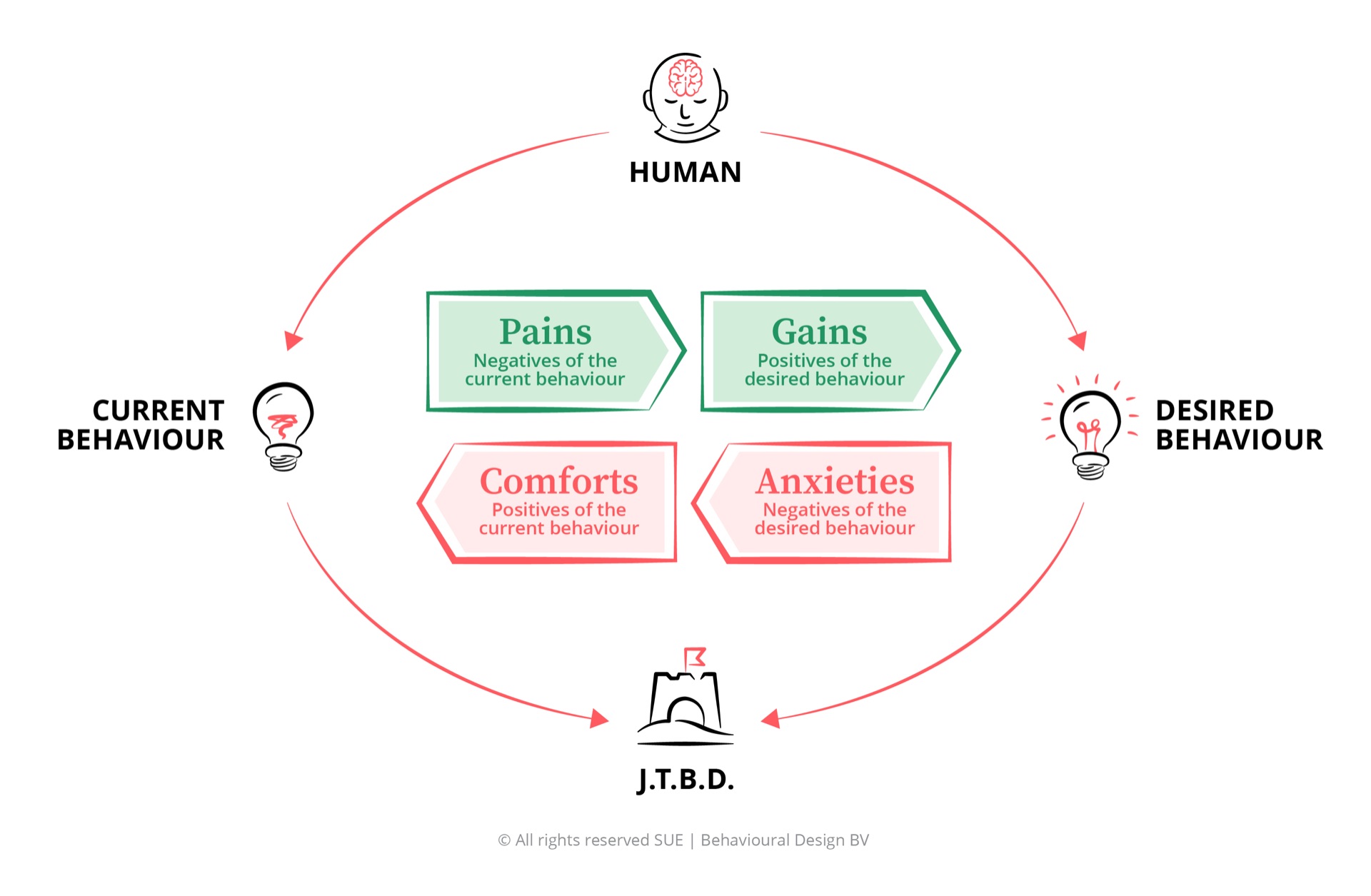
The pains are the friction in the buyer's current situation: the workaround that eats an hour a week, the product that keeps disappointing. Marketing that names the pain precisely gets attention that generic benefit copy never earns.
The gains are what the purchase makes possible. This is the part every brand is fluent in, and it is the least differentiating thing on the page, because every competitor is claiming it too.
The anxieties decide who abandons the basket. Will it fit. Will returning it be a nightmare. Will my colleagues think I overpaid. Anxieties are answered with evidence and guarantees, not with enthusiasm.
The comforts are the quiet winner of most competitive battles: doing nothing is easy, familiar and free. Your real competitor is usually the status quo, and the status quo has no marketing budget and does not need one.

How to apply marketing psychology, in five steps
This is the working sequence. It is deliberately boring, because the interesting part should be the finding, not the process.
1. Define one behaviour, not an objective. Not "increase brand consideration". Something countable and dated: renew the subscription before it lapses, book a demo from the pricing page, switch from the trial plan within fourteen days. If you cannot count it, you cannot design for it.
2. Find the moment. Where and when does that behaviour get decided? On a phone at 23:00, with a partner in the room. In an office, with a procurement form open. The moment carries more information than the demographic, which is also the argument for behavioural segmentation.
3. Map the four forces for that moment. Talk to people who recently did the behaviour, and to people who nearly did and then stopped. The second group is where the anxieties and comforts live, and almost nobody interviews them.
4. Design against the biggest force, not the easiest one. If the blocker is an anxiety about switching, another benefit headline will do nothing. Remove the risk instead: a rollback guarantee, a migration done for them, a named person to call.
5. Test the mechanism, not the wording. An A/B test between two headlines teaches you which sentence won. An experiment between two mechanisms, risk reduction versus gain amplification, teaches you something you can use for years. Build the habit and your conversion work starts compounding.
Where marketing psychology becomes manipulation
Every mechanism in this article works whether or not the product is any good. That is the honest problem at the centre of the discipline, and pretending otherwise is how the field earns its bad reputation.
The line is not the technique. It is the information asymmetry. Making a genuinely good option easier to choose is design. Making a poor option harder to evaluate is manipulation. A fake countdown, a pre-ticked insurance box, a cancellation flow with six screens: these all rely on the buyer not seeing what you did.
So use the test that survives a bad week: would this buyer, knowing exactly how the message was constructed, still be glad they bought? If the answer needs a caveat, you have designed a dark pattern and you know it.
Frequently asked questions about marketing psychology
What is marketing psychology?
Marketing psychology is the applied study of how people really decide to notice, consider and buy, used to design marketing. It draws on behavioural science, consumer research and memory research. The practical difference with classical marketing is the unit of analysis: marketing psychology studies a specific decision moment rather than a demographic profile, because context predicts choice better than description does.
What is the difference between marketing psychology and neuromarketing?
Neuromarketing measures physiological response, using eye tracking, EEG or skin conductance, to see how people react to stimuli. Marketing psychology is broader: it studies decision behaviour and its context, and mostly relies on field experiments and behavioural data. Neuromarketing is one measurement method inside the wider discipline, not a synonym for it. More on that in our piece on what neuromarketing is.
Does marketing psychology still work now that everyone knows the tricks?
The mechanisms keep working because they run on automatic processing, which knowing about them does not switch off. The tactics wear out. A countdown timer that once signalled genuine scarcity now signals a template. That is why the discipline matters more than the trick list: mechanisms are durable, executions are disposable.
Is marketing psychology manipulation?
It becomes manipulation when the technique only works because the buyer is missing information they would have wanted. A useful test: would this buyer, with full knowledge of how the message was built, still be glad they bought? Making a genuinely good option easier to choose is design. Making a bad option harder to evaluate is manipulation.
Conclusion
Marketing psychology is not a shelf of tricks you reach for once the campaign is written. It is a way of deciding what the campaign is for: one behaviour, one moment, four forces, one mechanism worth testing.
Do it in that order and the famous principles finally become useful, because you know which one you need. Do it in the other order and you get a countdown timer on a product nobody wanted.
Want to build campaigns this way? The online Deep Dive Behavioural Marketing Advanced teaches the full working method: forces, moments, interventions and experiments. Or learn the complete method in The Art of Influence©, rated 9.3/10 by more than 10,000 professionals.