Behavioural segmentation: segment on what people do, not who they are
Somewhere in your organisation there is a slide with four faces on it. Sophie, 34, urban professional. Mark, 52, value seeker. Each with an income bracket, a set of hobbies and a quote nobody ever said.
Now try to use that slide. Try to decide, from Sophie's face, whether to remove a step from the checkout, change the guarantee or shift the media budget. You cannot. The slide describes people beautifully and tells you nothing about what to do on Monday.
That is the whole problem with demographic segmentation, and it has been documented for sixty years.
Behavioural segmentation groups customers by what they do rather than by who they are: the job they are trying to get done, the trigger that starts their search, the barrier that stops them and the state they are in as a buyer. It produces segments you can act on, because each segment implies a different intervention. More on Behavioural Design for marketing →
What is behavioural segmentation?
Segmentation as a concept is old. Wendell Smith introduced it to the marketing literature in 1956 as an alternative to product differentiation: instead of one product shouted at everyone, several offers matched to distinct pockets of demand.[1] The idea was sound. What went wrong is what we chose to divide people by.
We divided by what was easy to measure. Age, income, postcode, household composition. Not because anyone believed those things caused purchases, but because that was the data the panels could sell.
Behavioural segmentation divides by something harder to collect and far more useful: observable behaviour and the situation that produced it. A segment is not "women aged 25 to 34". A segment is "people who start looking the week their contract renews and stop because they cannot tell whether their data transfers".
A demographic segment tells you who to talk to. A behavioural segment tells you what to change.
Read those two definitions again and notice what happened. The first is a media brief. The second is a product brief, a service brief and a media brief at once, and it already contains its own hypothesis.
Why demographic segmentation keeps failing
The criticism is not new and it did not come from behavioural science. Daniel Yankelovich made it in Harvard Business Review in 1964, arguing that demographic traits are weak predictors of buying behaviour and that companies should segment on values, needs and usage patterns instead.[2] Four decades later he returned to the subject with David Meer, noting that most companies still segmented on descriptors that had no link to what customers actually did, and calling for segmentation built on observed behaviour and willingness to pay.[3]
Between those two articles, Russell Haley proposed the practical alternative in 1968: benefit segmentation, grouping buyers by the benefit they are seeking rather than by their characteristics.[4] In his toothpaste research, buyers clustered around what they wanted from the product, decay prevention, taste, whiteness, price, and those clusters cut straight across age and income.
There is a second, structural reason demographic targeting disappoints, and it comes from the Ehrenberg-Bass tradition. Andrew Ehrenberg's repeat-buying work, later developed by Byron Sharp, showed that the customer bases of competing brands in a category look remarkably alike, and that brands grow mostly by reaching more light buyers rather than by owning a narrow demographic niche.[5] If your buyers and your competitor's buyers are demographically near-identical, a demographic segment cannot explain why anyone chose either of you.
The same reasoning explains why the biases catalogued in cognitive biases in marketing and advertising apply across segments rather than to one of them. They are properties of situations, and situations are what you should be segmenting.
Jobs to be Done as the segmentation frame
The most useful replacement for demography is a job. Clayton Christensen put it as a hiring decision: people do not buy products, they hire them to make progress in a particular circumstance.[6]
His fast-food example is worth retelling because of what the research team did, not because of the milkshake. A chain wanted to sell more milkshakes and had done the standard work: profile the milkshake buyer, ask that buyer what would improve the product, adjust thickness and flavour accordingly. Nothing moved.
So the team stopped profiling and started observing. They noticed a large share of milkshakes sold early in the morning, bought alone, taken away, in a car. The job was not dessert. The job was to make a long, dull commute survivable with one hand on the wheel, and to keep hunger away until lunch. The competition was not other milkshakes. It was bananas, doughnuts and bagels, each of which failed the job in its own way.[7]
Notice that the morning commuters and the parents buying a milkshake as an evening treat could be the same people. Same demographic, same person, two entirely different segments, because the situation differed. That is the whole argument for behavioural segmentation in one story. More on the frame itself in Jobs to be Done explained.
The four variables worth segmenting on
In practice, four behavioural variables carry almost all the useful signal. Each one is observable, and each one implies a different kind of intervention.
1. The job
What progress is this person trying to make? Two customers buying the same accounting software may be hiring it for completely different jobs: one wants to stop dreading the quarterly VAT return, the other wants to look credible to an investor. The first needs reassurance and automation; the second needs reporting that looks serious. Same product, two segments.
2. The trigger
What starts the search? A contract renewal, a house move, a bad experience, a colleague leaving, a regulator's letter. Triggers are the most underused variable in marketing because they determine timing, and timing determines whether your message is relevant or noise. Segment by trigger and your media planning changes shape.
3. The barrier
What stops people who wanted to buy? Switching costs, uncertainty about compatibility, fear of looking foolish, an approval they have to ask for. Barrier segments are the highest-return group because they are made of people who already want what you sell. Nothing in a demographic dataset will ever reveal them.
4. The behavioural state
Where is this person in relation to the behaviour: never done it, tried once, does it regularly, used to and stopped? A lapsed user and a never-user look identical on a demographic slide and need opposite treatment. One needs a reason to return, the other needs a reason to start.
The forces inside a segment
A behavioural segment becomes designable once you know which force holds it in place. The SUE | Influence Framework sorts them into pains, gains, anxieties and comforts.[8]
Run the four forces per segment and something useful happens: segments that looked similar turn out to be blocked by completely different things.
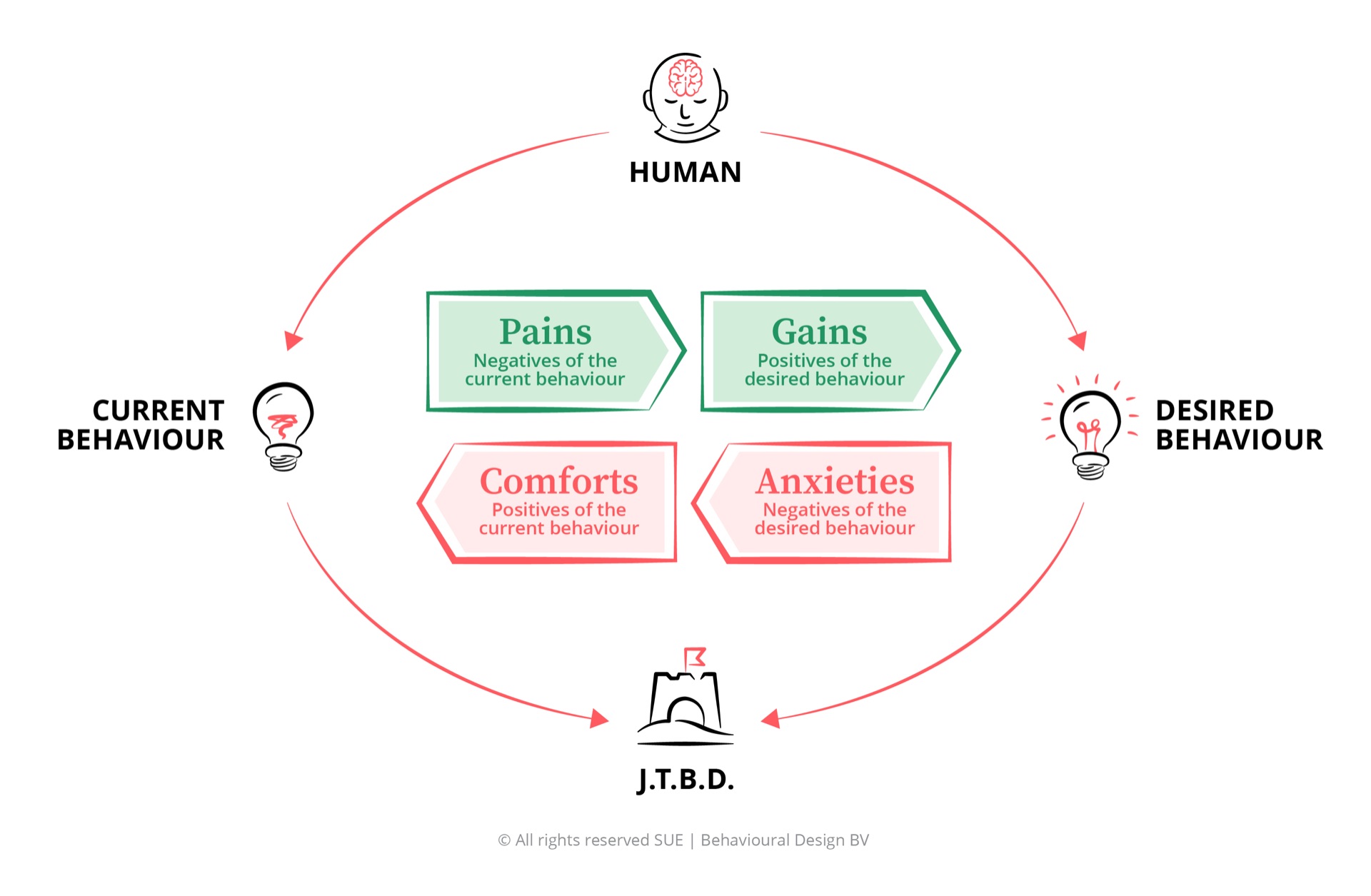
One segment may be dominated by anxieties: they want to move but cannot carry the risk. Give them proof, guarantees, a reversible first step.
Another may be dominated by comforts: the current situation is mediocre but frictionless. Nothing you say about benefits will beat that. You have to make switching absurdly easy, or make the cost of staying visible.
A third may have large pains and no idea a solution exists. That segment needs category education, not a discount.
Three segments, three completely different budgets. Try deriving that from a postcode.

How to build a behavioural segmentation in five steps
1. Start from behaviour you can count. Pull the behaviours that already exist in your data: who bought after a trial, who abandoned at which step, who came back after twelve months, who upgraded. This is your raw material, and it is free.
2. Interview the switchers, both directions. Talk to people who recently bought and to people who nearly bought and did not. Ask what happened, in order, from the first moment they noticed a problem. Do not ask why they chose you; ask what they were doing when they started looking. The story gives you jobs and triggers; the near-misses give you barriers.
3. Cluster on situation, not on person. Group the stories by job plus trigger. You will usually end up with three to five clusters. If two clusters would receive the same intervention, merge them. A segment that does not change a decision is decoration.
4. Size each segment with the data from step one. Qualitative work finds the segments; behavioural data tells you how many people are in them and what they are worth. Skipping this is how organisations end up designing for a vivid segment of eleven people.
5. Write one intervention per segment, then test it. Each segment should produce a single testable change: a different first step, a removed field, a guarantee, a message tied to the trigger. That is where segmentation meets conversion work, and it is the only proof that your segmentation is real.
What behavioural segmentation is not
It is not a persona with better adjectives. If your output is a document about a fictional person's weekend habits, you have made a mood board.
It is not the same as behavioural targeting either, despite the shared word. Behavioural targeting is an advertising technique that serves ads based on browsing history. Behavioural segmentation is a strategic model of demand that informs product, service, pricing and message, and it works perfectly well without a single tracking cookie.
And it is not permanent. Jobs shift, triggers change, barriers get removed by a competitor. A segmentation is a hypothesis with a shelf life, and the shelf life is shorter than the slide deck suggests. Revisit it when the behavioural data stops matching the story, which is also the honest signal that marketing psychology is doing its job.
Frequently asked questions about behavioural segmentation
What is behavioural segmentation?
Behavioural segmentation groups customers by what they do rather than by who they are: the job they are hiring your product for, the trigger that starts their search, the barrier that stops them, and their state as a buyer. It produces segments you can act on, because each one implies a different intervention rather than a different tone of voice.
Why does demographic segmentation fail?
Because demographics describe people rather than situations, and situations drive choice. Daniel Yankelovich argued as early as 1964 in Harvard Business Review that demography is a weak predictor of buying behaviour. Two people with identical profiles buy differently in different moments, and the same person buys differently on a Tuesday morning than on a Friday night.
What is the difference between behavioural segmentation and personas?
A persona describes a fictional individual: age, job title, hobbies, a stock photo. A behavioural segment describes a recurring situation: this job, this trigger, this barrier. Personas tell you how to write; behavioural segments tell you what to change. A persona can be made more behavioural by replacing the biography with a job, a trigger and a barrier.
How many behavioural segments should you have?
Fewer than most teams expect. Three to five is usually the working range, and each one must earn its place by implying a different intervention. If two segments would receive exactly the same campaign, the same product change and the same message, they are one segment with two names.
Conclusion
The test for any segmentation is embarrassingly simple. Hand it to someone who has to make a decision this week and see whether it helps them choose. Sophie, 34, urban professional never has.
Segment on the job, the trigger, the barrier and the state, and every segment arrives with its own instruction attached. That is not a nicer way to describe your customers. It is a different thing entirely: a map of where behaviour is stuck, and what to do about it.
Want to build one? The online Deep Dive Behavioural Marketing takes you through jobs, triggers, barriers and interventions with real cases. Or learn the full method in The Art of Influence©, rated 9.3/10 by more than 10,000 professionals.