Micromanagement is a symptom, and the cure is not trust
Almost nobody thinks they micromanage. Almost everybody has worked for someone who did.
That gap is the interesting part. It suggests the behaviour does not feel like control from the inside. It feels like being responsible for something you cannot see.
Which matters, because the standard advice is aimed at the wrong thing. Trust your team more. Step back. Let go. All of that asks a manager to accept more risk without doing anything about the risk.
Micromanagement is a pattern in which a manager controls the detail of work that has been delegated. It gets explained as a personality trait. It behaves like a response to missing information: when you cannot see how work is going, checking is the only way left to reduce uncertainty. More on behavioural design for managers →
What is micromanagement?
Not attention to detail, and not high standards. Micromanagement is the retention of decisions that were supposed to have moved. The work has been handed over; the judgement has not.
In practice it shows up as a pattern rather than an incident: being copied on everything, approving things that do not need approving, rewriting a colleague's draft rather than commenting on it, and asking for updates on a rhythm that matches the manager's anxiety rather than the work.
The cost is well documented and it lands in an unexpected place. Robert Karasek's demand-control model, published in 1979 and one of the most replicated findings in occupational health, shows that strain is driven by the combination of high demands and low decision latitude.[2] High demands with control over how you meet them is challenging work. High demands without that control is where the damage is.
So micromanagement does not simply annoy people. It converts demanding work into harmful work by removing the one variable that made it bearable.
Nobody sets out to micromanage. They set out to stop being surprised.
Why "trust your team more" does not work
Take the advice literally and you are asking someone to feel differently about a situation that has not changed. Feelings are a poor lever. And the manager's problem is usually real.
Consider what a manager is accountable for and what they can actually observe. They will answer for the delivery date, the quality, and the thing nobody spotted. What they can see is a status column in a tool, updated on Fridays, by people who are optimistic by disposition and by incentive.
Under those conditions checking is not irrational. It is the only instrument available. Remove it without providing another one and you have not created autonomy; you have created a manager who is anxious and quiet, which lasts about three weeks.
Two well-documented biases make the situation worse. Ellen Langer's work on the illusion of control showed that people systematically overestimate their influence over outcomes, especially when they are personally involved.[3] Being close to the work feels like affecting it. And the Dunning-Kruger findings on self-assessment help explain why managers rarely recognise the pattern in themselves: the skill needed to judge your own management behaviour is the one you are short of.[4]
What it costs on the other side of the desk
The effect on the person being managed is more specific than "demotivating".
Edward Deci, Richard Koestner and Richard Ryan's meta-analysis of 128 experiments showed that controlling conditions reliably undermine intrinsic motivation, and that the effect is strongest when the control is experienced as pressure to behave in a particular way.[1] The mechanism is that ownership moves. Once someone believes the outcome is the manager's call, the effort required to care drops away.
There is a second effect, and it is the expensive one. Amy Edmondson's research on psychological safety found that teams differ sharply in whether people believe it is safe to report a problem, and that this belief predicts learning behaviour.[5] Close supervision teaches people that visibility is dangerous. So they stop volunteering the early warning, and the manager who was checking constantly ends up with less information than the one who was not.
That is the trap in one sentence. Checking reduces uncertainty in the short term and increases it over time, which prompts more checking.

The forces acting on the manager
Design for the manager, not against them. The SUE | Influence Framework sorts the forces into pains, gains, anxieties and comforts.[6]
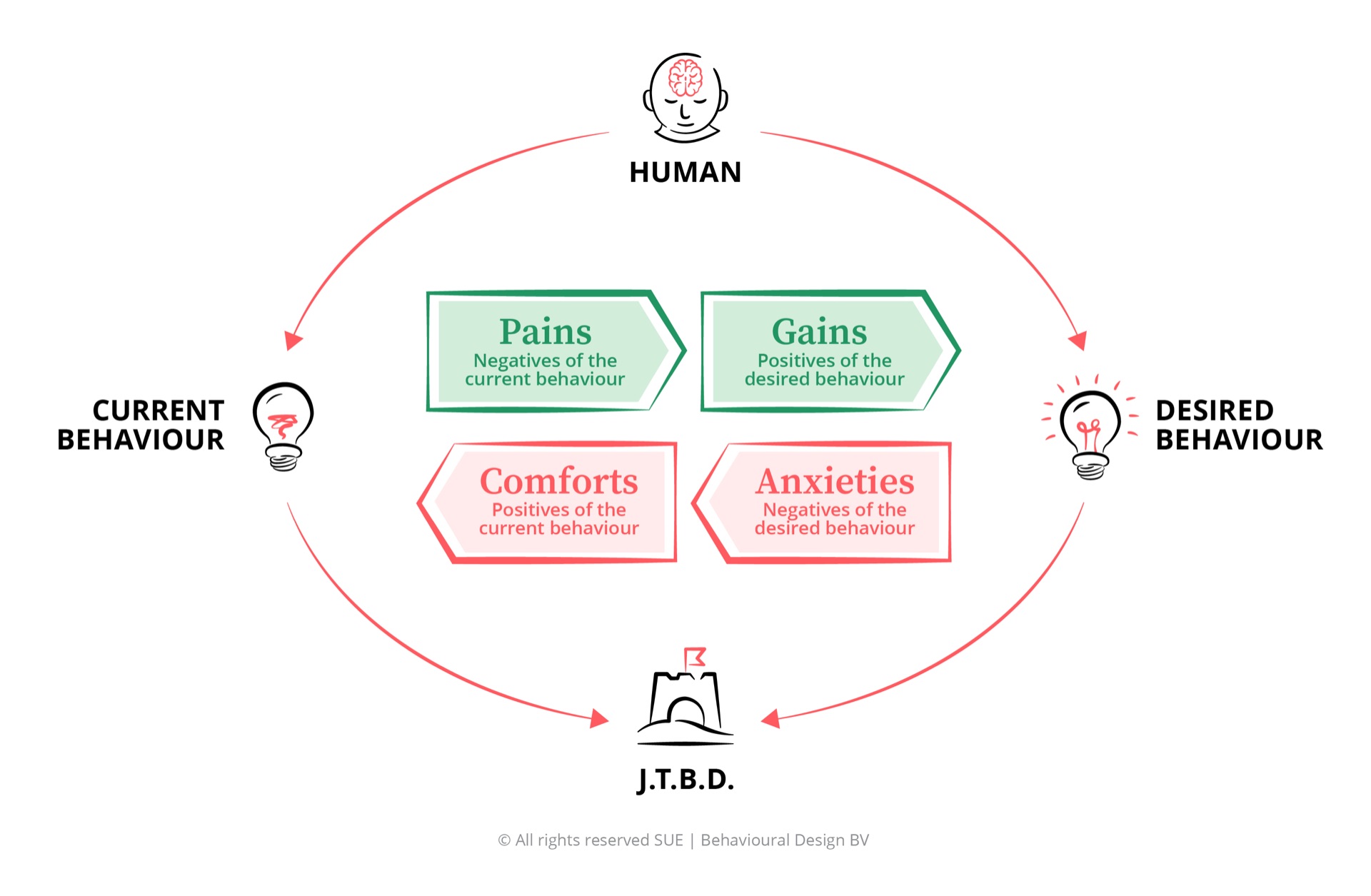
The pains of letting go are immediate and personal: being asked a question in a meeting and not knowing the answer, and carrying accountability for something you last saw two weeks ago.
The gains of stepping back are real but slow. A team that grows, time back, better decisions closer to the work. None of that arrives this week, and all of it is invisible while it is happening.
The anxieties are what actually drive the behaviour. If this goes wrong, I will be asked why I did not know. There is usually a specific memory attached: one project, one meeting, one moment of being caught out.
And the comforts of checking are considerable. It feels like working. It produces something to say when asked. And it is completely defensible, because nobody has ever been criticised for knowing too much about their own team's work.
Read that balance and the design problem becomes clear. You are not trying to make someone trust more. You are trying to give them a way of knowing that does not require interrupting.
Five things that reduce checking
All of these give the manager information. That is the point.
1. Agree what "done" means before the work starts
Most checking is a search for a definition that was never agreed. Write down what finished looks like, including quality, before anyone begins. Ambiguity about the destination guarantees involvement in the route.
2. Replace status updates with a visible artefact
A weekly update is a report about work. A shared document, board or environment that shows the actual work is information without interruption. The manager can look whenever the anxiety arrives, at three in the morning if necessary, and nobody is disturbed.
3. Define the decision rights explicitly
List what the person decides alone, what they decide and tell you, and what they bring to you first. Three categories, written down, five minutes. Most micromanagement is a boundary dispute that nobody has ever had out loud.
4. Design an early warning that is safe to give
The manager fears being surprised; the team fears reporting problems. Both are solved by the same mechanism: an agreed signal that means "this is going off track" and a promise about what happens next. Then reward its use visibly the first time it is used, because that first response sets the norm.
5. Schedule the checking
If the impulse arrives daily, do not tell the manager to suppress it. Give it a slot. A fixed fifteen minutes at a known time is a fraction of the disruption of six unpredictable interruptions, and it gives the anxiety somewhere to go.
If you are the one being micromanaged
You can do more about this than the situation suggests, because you can supply the missing information before it is requested.
Report before you are asked. An unprompted two-line update on Monday morning costs you almost nothing and removes the reason for Wednesday's interruption. It also changes who is in control of the rhythm.
Then be specific about what you want to decide. "I would like to make the call on X and tell you afterwards" is a proposal that can be accepted or refined. "I need more autonomy" is a complaint, and it will be received as one.
And name the anxiety rather than the behaviour. "What are you worried might go wrong here?" gets a usable answer more often than "you are micromanaging me", which gets a defence. Once the specific fear is on the table, you can design against it together, which is a much shorter conversation than the one about trust.
Frequently asked questions about micromanagement
What causes micromanagement?
Usually missing information rather than a need for control. A manager is accountable for outcomes they cannot observe directly, and checking is the only instrument they have. Ellen Langer's work on the illusion of control adds a second layer: being close to the work feels like influencing it, which makes involvement feel productive even when it is not.
Why is micromanagement so damaging?
It removes decision latitude while leaving the demands intact, and Robert Karasek's research identified precisely that combination as the driver of strain. On top of that, Deci, Koestner and Ryan's meta-analysis of 128 experiments showed that controlling conditions reliably undermine intrinsic motivation. The work stays hard and the ownership disappears.
How do I know if I am micromanaging?
Look at behaviour rather than intention. Are you copied on things you never act on? Do you rewrite work instead of commenting on it? Is the update rhythm set by the work or by your own unease? A more reliable test: ask your team what they decide without you, and see whether their answer matches yours.
How do you stop micromanaging?
Give yourself another way of knowing. Agree what done means before work starts, replace status updates with a visible artefact you can consult at any time, write down which decisions belong to whom, and schedule the checking instead of suppressing it. Trusting more is an outcome of those changes, not a method.
What should I do if my manager micromanages me?
Supply the information before it is requested, propose specific decision rights rather than asking for autonomy in general, and ask what they are worried about. The fear is usually concrete and often traces back to one incident. Once it is named, it can be designed against.
Conclusion
Micromanagement is the behaviour of someone who is accountable for something they cannot see. Told to trust more, they hear: accept more risk and do nothing about it. So they nod, and keep checking.
Give them a way of knowing that does not require interrupting, and the checking stops on its own. Define done before the start, make the work visible instead of reported, write down who decides what, and make the early warning safe to give.
Nobody needs to become a different person. The information just needs to arrive without a question attached.
Want to design how your team decides and reports? The online Deep Dive Leading Change teaches you to apply behavioural science to leading people: from resistance to follow-through.