The onboarding process is the cheapest week you will ever get
Think about what a new colleague actually did in their first week with you. Not what the plan said. What they did.
In most organisations the honest answer is: collected a laptop, sat through introductions to people whose names they will not retain, read policy documents, and waited for access to something.
Meanwhile the thing you cannot buy back was quietly being spent. For about two weeks, a new person has no habits here yet. Everything they will later do automatically is still an open question. That window closes, and it does not reopen.
An onboarding process is the sequence a new employee goes through in their first weeks. Most versions optimise for information and administration. The behavioural evidence points somewhere else: at what someone gets to contribute, who they actually meet, and what happens the first time they get something wrong. More on behavioural design for HR →
What is an onboarding process?
Formally, it is everything between signing and being fully productive. In practice it is usually a checklist that belongs to three departments at once: IT provides access, HR provides documents, and the team provides a lunch.
Talya Bauer, who reviewed the research for the SHRM Foundation, grouped the components into compliance, clarification, culture and connection.[3] Most processes handle the first two well, because they are concrete and someone owns them. The last two get a welcome email and a hope.
The problem with the checklist framing is not that it is wrong. It is that it optimises for the wrong scarcity. Information can be transferred at any point in the first year. The open window for setting behaviour cannot.
A new colleague spends two weeks deciding how things are done here. Most organisations spend those two weeks handing out logins.
Why the first weeks decide so much
Two mechanisms make this period unusually powerful, and both work whether or not you use them deliberately.
The first is that behaviour becomes automatic through repetition in a stable context. Phillippa Lally and colleagues tracked people forming everyday habits and found it took a median of 66 days for an action to become automatic, with wide variation depending on the behaviour.[4] Whatever a new colleague repeats in their first weeks, including asking permission for everything or never asking anything, is being laid down while the ground is still soft.
The second is that people read the rules from what they observe, not from what they are told. John Van Maanen and Edgar Schein described organisational socialisation as a set of tactics that teach newcomers what is acceptable here, most of them informal and unplanned.[2] The handbook says speak up. Whether someone speaks up depends on what they saw happen in week one when somebody else did.
Which is why the moment worth designing most carefully is the first mistake. Amy Edmondson's work on psychological safety showed that teams differ enormously in whether people believe it is safe to admit an error, and that this belief predicts learning behaviour.[5] A new colleague learns your team's answer to that question in a single afternoon, from one reaction.
The strongest evidence we have on onboarding
The most useful study on this is also the most inconvenient for the standard approach.
Daniel Cable, Francesca Gino and Bradley Staats ran a field experiment at a large Indian call centre.[1] One group got the usual induction: the organisation, its values, its way of doing things. A second group spent part of that same time on something else. They were asked to think about what was distinctive about themselves, what they were good at, how they would use those strengths in the role, and they were given a badge and a sweatshirt with their own name on it.
Seven months later the second group was still there in noticeably greater numbers, and customers rated their service higher. The published figure is a 32 per cent lower attrition rate than the group that received the standard induction.
What is striking is how little was changed. Not the pay, not the manager, not the work. About an hour of the first day was moved from telling people who the organisation is to asking people who they are.
The mechanism the authors propose is straightforward. Standard socialisation asks newcomers to set aside their own identity and adopt the organisation's. That takes continuous effort, and effort that goes into fitting in is not available for the work. When people can bring their actual strengths, the cost disappears.

The forces acting on someone in week one
Before you rewrite the schedule, map what the first days actually feel like from the inside. The SUE | Influence Framework sorts those forces into pains, gains, anxieties and comforts.[6]
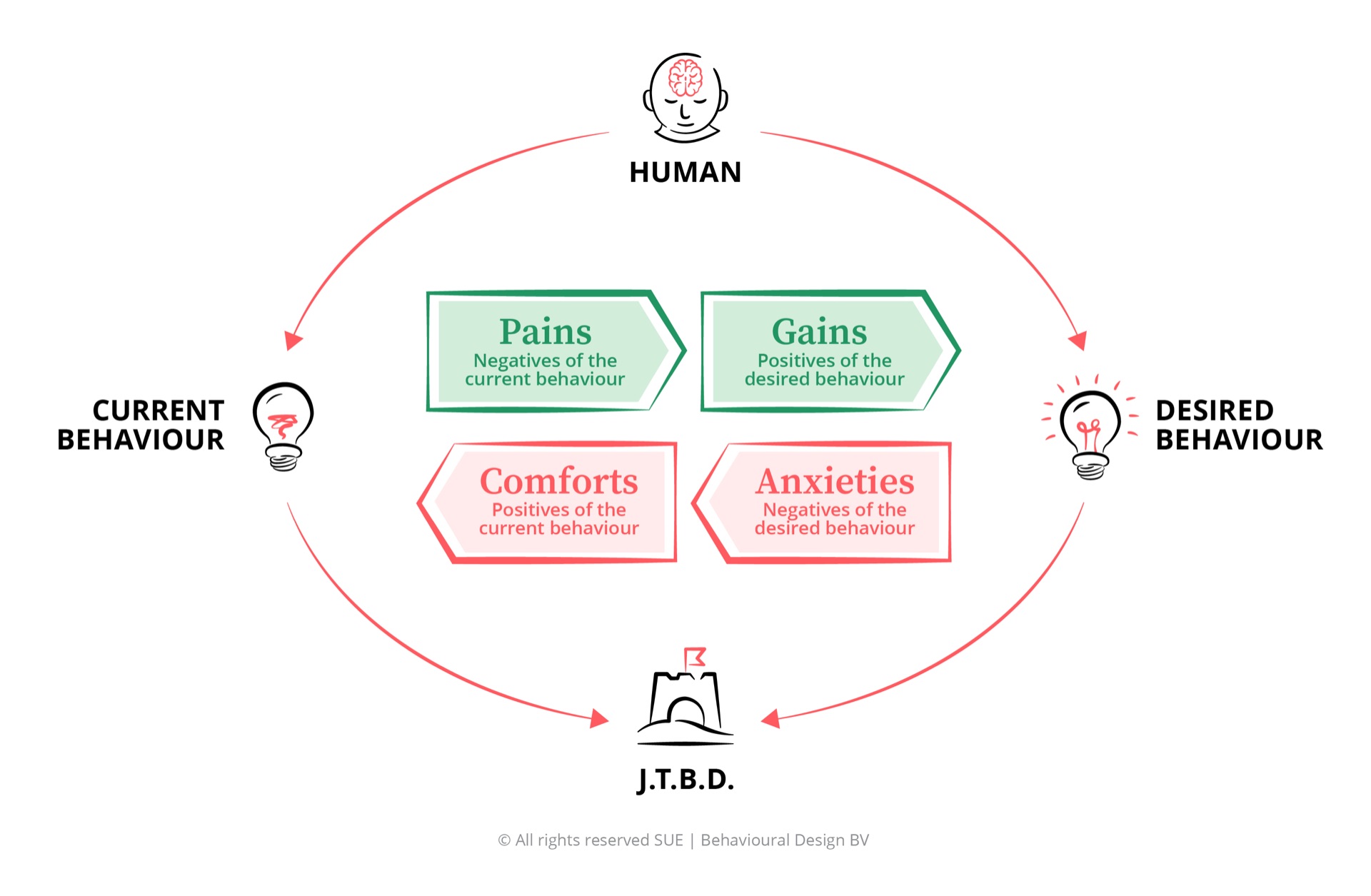
The pains are practical and constant: not knowing where anything is, not knowing whose time you are allowed to take, and the low-level exhaustion of having to ask about things you would normally just do.
The gains people want in week one are smaller than we assume. Not purpose or vision. Being useful once. Saying something in a meeting that lands. Finishing something.
The anxieties dominate everything else, and they are the same in every organisation: am I going to look stupid, was this the right move, and does this team already have an opinion about me.
And the comforts are what a nervous person reaches for by default: reading documentation instead of talking to people, waiting to be asked instead of offering, and staying safely inside the task rather than near the edge of it.
Notice that the default comforts are exactly the behaviours you do not want to make automatic. Left undesigned, week one teaches caution.
What to design instead, day by day
Six things, none of which requires a budget or a platform.
1. Something real, finished, in week one
Give a genuine task that reaches an end inside the first five days. Small is fine, trivial is not. It has to be something a colleague was actually waiting for, so that the finishing means something. Contribution before absorption.
2. A named person for stupid questions
Not a mentor with a programme. One colleague whose explicit job it is to be interrupted, told to the newcomer by name on day one. This single move removes the biggest daily cost of being new, which is calculating whose time you are allowed to take.
3. Ask what they are good at, and use it that week
This is the Cable and Gino intervention, and it takes half an hour. Ask what they do best, where they have been told they are unusually strong, and then find something in the first fortnight that uses it. The asking matters less than the using.
4. Design the first mistake before it happens
It will happen in the first month. Decide now how the team responds: what gets said, by whom, and in front of whom. A manager who says "good, now we know" in front of the others teaches the whole room something a values poster cannot.
5. Introduce fewer people, properly
Twenty names in two days produces zero relationships. Five people, each with a reason attached and a scheduled twenty minutes, produces five. Talya Bauer's connection component is the one most often reduced to a lunch, and it is the one that predicts whether someone embeds.
6. Ask on day thirty what was strange
A new colleague can see your organisation clearly for about a month, then the strangeness fades and they stop noticing. That month is a free audit of everything you have stopped questioning. Ask, write it down, and act on one thing.
What to stop doing
The list of what to remove is shorter and easier, and it buys the time for everything above.
Stop front-loading information that is available on demand. Policies, systems, the history of the company: none of it needs to be delivered in week one, and almost none of it is retained when it is. Move it to the point of need.
Stop introductions without a purpose. A tour of desks teaches names that will be forgotten by Thursday and costs a morning.
And stop treating the first day as the milestone. The day someone finishes something that mattered is the milestone. Design towards that, and the rest of the process arranges itself around it.
Frequently asked questions about the onboarding process
How long should an onboarding process take?
Longer than most and lighter than most. The behavioural work is concentrated in the first two to four weeks, when habits are still forming, and Phillippa Lally's research on habit formation suggests automaticity develops over a couple of months rather than days. Spread the information across that period instead of compressing it into week one.
What is the most important part of onboarding?
Contribution. Cable, Gino and Staats found that letting newcomers use their own strengths, rather than absorbing the organisation's identity first, produced 32 per cent lower attrition after seven months in a call centre field experiment. Finishing something real in the first week does more than any amount of induction.
What do most onboarding processes get wrong?
They optimise for information transfer, which can happen any time in the first year, and neglect the one thing that is genuinely time-limited: the window in which behaviour is still open. Systems and policies crowd out contribution, connection and the response to the first mistake.
How do you onboard remote employees?
The same principles apply, with the informal parts made explicit. Remote newcomers miss the accidental learning that happens near other people, so the named person for questions, the scheduled introductions with a reason attached, and the visible response to a first mistake all need to be deliberately arranged rather than left to happen.
How do you measure whether onboarding works?
Not with a satisfaction survey in week two, which mostly measures politeness. Count how many new starters finished something real in their first five days, whether they can name the person to ask, and how many are still there at nine months. Those three tell you more than any onboarding score.
Conclusion
Every organisation gets the same two weeks with a new colleague, and they are the only two weeks in which nothing about how that person works here has been decided yet.
Spend them on laptops and policy and you will have taught caution by Friday. Spend them on one finished task, one named person to interrupt, and a deliberate response to the first mistake, and you have set defaults that hold for years.
It is the cheapest design work available in an organisation, and it is almost always given to whoever has time.
Want to design the whole employee journey this way? The online Deep Dive The Behavioural Advantage in Talent Management shows you how to apply behavioural science across hiring, onboarding, appraisal and retention.