Presentation skills: design the decision, not the delivery
Think of the last proposal you presented that went nowhere. Not the one that was rejected, the one that got a warm reception, some nodding, a few good questions, and then the sentence that ends more initiatives than any budget cut: let's pick this up again after the summer.
Nobody said no. Nothing happened.
Almost all advice about presentation skills is aimed at the forty minutes you are speaking: your posture, your voice, the number of slides, the story arc. Meanwhile the outcome is decided in the ten minutes afterwards, when a room full of people works out whether saying yes is worth the trouble. That part is designable too, and hardly anyone designs it.
Presentation skills are usually described as the delivery techniques that make a speaker clear and confident. A more useful definition is the ability to design the decision your audience makes once you stop talking: what your proposal gets compared to, what you ask for, and how easy the next step is. Delivery is what people notice. Design is what they act on. More on behavioural design for communication →
What are presentation skills?
The standard list is familiar enough: structure, eye contact, pace, storytelling, handling questions, using visuals well. All of it is genuinely useful, and none of it addresses the moment that decides whether your work goes anywhere.
Look at what a presentation actually is. You are asking a group of people to spend money, time, attention or political capital on something that does not exist yet. They will make that call quickly, largely automatically, and mostly by comparison: against what they are doing now, against the last proposal they backed, against the two other things competing for the same budget.
Which means your real material is not your delivery. It is the comparison you set up, the request you make, and the size of the first step you ask for.
Your audience is not judging your talk. They are judging what saying yes will cost them on Monday.
Why delivery training falls short
Two problems sit underneath most presentations that fail, and neither is solved by rehearsing.
The first is that you know too much. In 1990 Elizabeth Newton ran a study at Stanford in which one participant tapped out a well-known tune on a table and another tried to name it. The tappers expected roughly half their listeners to get it. About two and a half per cent did.[1] In the tapper's head the melody is playing in full. The listener hears knocking. You have lived with your proposal for three months; your audience is meeting it at ten past two, between two other meetings, with the melody entirely absent.
The second is that we use slides to reassure ourselves rather than to inform anyone. Richard Mayer's work on multimedia learning found a consistent effect: presenting the same words on screen and out loud reduces how much people absorb, because both compete for the same processing channel.[2] The dense slide feels safe to the presenter for exactly the reason it fails the audience.
Fix both and you have a clearer presentation. You still may not have a decision, because clarity was never the binding constraint. The constraint is that your proposal has to beat doing nothing, and doing nothing never has to justify itself.
How audiences actually decide
Four mechanisms do most of the work in the room, and you can design for all of them.
The comparison sets the value. Amos Tversky and Daniel Kahneman demonstrated in 1981 that people reverse their preference between two identical outcomes depending on whether the outcome is described as lives saved or lives lost.[3] Nothing about the facts changed, only the reference point. Your proposal has no absolute value either. It only has a value relative to whatever it is being held up against, and if you do not choose that comparison, the room will choose one for you.
The first number sticks. Tversky and Kahneman also showed how strongly an arbitrary number pulls later estimates towards it.[4] In a meeting that means the first budget mentioned, yours or someone else's, becomes the scale everything else is measured on.
Doing nothing is the strongest competitor in the room. William Samuelson and Richard Zeckhauser named this the status quo bias in 1988: across a series of experiments, simply labelling an option as the current state made people far more likely to choose it.[5] The status quo also has a political advantage. Nobody gets blamed for the failure that was already happening.
More options mean fewer decisions. Sheena Iyengar and Mark Lepper found that shoppers offered twenty-four jams were about ten times less likely to buy than shoppers offered six.[6] The slide with seven possible directions feels thorough. It reads as unresolved, and an unresolved proposal gets postponed.
The forces acting on the person who has to say yes
Before you build the deck, map what the decision costs the people in the room. The SUE | Influence Framework sorts those forces into pains, gains, anxieties and comforts.[7]
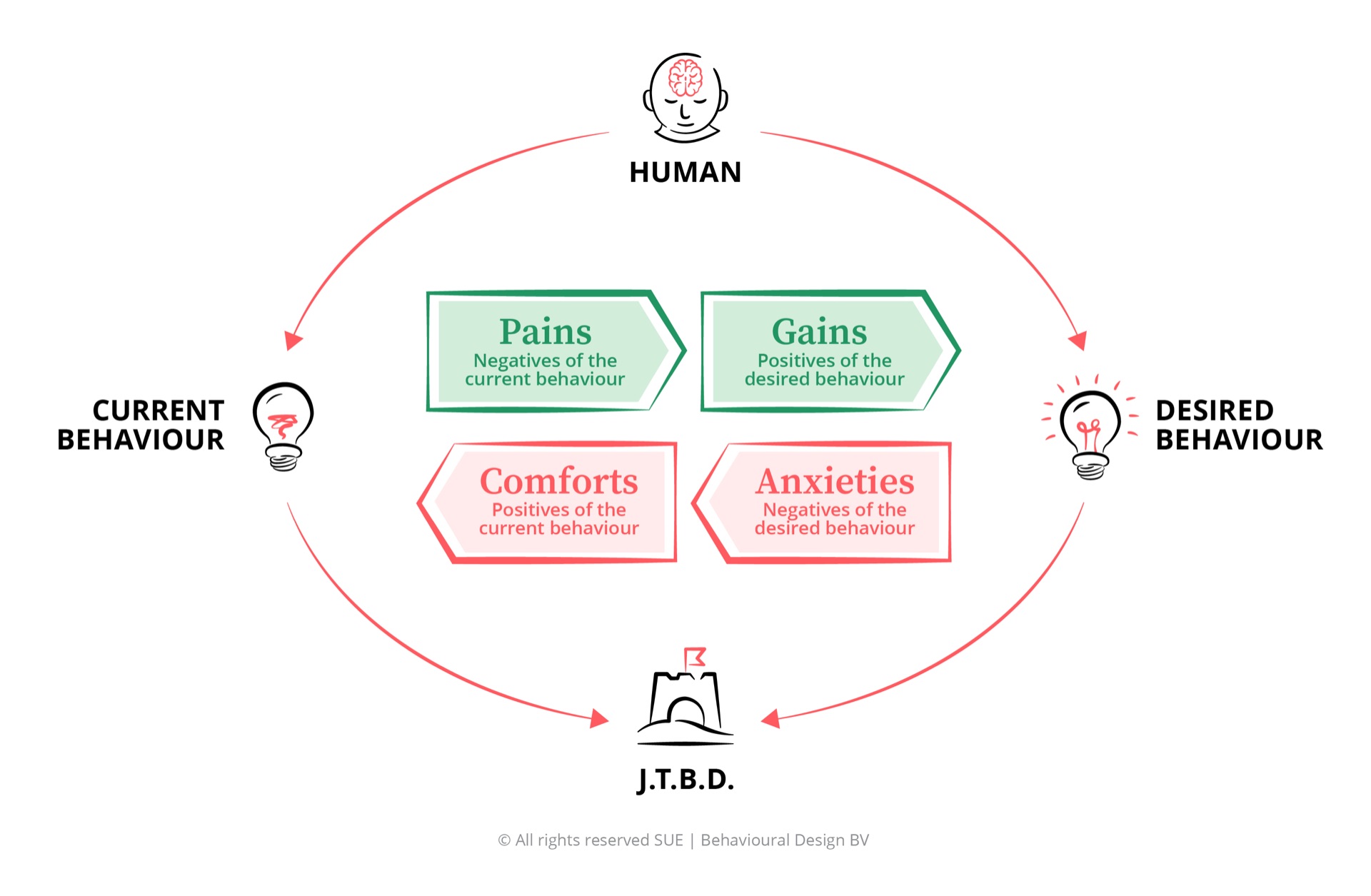
The pains are the ones you tend to lead with: the problem you have documented, the numbers that are heading the wrong way. Useful, but familiar to everyone in the room, and familiar pain is remarkably easy to tolerate.
The gains arrive later and belong partly to someone else. Your proposal pays off next year, quite possibly under a different sponsor, while the effort lands in this quarter and on this team.
The anxieties are where most proposals die, and they are rarely spoken aloud. What if it does not work and I championed it. What does this do to my own roadmap. Who loses something here, and will they hold it against me.
The comforts of postponing are excellent. Asking for more analysis looks rigorous, costs nothing, upsets nobody, and buys three months.
Read that balance and you can see why a better-delivered version of the same deck changes so little. You have not shifted a single force.
How to design the decision
Six moves. All of them happen on paper, before you rehearse anything.
1. Open with the decision, not the context
Start with the sentence "I am asking you to decide X today." From that moment people listen as decision-makers rather than as an audience, and they listen for what they need in order to say yes. The alternative, twelve minutes of background first, trains the room to sit back and evaluate.
2. Choose the comparison before the room does
Your proposal will be measured against something. Name it. Against last year's approach, against the competitor who already did it, against what the same money buys elsewhere. A proposal that arrives without a comparison gets compared to whatever is most convenient for the person with the least appetite for change.
3. Put a price on doing nothing
Quantify the status quo in the same units as your proposal. Not "we are losing ground", but "at the current rate this is a hundred and forty thousand a year, and the gap has widened each quarter for six quarters". Make waiting an option with a number on it, rather than the neutral background against which your number looks large.
4. Bring three options, and a recommendation
One option feels like a demand, seven like an unfinished thought. Three clearly different options with your recommendation named turns the discussion from whether to which. Say plainly which one you would choose and why, because a room that has to construct its own recommendation will usually construct the one that requires the least effort.
5. Spend your last sixty seconds on the ask
People remember the start and the end of a sequence far better than the middle, an effect Bennet Murdock documented in 1962.[8] Most presentations spend that valuable final minute on a summary and a thank you slide. Use it for the request, in one sentence, with a date attached.
6. Make the first step small enough to be boring
Big yeses are frightening; small ones are administrative. Ask for a two-week pilot with one team, a decision to spend a fixed amount on finding out, a named owner and a date to review. You are not lowering your ambition. You are lowering the size of the first commitment, which is the one people actually weigh.
The ten minutes after you stop talking
This is the part nobody designs, and it decides more than the presentation does.
The first person who speaks sets the anchor for everyone else. So decide in advance who that should be, and ask them beforehand. Not to stage-manage the outcome, but because leaving it to chance means the most reflexively cautious voice in the room frames the discussion, and every following comment is a response to that framing.
Prepare for the objection you are dreading rather than the one you can answer well. Everyone in the room already knows what it is. Raising it yourself, before someone else does, costs you nothing and buys you the credibility of having thought about it.
And leave with something that has a name and a date on it. Even a small commitment converts a discussion into a decision, and the difference between a proposal that is being considered and one that has a date is roughly the difference between nothing and something.
Frequently asked questions about presentation skills
What are the most important presentation skills?
The ones that shape the decision rather than the delivery: naming what you want decided, choosing the comparison your proposal is judged against, making the cost of doing nothing visible, limiting the options, and ending on the request. Clear delivery helps, but it rarely changes an outcome on its own.
Why do good presentations still fail to get a decision?
Because they compete against doing nothing, and doing nothing requires no justification. Samuelson and Zeckhauser showed that people stick with a default even when a better option is available. If the presentation never makes the cost of the status quo concrete, the safest response in the room is to ask for more information.
How many slides should a presentation have?
The number matters far less than what is on them. Richard Mayer's research on multimedia learning found that reading out text that is already on screen reduces how much people take in, because the same channel is processed twice. Use the slide for the thing you cannot say, and say the rest.
How do you present to senior stakeholders?
Lead with the decision and the recommendation, then the reasoning. Senior audiences interrupt, so the structure has to survive being cut short at any point. Decide beforehand which of them speaks first in the discussion, because the first opinion voiced anchors everything said after it.
Does presentation skills training work?
Delivery training improves delivery, which is real but limited. It does not address why proposals stall: an unclear ask, a missing comparison, an invisible status quo, too many options. Those are design problems in the presentation itself, and they can be fixed on paper before anyone rehearses.
Conclusion
The best presenter in your organisation is probably not the most persuasive person in it. Persuasion happens earlier, in the choices you make about what your proposal is compared to, what you ask for, and how small you are willing to make the first step.
Rehearse if it helps you. Then go back to the deck and check the four things that actually decide it: is the decision named, is the comparison chosen, does doing nothing have a price on it, and is the first step small enough that saying yes feels like admin rather than risk.
Delivery is what your audience compliments you on. Design is what gets you the budget.
Want to get better at this? The online Deep Dive Leading Change teaches you to frame proposals, handle resistance and design decisions with behavioural science.