Quiet quitting is not an attitude problem, it is an arithmetic problem
Someone on your team used to volunteer. They picked up the thing nobody had time for, stayed late when a deadline moved, answered the question in the group chat on a Sunday.
They still do the job. They do it well. They have simply stopped doing any of the rest.
Nothing happened that you could point to. No complaint, no incident, no conversation. Which is exactly why the label that gets reached for is a personality one: they have checked out, this generation wants less, people do not want to work any more.
Quiet quitting is the withdrawal of discretionary effort: someone keeps doing the job as described and stops doing everything beyond it. It gets discussed as an attitude. It behaves like a calculation about whether extra effort here produces anything other than more work. More on behavioural design for HR →
What is quiet quitting?
Strip away the term and what is left is precise: someone has stopped doing the parts of the job that were never in the job description. Covering for a colleague. Improving a process nobody asked about. Flagging the problem early instead of when it lands.
Organisational psychologists have had a name for that category of work since long before the term existed. Dennis Organ called it organisational citizenship behaviour: contributions that are genuinely optional, are rarely written down, and hold most organisations together.[4]
That definition matters, because it changes what you are looking at. Nobody is underperforming. They are performing exactly to specification, which turns out to be a surprisingly disruptive thing to do.
Quiet quitting is what a job looks like when you remove everything nobody ever asked for.
Why the attitude frame gets it wrong
Treat it as a mindset and the available responses are all bad. You can talk about commitment, run a values session, or start monitoring people more closely. Each of those confirms the thing the person has already concluded, which is that extra effort here buys scrutiny rather than credit.
There is a simpler test. Ask who in your organisation was promoted in the last two years, and what they were visibly rewarded for. Then ask what happened to the person who said yes to everything. In a lot of teams the honest answer is that they got more of everything, and the same salary as the person who said no.
Nobody planned that. It is a side effect of how work gets allocated: the reliable person becomes the default recipient of anything urgent, because giving it to them is the lowest-risk decision for whoever is handing it out.
Which makes withdrawal a reasonable response to an accurate observation, and that is a very different problem from a bad attitude. You cannot fix an accurate observation with a workshop.
What behavioural science says about withdrawn effort
Three findings do most of the explaining, and none of them is about motivation in the inspirational sense.
People calibrate effort to fairness, not to absolutes. John Stacey Adams showed in 1963 that we judge our own input-to-outcome ratio by comparing it with other people's.[1] Someone who works noticeably harder than a colleague for the same recognition does not conclude that they should relax. They conclude that the exchange is off, and then correct it, usually by reducing the input rather than demanding the output.
Sustained high effort with low reward has a measurable cost. Johannes Siegrist's effort-reward imbalance model, published in 1996 and tested in occupational health research since, describes what happens when high effort is paired with low reward in the form of money, esteem, security or advancement.[2] The imbalance predicts strain and withdrawal. Reward here is not only pay; being visibly valued counts, and so does knowing your position is secure.
The contract that gets broken is the unwritten one. Denise Rousseau described the psychological contract: the set of beliefs an employee holds about what they owe the organisation and what it owes them, almost none of it on paper.[3] Sandra Robinson and Elizabeth Morrison later traced how a perceived breach of that contract translates into reduced contribution.[5] The breach is rarely dramatic. A promised project that went to someone else. A promotion round that was postponed twice.
Put those together and the pattern is consistent. Somebody has run the numbers, concluded that the extra effort is not part of an exchange, and adjusted. The adjustment is quiet because there is nothing to announce.

The forces behind going the extra mile, and stopping
Map what the discretionary effort actually costs and returns. The SUE | Influence Framework sorts those forces into pains, gains, anxieties and comforts.[6]
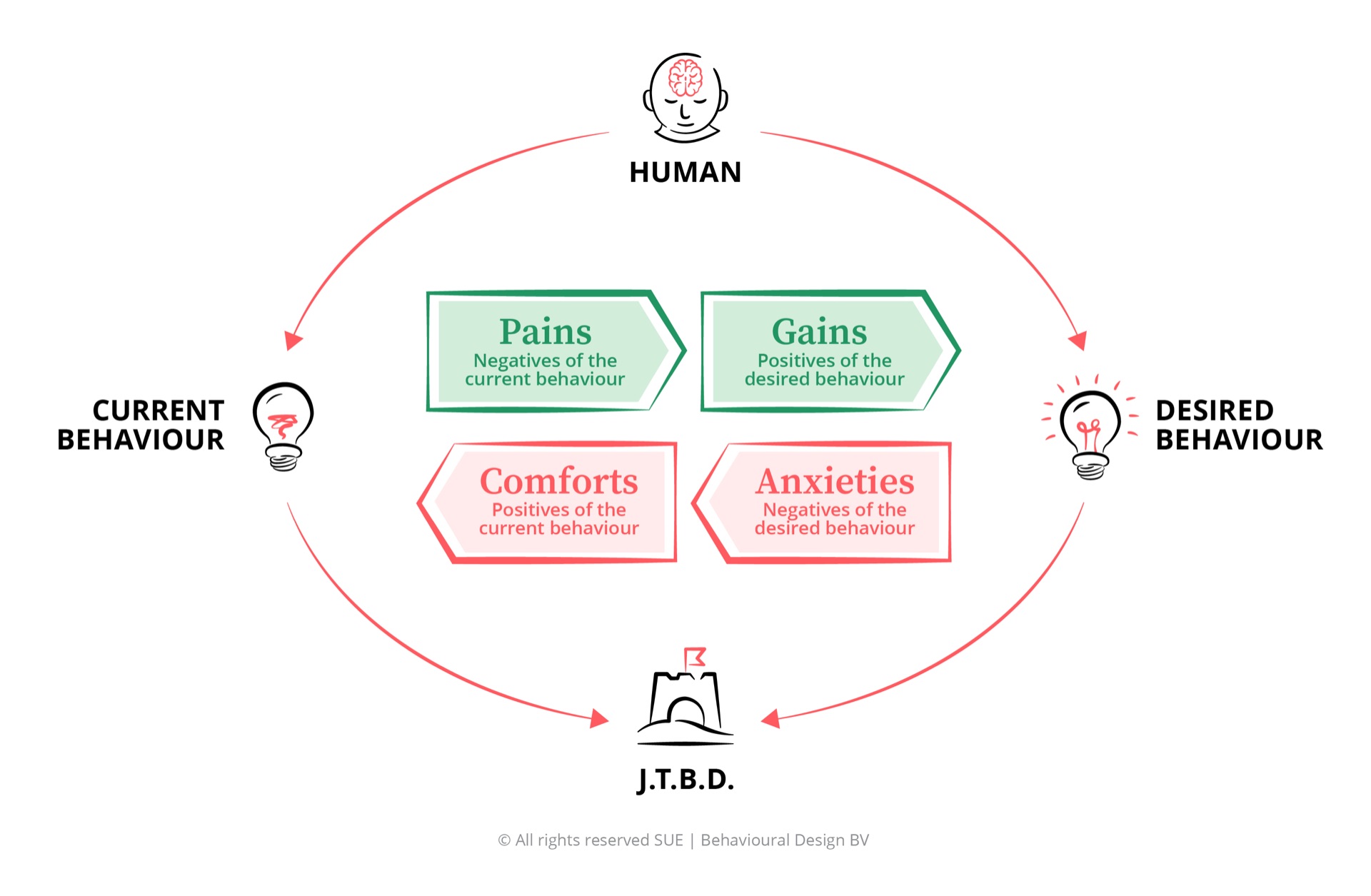
The pains of going beyond are concrete and immediate: evenings, a full calendar, being the person who is always available, and the specific frustration of watching that become the expectation rather than the exception.
The gains are vague and deferred. Visibility, maybe. Being thought of when something opens up, at some point. In most teams nobody can name a single case where extra effort visibly converted into anything.
The anxieties are what tips it. If I stop, will it be noticed and held against me? Usually the honest answer is no, which removes the last reason to continue.
And the comforts of doing exactly the job are considerable: predictable hours, no resentment, and a completely defensible position in any conversation, because the work is being done as agreed.
That balance is why the label irritates people who are on the receiving end of it. They are not doing less than they agreed. They are doing precisely what was agreed, and the organisation has quietly been depending on more.
Audit what your organisation actually rewards
Before changing anything, find out what the current design teaches. Four questions, answerable in an afternoon with real records rather than impressions.
1. Who got promoted, and what for?
List the last two years of promotions and write next to each one the behaviour that visibly earned it. If the pattern is tenure, visibility, or being liked by one particular person, everyone in the team already knows and has adjusted accordingly.
2. Where does urgent work land?
Take the last ten urgent tasks and note who got them. If it is the same three names, you have found the mechanism: reliability is being taxed rather than rewarded, and the tax rate is rising.
3. What happened to the last person who raised a problem early?
Early warning is discretionary effort in its purest form, and it is expensive to give. If the last person who did it ended up owning the problem, nobody in that room will do it again.
4. Can anyone name a case where extra effort paid off?
Ask the team directly. If nobody can produce an example, you do not have an engagement problem. You have an evidence problem, and it is solvable.
Four things worth changing
Make the exchange explicit
Discretionary effort works when it is part of a visible trade. Say out loud what someone gets for taking on the difficult thing: the next interesting project, a named role, time back, a specific step towards something they want. Vague appreciation is not a currency.
Rotate the reliable work
If urgent tasks keep landing with the same people, allocate them deliberately instead of by reflex. This is a scheduling decision, not a culture initiative, and it is the fastest thing on this list to implement.
Reward the early warning louder than the rescue
Most organisations celebrate the person who fixed the crisis and say nothing about the person who flagged it three months earlier. That teaches everyone to wait. Name the early warning publicly, and name it as the more valuable of the two.
Close the loop on what people raised
The cheapest fix available. When someone gives you something extra, an idea, a warning, a piece of work nobody asked for, tell them what happened to it. Even when the answer is that you decided not to act on it. Silence is what converts a contributor into someone who does exactly the job.
Frequently asked questions about quiet quitting
What is quiet quitting exactly?
The withdrawal of discretionary effort. Someone keeps doing their job as described and stops doing the parts that were never in the description: covering for colleagues, improving things nobody asked about, flagging problems early. Dennis Organ called that category organisational citizenship behaviour, and most organisations depend on it without ever having asked for it.
Is quiet quitting a generational thing?
The evidence points at the exchange rather than the age group. John Stacey Adams showed in 1963 that people calibrate effort by comparing their input-to-outcome ratio with other people's, and correct an imbalance by reducing input. That mechanism is not new and is not specific to one cohort. What changes between workplaces is whether extra effort visibly pays.
How do you spot quiet quitting in a team?
Look for what stopped rather than what is failing. Performance stays acceptable while the extras disappear: fewer questions in meetings, no more early warnings, nobody volunteering for the awkward task. It is easy to miss precisely because nothing is going wrong yet.
What should a manager do about it?
Audit what the organisation rewards before addressing anyone's attitude. Check who was promoted and for what, where urgent work lands, and what happened to the last person who raised a problem early. If reliability is being taxed rather than rewarded, the withdrawal is a correct reading of the situation and no conversation about commitment will change it.
Is quiet quitting the same as disengagement?
Not quite. Disengagement usually shows up in the work itself. Quiet quitting leaves the work intact and removes everything around it, which is why engagement scores can stay flat while the team quietly stops contributing beyond the brief.
Conclusion
The term suggests a person who has given up. What it usually describes is a person who has been paying attention.
So before the conversation about commitment, do the arithmetic they have already done. Look at who was rewarded and for what, where the urgent work lands, and whether anyone can name a single time that going beyond the job produced anything but more of it.
Fix that, and the extra effort tends to come back on its own. It was never withdrawn out of principle.
Want to design what your organisation rewards? The online Deep Dive The Behavioural Advantage in Talent Management shows you how to apply behavioural science across hiring, onboarding, appraisal and retention.