
Marketing is increasingly less the strategic language of the boardroom. Customer experience has taken that place - and not by accident.
Marketing is about deploying tools, techniques and tactics to steer customer behaviour: an advertisement, a campaign, an offer. Customer experience is the outcome that actually predicts buying behaviour: what it feels like to be a customer of your organisation, from the first touchpoint to long after the purchase.
That shift is fundamental. If CX is the outcome that predicts buying behaviour, then understanding and designing CX is not a marketing function - it is the strategic layer that marketing alone cannot provide. Good marketing brings people to the front door. Good customer experience determines whether they come back, buy more and bring others along.
Most organisations have not yet made that transition. They measure customer satisfaction, manage scores, conduct exit interviews. They know what customers say. But they do not understand what customers are genuinely driven by - and that difference is precisely the difference between a CX programme that works and one that only tracks scores.
Customer experience is the outcome that predicts buying behaviour: the totality of experiences a customer has with an organisation, from first contact to long after purchase. Designing CX means consciously shaping that outcome - not by measuring satisfaction, but by understanding which forces promote or block customer behaviour: their jobs-to-be-done, their anxieties, their comforts. That is the strategic layer marketing alone cannot deliver. More about Behavioural Design for Marketing & CX →
What is customer experience?
Customer experience encompasses every touchpoint a customer has with an organisation: the first advertisement, the website, the purchase process, delivery, customer service, and everything that follows. It is not only what happens, but how it feels.
That nuance is crucial. Two companies can deliver exactly the same service - same price, same product, same delivery time - and yet create a fundamentally different customer experience. The context, the sequence, the language, the visual design, the small unexpected details: these determine the experience, not the objective facts.
Rory Sutherland puts it concisely: “The context in which people use your product is, in their value perception, as important as the product itself.” That is not soft marketing theory. It is a hard behavioural science reality.
“The context in which people use your product is, in their value perception, as important as the product itself.”
Customer experience is therefore not a department or a function. It is the sum of every decision your organisation makes about how customers experience your brand. And every decision you do not make, your organisation makes too - you always get a customer experience, the question is only whether you designed it consciously.
Customer experience as part of your value proposition
Most organisations view customer experience as a layer on top of their product or service: “the way we deliver our value.” That is too narrow. In the strongest customer relationships, the experience itself is an inseparable part of the value proposition.
Take Costco, the American membership warehouse with more than 130 million members worldwide. At first glance the value proposition seems simple: cheap products in large quantities. But anyone who believes that does not understand why more than 90 per cent of members renew annually - without discount promotions or loyalty points.
Costco’s customer value proposition consists of two inseparably linked pillars:
- Value: a carefully curated assortment of roughly 3,700 products - compared to 30,000 to 50,000 in a typical supermarket. That limitation is not a cost-saving measure; it is a design choice. Fewer options means less decision fatigue, higher purchase volumes per SKU and therefore better unit prices. Kirkland Signature, the own label that accounts for 25 to 30 per cent of total revenue, sits prominently on the shelves - not hidden on the bottom row as cheap own-label products typically are. The signal: we trust this product ourselves.
- Experience: the store as a destination. The free food samples that run simultaneously at 15 to 20 points on busy days, steering the flow through the store. The legendary restaurant with the hot dog and soft drink for $1.50 - a price Costco has maintained since 1985. Founder Jim Sinegal reportedly told a manager who wanted to raise the price: “If you raise the price of the effing hot dog, I will kill you.” No joke - it is a deliberate anchoring strategy. That $1.50 resets the customer’s price expectation for the entire store.
On top of that, there is the treasure hunt layer: part of the assortment rotates continuously, with limited quantities per item. Customers know they must buy today, because tomorrow it is gone. That is not arbitrary - it is an orchestrated mix of scarcity, variable reward and the joy of discovery that makes every store visit unpredictable enough to want to return.
The annual membership fee of $65 to $130 acts as a behavioural amplifier. Once paid, members feel the psychological pressure to earn back that investment - more visits, larger shopping trolleys. Paradoxically, members are therefore less price-sensitive within the store: they have already “paid to play.” The result: an annual renewal rate above 90 per cent, and staff turnover of 5 to 10 per cent against 50 to 150 per cent in the rest of the sector - because Costco takes the CX for its employees seriously too.
Remove the experience and you have a cheap wholesaler. Remove the value and you have a pleasant day out without a reason to return. Together they create a relationship that is difficult to replicate - not because the formula is secret, but because every element reinforces the others.
This is the core of behaviour-driven CX: not “how do we deliver our value?”, but “how is the experience itself part of the value?”
Why customer research misses the real ‘why’
Imagine asking Costco members what they would like to improve about the shopping experience. A significant proportion will say: “smaller packaging.” If you take that answer at face value, you start working on smaller packaging. And then you are dismantling precisely what makes Costco distinctive.
The real insight sits a layer deeper. The reason part of the customer base does not use bulk purchases has nothing to do with a preference for small quantities. It is a cashflow problem. Families living paycheck to paycheck can do the per-unit-price calculation perfectly well - but cannot front the £50 or £80 required at the time of purchase. The barrier is not the packaging size. The barrier is the moment of payment.
This difference does not appear in a survey. You find it only by asking about actual behaviour, not stated preferences.
This is precisely the gap that traditional customer research structurally misses. Surveys and focus groups measure attitudes - what customers think they want, filtered through social desirability and limited self-insight. They give you the output of rational reasoning (System 2), while buying behaviour is largely driven by System 1: automatic, emotional, context-driven.
Virgin Atlantic discovered this the hard way. Attitudinal research indicated that passengers valued “adventure” and “excitement.” Behavioural research - in which researchers observed and asked about actual behaviour - revealed that passengers actually responded to “stress-free,” “responsive” and “helpful.” The CX redesign based on behavioural insights yielded £1 million in additional profit over the same period - which Virgin Atlantic itself described as “the most successful reframing exercise we have ever done.”[1]
The lesson: intentions tell us nothing about real behaviour. Always ask what someone has done, never what they intend to do.
Customer experience is largely System 1
Kahneman and Tversky showed that our brain operates on two systems. System 2 is the conscious, rational system - slow, analytical, effortful. System 1 is the automatic system - lightning fast, intuitive, emotional. It is estimated that 96 per cent of our behaviour is driven by System 1.[2]
For customer experience this has a direct implication: customers do not experience your brand the way you intended. They experience an edited, simplified version, filtered through System 1. That system does not make decisions based on features or price comparisons - it responds to atmosphere, familiarity, social signals and how something feels.
Small contextual details determine the experience disproportionately. The scent in the room, how quickly someone is helped, the tone of the confirmation email, the way an app responds to a tap: these determine how the customer remembers and evaluates the whole.
Kahneman described the “peak-end rule”: people remember an experience based on the peak (positive or negative) and the ending, not on the average. A smooth checkout after an overwhelming product range makes a world of difference. A glitchy confirmation email after a flawless purchase does too - in the negative direction.
That does not mean rational arguments are irrelevant. But they come later: as confirmation of a decision System 1 has already made. Design your CX for System 2, and you miss 96 per cent of what genuinely moves the customer.
Customer missions: one customer, multiple jobs-to-be-done
Clayton Christensen formulated it this way: when someone “hires” a product or service, they do so to fulfil a specific job-to-be-done - the progress someone wants to make in a given situation.[3] The famous example: fast food customers who bought a milkshake in the morning did not do so for the taste, but to get through the long commute. The job was “make the drive less boring” - not “drink something nice.”
The uncomfortable insight for CX designers: the same customer has multiple fundamentally different jobs at the same company. And every job requires a different customer experience.
Back to Costco. Take a member who has visited dozens of times over the past year. An analysis of their visits reveals three distinct patterns:
- The efficiency mission: on weekday evenings, moving quickly through the store, picking up regular products, spending as little time as possible. The job: “restock my pantry without hassle.”
- The treasure hunt mission: on Saturday afternoons, moving slowly through the aisles, looking for unexpected deals or new products. The job: “find something interesting I would not otherwise discover.”
- The experience mission: on Sunday morning with the children, for the hot dog and food samples, then a round through the store. The job: “give us a fun outing without spending much.”
Each of these missions requires a different CX response. The efficiency mission calls for clear signage, consistent shelf layout and fast checkouts. The treasure hunt calls for rotation, surprise and the joy of discovery. The experience mission calls for warmth, family-friendly activities and a reason to linger.
Optimising CX for one mission only sabotages the other two - and you will not know until customers leave.
This is why traditional customer personas fall short. “Sarah, 42, mother of two, conscious consumer” tells you nothing about the three fundamentally different jobs for which Sarah visits the same store every week. Behaviour-driven CX does not build on demographic profiles, but on jobs-to-be-done per situation.
The Influence Framework as a diagnostic tool for CX
Knowing that customers have multiple jobs is step one. The real CX question is: what stands between the customer and the desired behaviour? What pushes them towards the desired action, and what holds them back?
The SUE Influence Framework maps four forces per customer mission:
- Pains: what is not working in the current experience? Which frustrations push the customer towards change?
- Gains: what does the customer want to achieve with the desired behaviour? What do they stand to gain?
- Comforts: why does the customer stay with their current behaviour? What is comfortable about the status quo?
- Anxieties: what holds the customer back from the desired step? Which doubts, thresholds and risks are at play?
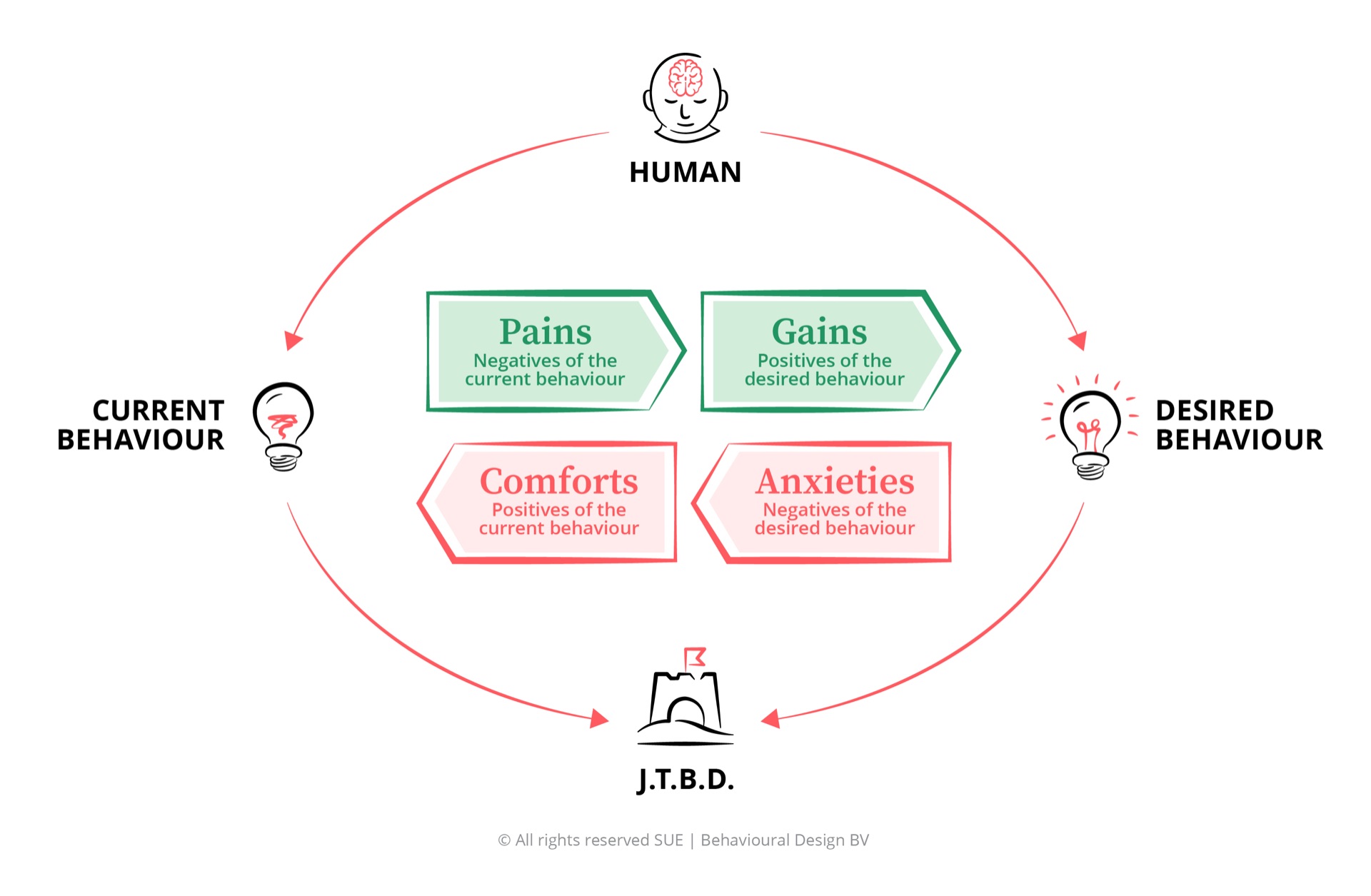
Most CX teams focus almost exclusively on pains and gains: they try to remove frustrations and emphasise benefits. That is only half the work. The forces that hold customers back - comforts and anxieties - determine whether the intervention sticks or evaporates.
Take the treasure hunt mission at a members-only store. The pain is clear: the customer cannot find such deals anywhere else. The gain is equally clear: a sense of discovery and the pleasure of an unexpected find. But what are the comforts? The familiar local supermarket is quick, predictable and requires no membership. What are the anxieties? The upfront cost of the membership, the bulk that needs storing at home, the feeling that you might not buy enough to justify the membership fee.
If you do not address those anxieties - in the onboarding, in the communication, in the store layout - you lose potential members not to the competition, but to doubt.
From insight to CX intervention: a practical approach
CX design that works always follows the same logic: start with the behaviour, not the message. The only question that matters: which specific behaviour do I want to trigger, for which customer, in which situation, and what is holding them back right now?
Step 1: Define the behaviour problem
The question is always concrete: which specific behaviour is missing? Are customers returning too infrequently after a first purchase? Are they underusing a service they already have? Are they not converting from a trial to a paid subscription?
Each of those behavioural patterns has different causes. You cannot address them with the same intervention.
Step 2: Conduct behavioural research
Do not ask about preferences or intentions. Ask about actual behaviour: “When did you last stop using X? What did you do instead?” Observe customers in the real situation. Look for the cashflow equivalent in your sector - the real barrier that never surfaces in a survey.
The minimum effective dose: two hours every six weeks in conversation with real customers, asking questions about what they have done, not what they want to do.[4]
Step 3: Map the Influence Framework per mission
Per customer mission and per relevant segment: map the four forces. Which pains push the customer towards the desired behaviour? Which gains do they stand to win? Which comforts keep them with their current behaviour? Which anxieties block the step forward?
This gives you the richest material a CX team can have - richer than any NPS analysis. You now understand why the score is what it is, and that is the insight numbers can never give you.
Step 4: Design for System 1
Select the touchpoint with the greatest impact on the customer mission. Design an intervention that removes a specific anxiety or uses an existing comfort as a stepping stone towards the desired behaviour - what we call piggybacking. Make the desired behaviour so easy that the customer does not need to think about it.
IKEA does not accidentally build their stores so that you pass every department before reaching the checkout. They do not accidentally give you a clipboard and pencil as you enter. They do not accidentally serve cheap meals in a restaurant in the middle of the store. Each of those choices is a choice architecture decision: a response to a specific job-to-be-done, grafted onto a deep understanding of comforts and anxieties.
That is what behaviour-driven CX design does: it makes the environment an ally of the desired behaviour. It eliminates unnecessary friction at the points where it causes the most damage, and adds meaningful moments at the points where they are most memorable.
 Training for professionals
Frequently asked questions about designing customer experience
What is customer experience?
Customer experience is the totality of experiences a customer has with an organisation, from first contact to after purchase. CX goes beyond satisfaction: it encompasses the emotions, expectations and behaviours at every touchpoint. Good CX strategy starts with a deep understanding of what genuinely drives customers, not what they report in a survey.
What is the difference between CX and measuring customer satisfaction?
Measuring customer satisfaction (NPS, CSAT) tells you what customers say about their experience after the fact - a lagging indicator. Designing customer experience starts earlier: with the question of which behaviour you want to trigger, which forces promote or block that behaviour, and how to shape the context so the desired behaviour occurs naturally. Measuring is useful as a signal, but designing requires deeper insight into actual behavioural drivers.
What are customer missions and why do they matter for CX?
A customer mission is the specific job-to-be-done a customer wants to fulfil at a given moment. The same customer may have three fundamentally different missions at the same company: efficiently restocking essentials, discovering something new, or simply enjoying an experience. Every mission requires a different CX response. Designing CX for one mission only sabotages the other two.
Why do most CX programmes fail?
Most CX programmes fail for two reasons. First, they measure attitudes instead of behavioural drivers: surveys give you stated preferences, not actual behavioural motivations. Second, they treat CX as one-size-fits-all. Because customer missions differ fundamentally by moment and situation, a generic CX approach works optimally for no one.
How do you apply the Influence Framework to customer experience?
The SUE Influence Framework maps four behavioural forces per customer mission: pains (frustrations in the current experience), gains (what the customer wants to achieve), comforts (reasons to stay with current behaviour) and anxieties (barriers to the desired behaviour). By creating an IF per mission and per segment, you get the richest material for targeted CX interventions - far richer than any NPS score can deliver.
1.5 minutes of Influence
Every week I notice something: a hospital sign, a supermarket shelf, a phrase in a meeting. Always something that shows exactly how context shapes behaviour. I write it down. Every Thursday morning it lands in your inbox. In 90 seconds.
Read by 10,000+ professionals · Free · Unsubscribe any time. By subscribing you agree to our privacy policy.