You know what you should do. You know you should start that report earlier, save more money, actually use that gym membership. And yet, when the moment arrives, you do not. You open another browser tab. You buy something anyway. You cancel the gym.
This is not a willpower deficit. This is an architecture problem. And commitment devices are the architecture solution.
Commitment devices are arrangements that a person makes in the present to constrain or shape their future behaviour. They work by raising the cost of undesired future behaviour before the moment of temptation arrives. From Odysseus tied to the mast to automatic saving: they bridge the gap between who you are now and who you want to be. The SUE Influence Framework shows why present bias keeps reopening that gap - and how commitment devices structurally close it.
What are commitment devices?
The most elegant definition of a commitment device comes from behavioural economist Richard Thaler: an arrangement that a person makes in the present to restrict the options available to their future self. The concept rests on time inconsistency. Your current self has preferences that your future self will not share when the moment of temptation arrives.
Your current self wants to eat healthily. Your future self - hungry, tired, after a long meeting - wants the fastest option available. Your current self wants to finish the presentation ahead of schedule. Your future self still has three days and finds the deadline comfortably distant. Your current self wants to save more. Your future self sees those shoes in the shop window.
Commitment devices give your current, more rational self the final say. They make it harder, costlier or impossible for your future self to make the worse choice. Not by strengthening willpower - willpower is finite and unreliable - but by changing the structure of the choice itself.[1]
"Humans are to thinking what cats are to swimming. We can do it if we have to, but we much prefer not to."
— Daniel Kahneman, Princeton University
 Amsterdam City Centre
Odysseus and the mast: the original commitment device
The earliest recorded description of a commitment device appears in the Odyssey. Odysseus knows his ship must sail past the Sirens - creatures whose song is so seductive that sailors swim to their deaths to reach them. Odysseus wants to hear the song. But he also knows that his future self, enchanted by the sound, will steer the ship onto the rocks.
His solution: he orders himself tied to the mast. He instructs his crew to fill their ears with beeswax and to refuse to release him, no matter how desperately he pleads. The commitment is made before the temptation begins. His future self has no choice left.
This is the essence of every commitment device. You do not eliminate the temptation. You remove the possibility of giving in to it. And you do that at a moment when you can still think clearly, before the emotional state shifts and your judgment clouds over.
StickK and the evidence: what the science shows
Dean Karlan, economist at Yale, built StickK.com as a scientific experiment that simultaneously became a product. The platform lets users enter commitment contracts: you set a goal, determine a stake (money that goes to a charity or an “anti-charity” - an organisation you dislike - if you fail), appoint a referee and optionally choose supporters.
The findings are consistent: people who attached a financial stake to their commitment achieved their goal significantly more often than those who did not. Loss aversion worked in their favour: the pain of potential loss motivated more strongly than the prospect of potential gain.[1]
Ariely and Wertenbroch showed in a celebrated study that students who were allowed to set their own deadlines for papers - thereby creating commitment devices for their own behaviour - achieved better results than students given complete freedom. Even when the self-imposed deadlines were later than the imposed deadlines in a control group.[2] The structure created the success.
You're reading about it. But what if you could apply it yourself, to customers, colleagues, citizens or stakeholders?
As Europe's #1 academy in Behavioural Design, we train professionals in analysing, predicting and influencing behaviour, live, online or in-company. Based in Amsterdam, with more than 10,000 alumni from London to Sydney and Singapore to New York.



 EQAC
EQACCertified
Training
Three commitment devices for the workplace
Public goal announcements
One of the lowest-threshold commitment devices is publicly announcing a goal. When only you know you want to achieve something, the cost of failure is purely internal. When you announce it - to your team, your manager, your colleagues - the cost becomes social. Failure now also means losing face.
This is why public goals outperform private goals, though they carry a risk when shared too broadly too early. Research by Peter Gollwitzer shows that publicly discussing identity-related goals - “I am becoming a better leader” - can have the opposite effect: the brain experiences others’ recognition as partial success, and subsequently reduces intrinsic motivation to pursue the goal.
The advice: announce concrete, behavioural goals, not identity statements. Not “I am going to live more healthily” but “I am going to complete my most important task every morning before nine o’clock, and I will report back to you next week on how it went.” That is a commitment with a built-in accountability check.
Pre-committed deadlines
Most deadlines are externally imposed. Commitment devices turn self-imposed deadlines into a deliberate instrument. The tactic: set your own hard deadline three days before the real deadline, and communicate that earlier deadline to someone who will hold you accountable.
This sounds trivial but has a powerful effect. Your current self decides that an intermediate deadline exists. Your future self - which would normally use all available time up to the real deadline and produce worse work under pressure - has less room to manoeuvre. The buffer you create is not just time saved. It is the mental space for revision and reflection that without the commitment device would never exist.
Automatic saving as an institutional commitment device
The most thoroughly evidenced commitment device in the financial world is automatic saving via payroll deduction. The logic is straightforward: if the money never appears in your account, you cannot spend it. Your future self has no access to the decision your current self has already made.
In the workplace the same principle applies to time. When you install blocker apps that make social media inaccessible during working hours, you remove the decision space for your future self. You do not have to make an active choice at the moment of temptation - tired, frustrated, stuck on a difficult task - to put your phone down. The environment has already made that decision.
The Influence Framework and the intention-action gap
Commitment devices are so effective because they directly target the forces that the SUE Influence Framework identifies as the drivers of the intention-action gap.
Pains: the pain of not reaching your goal is real but abstract and future. Present bias ensures that pain weighs insufficiently at the moment of decision. Commitment devices make the pain immediate and concrete: if I do not start on the presentation today, I lose the freedom to course-correct tomorrow.
Gains: the benefits of desired behaviour lie in the future. Present bias heavily discounts those future benefits. Commitment devices pull part of the reward into the present: the feeling of control, the structure of a plan, the social approval of a public commitment - all of those are immediate.
Comforts: the comfort of procrastination - not deciding now, maybe later - is powerful. Commitment devices eliminate that comfort by making the decision now. There is no “maybe later” when you have already tied yourself to the mast.
Anxieties: the fear of starting, the fear of failure, the fear of the discomfort of change keep people locked in their current behaviour. Commitment devices reduce that anxiety by simplifying the environment: the choice has already been made, you only have to do what you already decided.
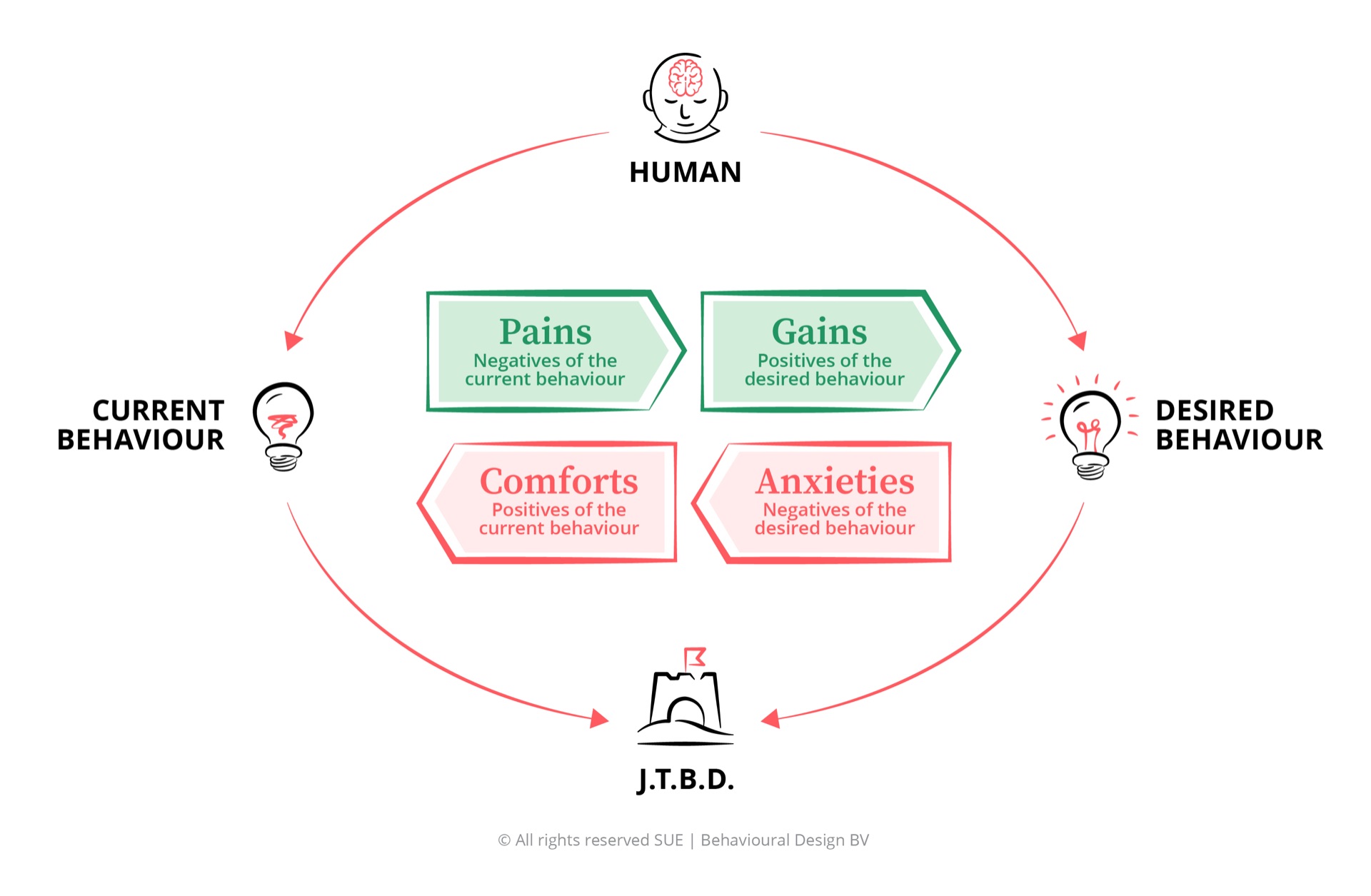
The key to an effective commitment device is understanding which of these four forces is strongest in your specific behavioural challenge. If the main blocker is the Comfort of procrastination, an automatic system works best. If the main blocker is the Anxiety of getting started, a public commitment with accountability works better.
 Training for professionals
Frequently asked questions
What is the difference between a commitment device and ordinary willpower?
Willpower relies on your ability to make the right choice at the moment of temptation. Commitment devices remove the decision before the moment of temptation arrives. You decide now, when you are calm and rational, so that your future self no longer has to choose. It is structural rather than situational.
What is StickK and how does it work?
StickK is a platform created by Yale economist Dean Karlan that lets you enter a commitment contract. You choose a goal, set a stake (money that goes to a charity or anti-charity if you fail), appoint a referee and optionally choose a group of supporters. The financial stake makes the commitment tangible and raises the cost of failure.
Why do commitment devices work?
Commitment devices work because they structurally address present bias. Present bias is the tendency to weight immediate rewards more heavily than future ones. By making a commitment now, you increase the effective cost of undesired behaviour and reduce the pull of the immediate temptation.
What are examples of commitment devices in the workplace?
Public goal announcements increase accountability. Deadlines set before the real deadline create room for correction. Automatic saving via payroll deductions removes the decision. Blocker apps that shut off social media during focus time remove access to distraction.
What is the connection between commitment devices and present bias?
Present bias is why good intentions fail: your future self wants to choose differently from your current self. Commitment devices bind your future self to the preferences of your current, more rational self. They bridge the intention-action gap by changing the structure of the choice.
Conclusion
The intention-action gap is one of the most frustrating experiences in professional life: you know what you need to do, you want to do it, and yet you do not. Commitment devices are not the solution to every procrastination problem, but they are the most structural approach behavioural science knows. Want to learn how to design them for your organisation or behavioural challenge? The Behavioural Design Fundamentals Course gives you the methodology. Rated 9.7 out of 10 by more than 10,000 professionals from 45 countries.

1,5 minutes of influence
Every week I notice something: a hospital sign, a supermarket shelf, a phrase in a meeting. Always something that perfectly illustrates how context shapes behaviour. I write it down. You get it in your inbox, every Thursday morning. In 90 seconds.
Join 10,000+ readers · Free · Unsubscribe anytime