Thursday 20 August 2026
Micromanagement: why your most-checked employee performs worst
 By Astrid Groenewegen · 3 min read
I have a confession to make: I have a guilty pleasure. I simply love British crime series that are gentle and nice. Think Midsomer Murders (you have to love Barnaby), Father Brown, or Agatha Christie's Miss Marple. I know. It is not exactly gritty stuff, but I love the English countryside setting and solving the puzzles along the way. It got me thinking, though. How do we handle crime in real life, when there are no scones involved? Do we actually believe in second chances?
How much of what we call character is really just the situation someone happens to be standing in, and what happens to their performance once we design that situation on purpose?
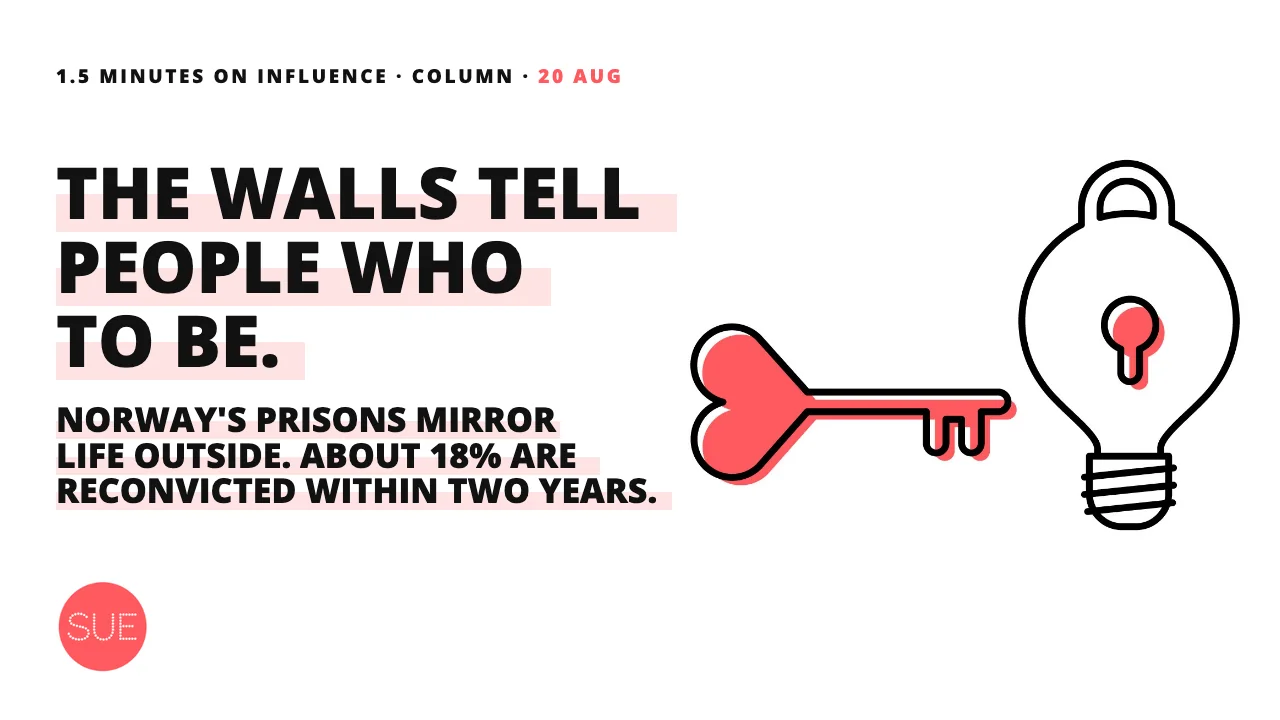
In searching for the answer, I landed in Norway. For most of the twentieth century, Norway ran prisons much like everyone else, and by the 1980s saw the same result: by commonly cited estimates, somewhere between sixty and seventy per cent of released prisoners were back behind bars. The conventional response is to make prison harsher. Norway went the other way. Its prisons, Halden chief among them, are built on the normality principle: life inside should resemble life outside as closely as safety allows. At Halden, opened in 2010 as a maximum-security prison, there are no bars on the windows, guards eat with the inmates, and there is a kitchen, a recording studio, and a library. Norway's two-year reconviction rate was roughly eighteen per cent in 2018, low by international standards, though countries measure it differently. It fits the logic, even if prison design is surely not the only factor. The behavioural science here is about identity, and how powerfully a setting assigns it.
People tend to become the person their context tells them they are.
A place that treats someone as a dangerous prisoner, stripped of dignity and choice, quietly confirms exactly that identity, and they leave as that. A place that treats someone as a citizen who happens to be serving time makes a different identity available, and people grow towards it. The behaviour was never fixed in the person. The walls were telling them who to be.
Three practical moves you can use, well beyond prisons:
1. Treat people as the version of them you want, not the one you fear. A new hire treated as untrustworthy, with every step checked and gated, learns to behave as if they cannot be trusted. Extend the identity you want people to grow into.
2. Read the signals your environment is sending. Every space quietly tells people who they are: the locked cabinets, the surveillance, the rules on the wall. Change the signal that contradicts the behaviour you want.
3. Design for who someone is becoming, not only who they are now. Before you tighten control after a mistake, ask whether the tighter regime confirms the very identity you are trying to move someone away from. Often, the braver design is to widen trust, not narrow it.
So maybe the scones, the teatime, and the endless summer markets my beloved series are set in are not just back-drop but a fundamental part of getting people back to a life worth contributing to. Not a guilty pleasure, then, but a little pleasure in being guilty.
Sources
Norwegian Correctional Service (2018 reconviction figures, study commissioned by the service): 18 per cent reconvicted within two years. As reported by The Local (2023), How different is the Norwegian prison system really? https://www.thelocal.no/20231213/explained-how-different-is-the-norwegian-prison-system-really
Al Jazeera (2015). Norway’s prison without bars: ‘It’s a trust thing’. https://www.aljazeera.com/features/2015/3/11/norways-prison-without-bars-its-a-trust-thing
NPR (2015). Inside Norway’s Halden prison. https://www.npr.org/transcripts/410532066
Read the full guide:
Micromanagement is a symptom, and the cure is not trust →