AI training for employees: what actually works
Every week another organisation announces its AI training programme. Thousands of employees sit through workshops about ChatGPT, Copilot or Claude. They leave with a sense of excitement and a list of prompts. Three weeks later, most of them are doing exactly what they did before.
This is not a technology problem. It is a behaviour change problem. And that distinction matters more than most L&D teams realise. The gap between knowing how AI works and actually using it every day is not a knowledge gap - it is a behavioural gap. And you cannot close a behavioural gap with more information.
In this article I want to explain why most AI training programmes fail, what the behavioural science actually tells us about making new habits stick at work, and what effective AI upskilling looks like in practice.
AI training for employees is a structured programme that builds the awareness, skills and habits needed to use artificial intelligence tools effectively in daily work. Effective AI training goes beyond tool walkthroughs: it addresses psychological barriers to adoption (anxiety, comfort with existing habits), builds confidence through deliberate practice, and uses habit-forming mechanisms to ensure new behaviours become automatic rather than effortful.
What is AI training for employees?
At the most basic level, AI training for employees means giving people the knowledge and skills to use AI tools in their work. That might involve prompt writing, understanding what AI can and cannot do, or learning to integrate specific tools into existing workflows.
But when you look at organisations that have genuinely transformed how their people work with AI, you quickly notice that their training programmes do something different. They do not just teach tools. They actively shape behaviour.
There is a useful distinction here between AI awareness, AI capability and AI habit. Awareness means understanding what AI can do. Capability means being able to use it when you try. Habit means reaching for it automatically, the way you reach for a calculator rather than doing arithmetic by hand.
Most AI training programmes stop at awareness. Some reach capability. Almost none are designed to build habit. And yet habit is the only level that produces genuine, lasting change in how organisations work.[1]
Why most AI training programmes fail
A McKinsey study on AI adoption found that less than a third of organisations report successful AI integration across their workforce, even after significant investment in training.[2] The reason is almost never a lack of good tools or poor instruction. The reason is that the training is designed around the wrong theory of change.
The implicit assumption behind most corporate training is this: if people know something is valuable and know how to do it, they will do it. This assumption is wrong. It is wrong about nutrition. It is wrong about exercise. And it is wrong about AI adoption at work.
Behavioural scientists have been documenting this gap for decades. We call it the intention-action gap - the chasm between what people say they intend to do and what they actually do when they return to their desks, their habits and their cognitive shortcuts.
"The problem with most AI training is not that employees don't understand AI. It's that the training doesn't address why they aren't using it."
When you look at why AI adoption fails in organisations, you find the same patterns: employees feel anxious about looking incompetent if they use AI incorrectly, they default back to familiar tools because those feel safe and comfortable, there is no clear trigger or moment in the day where AI use makes obvious sense, and the friction of adopting a new workflow feels higher than the benefit of automation.
None of these barriers are knowledge problems. They are behaviour problems. And they require a different kind of solution.
The knowledge-behaviour gap is well documented in Behavioural Design. Most behaviour is controlled by System 1 - the fast, automatic, habit-driven part of the brain. New knowledge lives in System 2 - the slow, deliberate, effortful part. System 1 almost always wins. This means that telling people about AI in a workshop changes what they know. It does not change what they do by default.
The behavioural science behind successful AI adoption
If knowledge is not the lever, what is? Behavioural science points to three factors that actually determine whether new workplace behaviour sticks: reducing anxiety, creating clear triggers and building habits through repetition in context.
Anxiety: the hidden barrier
Psychological safety is the single most underrated factor in AI adoption training. Before employees will experiment with AI, they need to feel safe to do so - safe to make mistakes, to look uncertain, to produce outputs that are not perfect. In organisations without that safety, employees will not meaningfully engage with AI training, even if they attend it.
This is not a soft concern. Research on workplace learning consistently shows that anxiety suppresses practice, and practice is the only thing that builds capability. A training programme that does not actively address the anxiety of looking incompetent will produce very low levels of genuine experimentation - regardless of how good the content is.
Triggers: the missing mechanism
Most AI training fails to answer the most practical question: when exactly should I use this? Employees leave a workshop knowing that AI exists and that it is useful. But they have no clear trigger - no specific moment in their daily workflow where they have decided in advance to reach for an AI tool.
Behavioural science is clear on this: without a trigger, behaviour does not happen reliably. Implementation intentions - specific "when X, then Y" plans - dramatically increase the likelihood that people follow through on intentions. Effective AI training builds these into the programme itself. Instead of "use AI more," employees leave with "when I receive a brief, my first step is to draft a response with AI before refining it."
Habits: the goal that most training never reaches
Habit formation requires repetition in context. A behaviour becomes automatic when it has been performed enough times in the same situation that it stops requiring deliberate effort. This cannot happen in a single day workshop, no matter how good the facilitator is.
Effective AI adoption training is therefore not an event. It is a process. It requires repeated practice over weeks, with real tasks, real outputs and a safe space to compare notes with colleagues. The research on workplace behaviour change is consistent: programmes that include follow-up practice sessions, peer accountability and reflection produce significantly better outcomes than single-day training.[3]
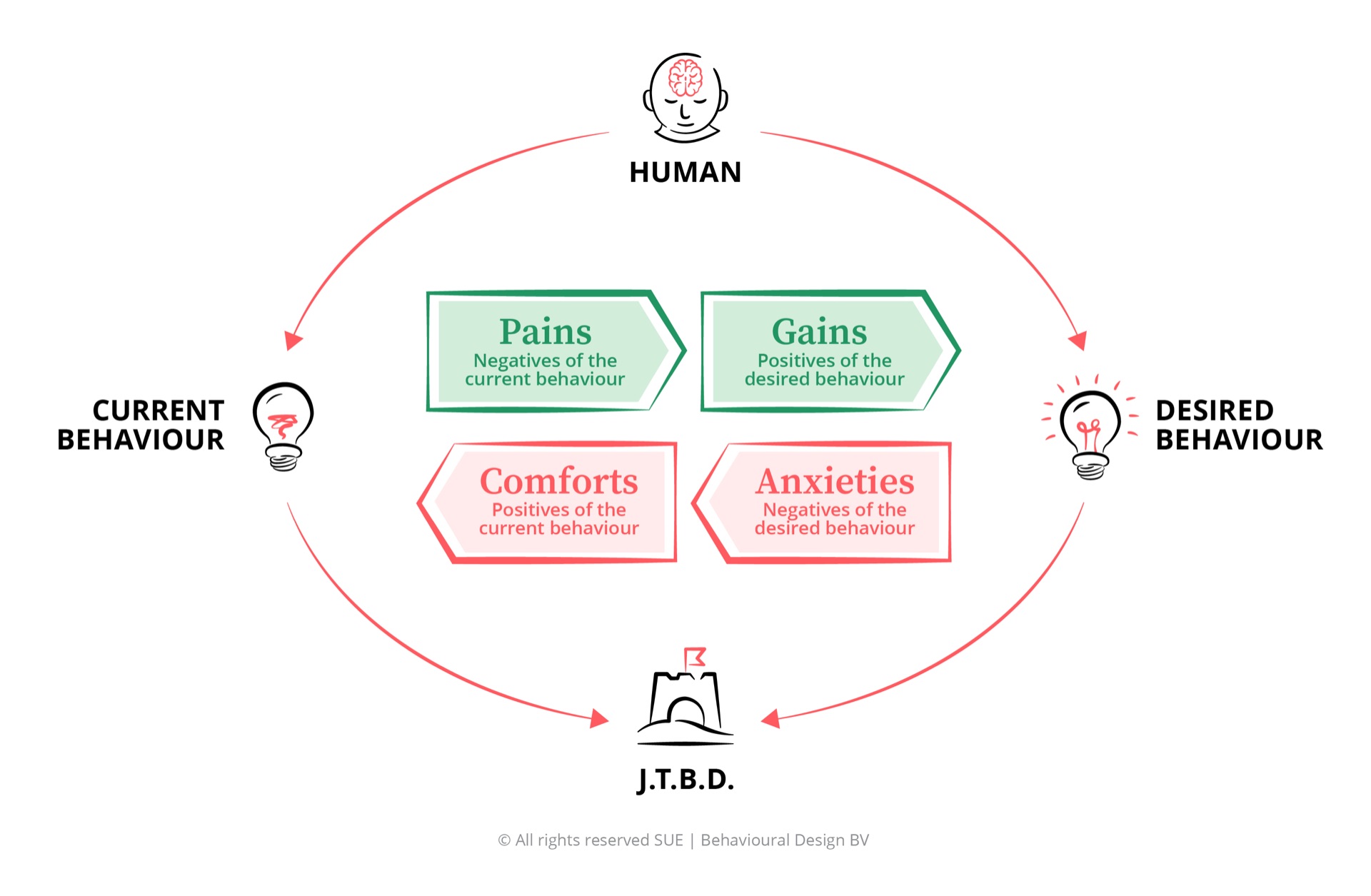
When we apply the SUE Influence Framework to the challenge of AI adoption, a clear picture emerges. Employees' Job-to-be-Done is not "learn AI" - it is "do my job well and be seen as competent." Pains include anxiety about looking incompetent, frustration when AI outputs require heavy editing, and the cognitive cost of learning a new tool. Comforts are the existing habits and workflows that feel familiar and safe. Gains - saved time, better outputs, competitive advantage - are often abstract and delayed rather than immediate and concrete.
This mapping immediately shows where the design of AI training typically goes wrong. It leads with gains (look what AI can do!) while ignoring comforts (but I already have a system that works) and anxieties (what if I do this wrong in front of my colleagues). Effective AI training has to address all of these forces, not just the motivating ones.
What effective AI training actually looks like
Given what the behavioural science tells us, what should a genuinely effective AI training programme for employees include? I think about this as three levels that must all be present - awareness, practice, and habit - and most programmes only reliably deliver the first.
Level 1: Awareness
Awareness is where almost all AI training begins, and it is necessary but insufficient. At this level, employees understand what AI can and cannot do, they have seen examples relevant to their own role and they have had a chance to explore tools in a low-stakes environment.
Critically, good awareness training also addresses anxiety directly. This means explicitly acknowledging that AI outputs are imperfect, that learning to use AI well takes time, and that making mistakes is the point of this phase. Creating a safe container for experimentation is not a soft add-on - it is the precondition for everything that follows.
Level 2: Practice
Practice is where most training programmes fall short. It requires employees to use AI on their actual work tasks, in their actual context, with feedback on the quality of their outputs. This cannot happen in a generic workshop with generic prompts.
Effective AI training at the practice level assigns real tasks: draft this type of document using AI, then compare it with what you would have produced without it. It builds in structured reflection: what worked, what did not, what would you do differently. It creates peer learning moments where people share what they are discovering.
The research on expertise development is clear that practice must be deliberate and effortful to produce genuine skill gains. Passive exposure to AI demonstrations does not produce the neural pathways that enable fluent AI use. Only doing - and getting feedback on the doing - achieves that.
Level 3: Habit
Habit is the goal, and it is the level that requires the most design effort. Building AI use into the daily workflow means identifying specific moments - triggers - where employees commit to reaching for AI tools before defaulting to their existing habits.
This requires time. Most behavioural research suggests that new workplace habits take between four and eight weeks of consistent practice to become automatic. A single training day, however excellent, cannot produce this. A well-designed programme includes a structured follow-up period, regular short practice sessions, a buddy or team check-in system and explicit reflection on where AI is becoming part of the workflow and where it still feels effortful.
Building genuine support for change in an organisation also requires that managers model the new behaviour. If employees see their managers using AI naturally, the social proof effect dramatically accelerates adoption. If managers do not use it, the unspoken message is that AI is optional.
"Habit formation requires repetition in context. You cannot build an AI habit in a room. You build it at a desk, on real work, over weeks."
One pattern we consistently see in organisations that successfully embed AI adoption is the "commitment device" structure: employees publicly declare one specific AI behaviour they will try in the next two weeks, then report back on what happened. This combines implementation intention (specificity), social accountability (public commitment) and reflection (review) - three of the most powerful behaviour change mechanisms in the literature.
This is also why leadership training that does not change behaviour has such a familiar pattern. The same dynamics apply to AI training. The workshop is not the problem. The absence of practice, accountability and habit-forming follow-up is the problem.
How to choose an AI training programme for your team
If you are responsible for AI upskilling in your organisation, the most useful framework is to evaluate any training programme against those three levels. Does it build awareness, including reducing anxiety? Does it include genuine practice on real tasks? Does it have a mechanism for habit formation over time?
Beyond that, there are four practical questions worth asking of any provider.
Is the content role-specific? Generic AI training that does not connect to the actual daily tasks of your employees will produce very low levels of sustained use. The more closely the training connects to real work scenarios - not hypothetical ones - the better the transfer to actual behaviour.
What happens after the training day? If the answer is "nothing" or "we send a follow-up email," the programme is unlikely to produce lasting behaviour change. Look for structured follow-up: short practice sessions, peer check-ins, manager integration and reflection loops.
How does the programme address anxiety? If a training provider does not mention psychological safety, resistance or the emotional dimension of AI adoption, they are probably not thinking carefully enough about the behaviour change challenge. The best programmes create an explicit safe space for imperfect experimentation.
What does success look like? Beware programmes that measure success by completion rate or satisfaction scores. The relevant outcome is behaviour change: are employees using AI tools differently six weeks after the training than they were before? That requires follow-up measurement, not just end-of-day surveys.
When you look at AI adoption in organisations that are genuinely succeeding, the training programmes they use share these characteristics. They are designed for behaviour change, not knowledge transfer. They treat adoption as a process, not an event. And they explicitly address the psychological barriers - anxiety, comfort, habit - that stand between employees knowing about AI and actually using it.

Conclusion
AI training for employees is everywhere right now, and the quality varies enormously. The distinguishing factor is almost never the quality of the content about AI. It is whether the programme is designed to actually change behaviour, or simply to transfer information.
The behavioural science is clear. People do not change habits because they learn something new. They change habits when the barriers to the new behaviour are addressed - anxiety reduced, triggers created, friction lowered - and when there is enough repeated practice in context to make the new behaviour automatic.
If you are investing in AI training for your organisation, ask a simple question: is this designed to change what employees know, or what they actually do? The first is a workshop. The second is a behaviour change programme. Only one of them produces lasting results.
Frequently asked questions about AI training for employees
What is AI training for employees?
AI training for employees is a structured programme that builds the awareness, skills and habits needed to use artificial intelligence tools effectively in daily work. Effective AI training goes beyond tool walkthroughs - it addresses the psychological barriers to adoption, builds confidence through deliberate practice, and uses habit-forming mechanisms to ensure new behaviours become automatic rather than effortful.
Why do most AI training programmes fail?
Most AI training programmes fail because they focus on knowledge transfer rather than behaviour change. Employees learn what AI can do in a workshop, but return to their desks and continue doing things the old way. The real barriers are anxiety, habit, the absence of clear triggers and the friction of applying new tools to real tasks - none of which are addressed by more information.
What does effective AI upskilling look like?
Effective AI upskilling operates on three levels: awareness (understanding what AI can do and reducing anxiety about using it), practice (applying AI to real tasks in a safe environment with feedback), and habit (embedding AI use into daily workflows so it becomes automatic). Training that only covers the first level rarely produces lasting behaviour change.
How do you choose an AI training programme for your team?
Look for four things: role-specific content that connects AI tools to actual daily tasks, a safe practice environment where employees can experiment without judgment, a structured follow-up mechanism that supports habit formation after the initial training day, and a definition of success based on behaviour change rather than satisfaction scores.
How long does it take to train employees on AI?
A one-day workshop can raise awareness and reduce anxiety. Turning AI use into a daily habit typically requires four to eight weeks of supported practice, with real tasks, a safe space to experiment and structured reflection. Research on habit formation consistently shows that repetition in context is what makes new behaviours stick - not the quality of the initial training event.
