Why being right loses the climate debate
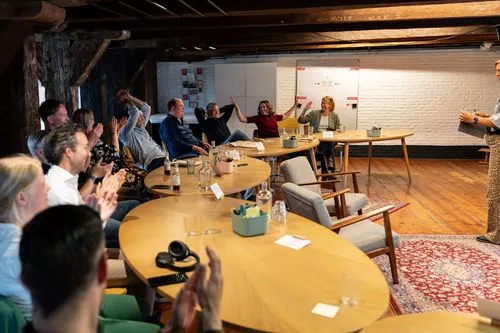
On Wednesday 13 May, I stood in Pakhuis De Zwijger in Amsterdam to give the closing address of an evening built around the Dutch book F*ck de klimaatverandering ("F*ck climate change"), in which ten authors offer ten different angles on why the climate movement keeps getting in its own way. I'm one of those ten. At the end of the evening, the moderator asked me: you're a behavioural psychologist, can you tie this together for us? A synthesis, no conclusion.
I picked a position nobody in the room was waiting for. How do you convince right-wing people to take climate action? Beyond the progressive, already-engaged crowd in the front rows who agreed with me anyway: the large majority out there who stay cold to our stories.
Being right versus winning is the distinction between being morally or factually correct, and actually succeeding in changing someone else's behaviour. The harder you argue from being right, the more insufferable you come across to people who disagree with you. What does work: changing the question from a sacrifice to an appealing alternative, and getting your hands dirty instead of just telling a story. More on persuasive communication →
The problem with being right
The essence of that evening sat in the tension between being right and winning. The harder we, as a climate movement, argue from our own rightness, the more insufferable we become. Especially to people who vote right-wing.
What that group definitely tunes out is doom porn. So much climate communication wallows in anger and outrage that it has almost become its own genre. It feels satisfying to write and to share. It confirms the people who are already convinced. And it reaches almost nobody who still needed convincing.
It's about winning, not about being right.
That line comes from Peter, one of the other speakers that evening, and I quoted him back to the room. Another fellow speaker, Evert, made a sharp point about the question we should really be asking. That's where it starts: with a different question, instead of a better argument.
Change the question
The climate movement almost always asks the same question: guilt, penance, sacrifice, punishment, doom and averting damnation. There's a different question available, and it's a lot more optimistic.
Ask me to have a fantastic hiking trip with my son, rather than to stop flying. That's a completely different question. I stay on the ground because of it, and I experience that as a choice rather than a ban. I get inspired by an alternative that is far more beautiful to embrace. Replace "go vegan" with an invitation to a Middle Eastern street food restaurant, and I'll eat vegetarian for the rest of my life.
That's what concretisation in the SUE Influence Framework comes down to: a gain only really works once someone can vividly picture it. The pursuit of something beautiful, more than the avoidance of a punishment.
There's a question underneath that one, which we find uncomfortable to ask, and that's the question about fossil fuel. We've all collectively held on to the belief that fossil is the big villain. To an extent, that's true. But something gets completely buried underneath it: access to cheap fossil energy is, alongside the warming it causes, also the source of prosperity. The prosperity that lets me, a Belgian who's lived in the Netherlands for twenty years and still carries a faint Flemish accent, sit in that room that evening.
The transition away from fossil fuel is a transition for prosperity, more than a transition against fossil fuel. We're at a fantastic moment, because this is now about we need blackmail-free energy, rather than we need to get off fossil fuel.
Olof van der Gaag spent eight years as director of the Dutch nature and environment organisation Natuur en Milieu, and is now chairman of the Dutch renewable energy association NVDE. He's stopped calling it green energy. Van der Gaag calls it orange energy: homegrown energy you can be proud of, energy that stops you being held hostage by Trump when he gets out of bed on the wrong side, by the emir of Qatar, or by Russia. I can assure you right-wing people respond hard to that.
Socialism will be fun, or it won't exist at all.
— Steve Stevaert, Flemish politician
Steve Stevaert, the Belgian politician who once made the progressive, left-wing story exciting again and died far too young, said that about socialism. I think it applies just as well to the climate transition. The climate transition will be enjoyable, or it will never happen at all. However objectionable that feels from our own moral framework: it's about winning, more than about having the moral high ground.
Getting your hands dirty: four people who won
Winning is about more than telling a different story. It's about getting your hands dirty. Four examples that show it.
I already mentioned Olof van der Gaag. By making the switch from environmental director to chairman of a renewable energy association, and putting his personal reputation and activism to work for the energy transition instead of against it, he's achieved more than another campaign from the sidelines ever could.
Donald Pols, then director of Milieudefensie (the Dutch branch of Friends of the Earth), announced a move towards Tata Steel shortly before this evening and was torched for it by his own base. I think it's a fantastic act, precisely because it's uncomfortable: he put his own reputation and activism on the line for the chance to achieve much more. That's where the difficult tension sits. Staying doctrinally pure clashes with taking big steps. Sailing on your own moral high ground clashes with wanting impact in a world that is messy and rarely cooperates perfectly.
Update, early June 2026
Pols was dismissed by Tata Steel less than two days after starting. The cause was an undisclosed past as a leader of a far-right student movement in South Africa, which opposed the end of apartheid in the early nineties. It changes nothing about the point above: the risk Pols took in putting his activism to work outside familiar territory still illustrates "getting your hands dirty". The outcome just makes visible how messy that road can be.
Alex Datema, a dairy farmer in Groningen and long-time chairman of the Dutch agricultural nature organisation BoerenNatuur, became director of Food & Agri Netherlands at Rabobank in 2023. From that role, he's involved in financing the very sector he comes from. There's plenty to say about a move like that, but the transition moves further if we make farmers part of the success story instead of figuring out how to get rid of "polluting farmers". Make farmers the heroes of transforming our food system. Pay them to maintain the landscape instead of buying them out. Then you let the financial incentives roll in the right direction.
Marjan Minnesma of Urgenda is my favourite example. I interviewed her for my podcast, and she said something that stuck with me: she'd rather be seen as an entrepreneur than as an activist. Urgenda is the organisation, above all others, that forced climate action from the Dutch government through the courts, but Minnesma told a completely different kind of story.
She has a neighbour who farms. She asked him why he used dead, industrial production grass instead of herb-rich grassland. His answer: that herb-rich grass costs twice as much. So Minnesma thought: if it's just as cheap as ordinary grass, he'll buy it. She bought an enormous stock of herb-rich grassland seed, set up a group purchase online, and sold it by the square metre at the price of ordinary grass. Within a few weeks, the stock had sold out.
That first success story snowballed. Provinces started calling. Then LTO, the Dutch farmers' interest organisation that used to dismiss Minnesma as an annoying climate activist, got on board too.
Update, 22 May 2026
Marjan Minnesma died nine days after this evening, aged 59, from the effects of breast cancer she had been fighting privately for some time. She kept working until early May. The story about the herb-rich grassland is one of the last times she told it herself.
What this has to do with the Influence Framework
At SUE we use the Influence Framework to break behaviour down into four forces: pains, gains, comforts and anxieties. Everything I said in Pakhuis De Zwijger fits neatly into that model, even though I called it something else at the time.
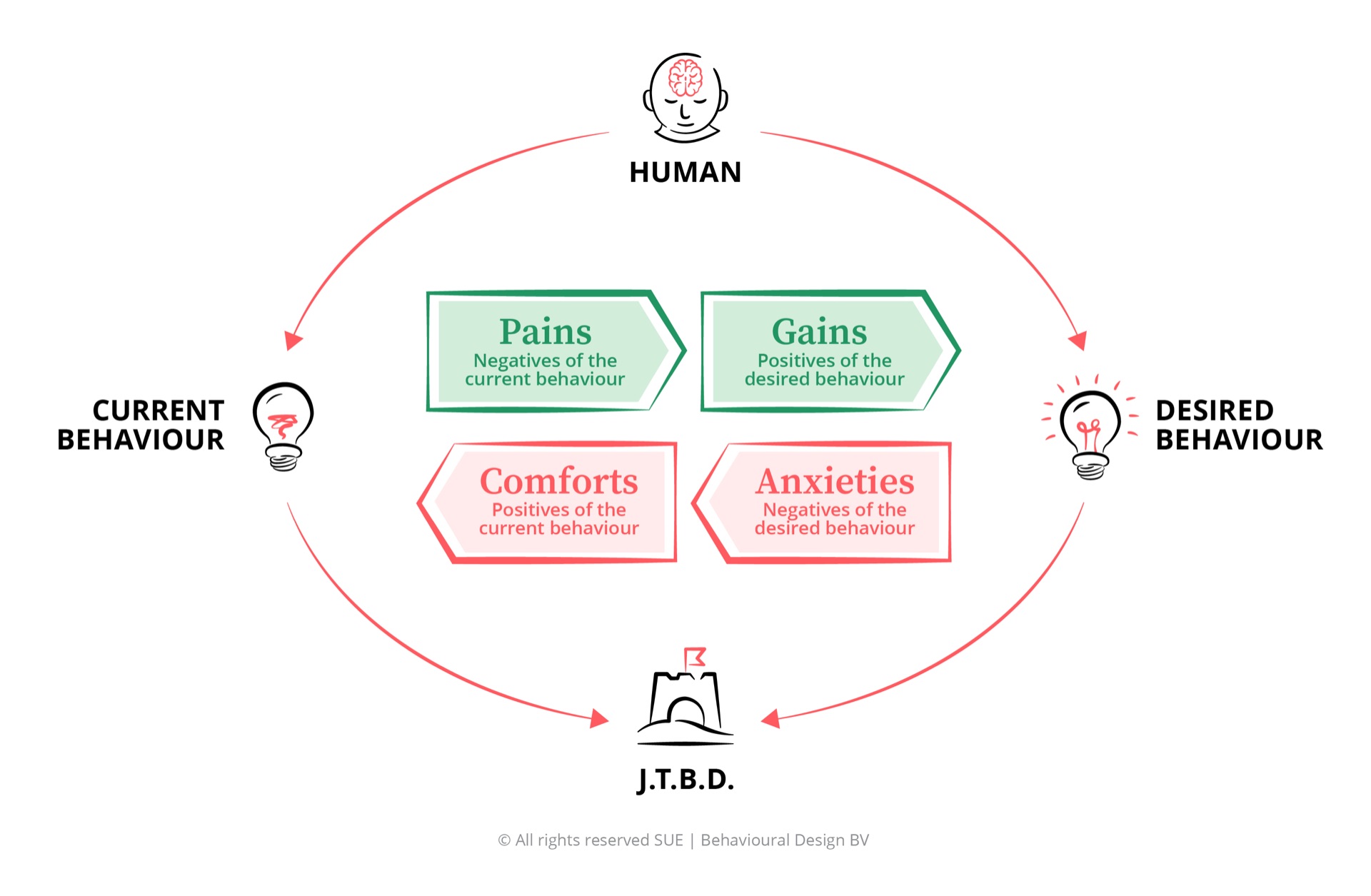
The classic climate message pushes on pains: guilt, punishment, doom and damnation. That works on people who already feel addressed, because recognition reinforces an existing position. On everyone else, the same message mostly triggers resistance. Ask me for a hiking trip with my son, and I get shown a gain instead of a pain to avoid.
Blackmail-free energy and orange energy do something different. They take an existing comfort, namely independence and pride in what's homegrown, and use it as a lever for the transition instead of working against it. At the same time, they weaken an anxiety that often goes unaddressed among right-wing voters: distrust of dependence on foreign powers. Kurt Lewin, the social psychologist whose force field analysis the Influence Framework is built on, showed that behaviour rarely changes by pushing driving forces harder. It works better to weaken the forces holding it back.[1]
That's exactly what Van der Gaag, Datema and Minnesma did. None of the three tried to win the other person over with a stronger argument. They took what the other person already valued, whether price, pride, or independence, and built a bridge over it.
The Netherlands, a country of self-sabotage
I closed with an observation about my adopted country. The Dutch, and I count myself among them by now, love to wallow in their own rightness. Worse, they've also been handed every possible tool to force that rightness through, and that slows the energy transition down in practice.
Every step you want to take in the energy transition can be sabotaged because neighbours reject an electricity cabinet on their street. Every project can be sabotaged because an environmental group found a protected species somewhere, halting it for two years. Those objection procedures serve a real purpose. But through that same route, the one of getting your hands dirty, we also need to dare to write new laws and regulations that help the transition along instead of killing it off.
Conclusion
Being right feels good. It's safe, it's morally comfortable, and it confirms who you already are. Winning is more uncomfortable. It asks you to change the question from a sacrifice to an appealing alternative, to acknowledge what's valuable about the status quo before you ask someone to give it up, and to take risks yourself instead of shouting from the sidelines about who's right.
That's true for climate action. It's just as true for any change you're trying to bring about with a colleague, a client, or a community.
Frequently asked questions
What is the difference between being right and winning?
Being factually or morally correct about a topic rarely changes someone else's behaviour by itself. The harder you argue from being right, the more insufferable you often come across, especially to people who disagree with you. Winning someone over requires a different approach than simply broadcasting that you are right.
Why does doom messaging fail to break through climate scepticism?
Doom messaging mainly appeals to people who are already convinced: it confirms what they already feel. For people who are sceptical or indifferent towards climate action, a message of guilt, punishment and doom backfires. They tune out, or dig in further.
What is blackmail-free or 'orange' energy?
Blackmail-free energy is renewable energy framed as homegrown energy, one that frees a country from dependence on fossil imports from powers like Russia or Qatar. Olof van der Gaag, chairman of the Dutch renewable energy association NVDE, calls it "orange energy" instead of "green energy": energy you can be proud of, regardless of your politics.
How does the SUE Influence Framework help persuade climate sceptics?
The SUE Influence Framework looks at four forces: pains, gains, comforts and anxieties. Instead of pushing harder on the pain of climate change, which mostly triggers resistance, it works better to paint an appealing alternative and take the other person's anxieties and doubts seriously instead of ignoring them.
What can communication professionals learn from this climate example?
That persuasion rarely works through more arguments or by being more right. Change the question from a sacrifice to an appealing alternative, acknowledge what the other person already values in the status quo, and be willing to take risks yourself by taking concrete steps rather than just telling a story.
Apply this in your field: Communications · Marketing · HR · Change management · Managers
See our training programmes →