
You attended a leadership programme. You learned to ask open questions, listen actively, hold back on solutions. You applied it in your next one-on-one. It felt awkward but right. A week later, everything was back to normal.
That is not your fault. It is how coaching leadership is taught.
Most programmes treat it as a conversation technique. Ask the right question and behaviour changes. But behaviour does not change because of questions. Behaviour changes because of context.
Coaching leadership is a leadership style where you don't direct tasks but shape behaviour. You ask questions instead of giving answers, give autonomy instead of instructions, and design the environment so team members make the right decisions themselves. The difference with standard coaching: you don't just change the conversation, you change the context. More about Behavioural Design for managers →
What is coaching leadership?
Coaching leadership is the opposite of directive leadership. Where a directive leader tells people what to do and how, a coaching leader asks questions. Not to be nice, but because questions have a different psychological effect than instructions.
The mechanism is simple and powerful. When someone reaches a conclusion themselves, psychological ownership emerges. The conclusion feels like mine. And something that is mine, I defend. Something that belongs to my boss, I execute as long as someone is watching.
At Sherpa Prep, a GMAT training company in the US, they discovered this by accident. The instructor had spent years telling students how many hours they needed to study. It didn't work. Students nodded and then did their own thing. Then he changed the approach. He asked two questions: "Why do you want to go to graduate school?" and "What score does your target university require?" The students answered those questions themselves. Then they turned to the instructor and asked how many hours that would take. When he told them, every student accepted it and did the work.
Same information. Radically different effect. The difference: autonomy.
 Amsterdam City Centre
Why standard coaching leadership doesn't work
Most leadership programmes teach coaching as a set of skills. Ask open questions. Listen without judgement. Summarise. Don't give advice.
That is a recipe for disappointment.
Not because those skills are useless. But because they are a willingness intervention. They work on the motivation of the leader ("I want to lead differently") without changing anything about the context in which that must happen.
And context always beats intention.
In behavioural science, we know the Fundamental Attribution Error: the tendency to attribute behaviour to the person ("he's not coaching enough") while the situation explains the behaviour. A manager who coaches brilliantly in one team and falls back to directive in another is not inconsistent. That manager is responding to two different contexts.
Concretely: if your week is packed with decisions that need to be fast, if you are evaluated on output rather than team development, if your team members have no room to make mistakes, then coaching leadership is a luxury the context does not permit. No training in the world compensates for a reward system that rewards the wrong behaviour.
Simplicity eats willpower for breakfast.
That is a principle from BJ Fogg at Stanford. It means: make desired behaviour easy and it happens. Make it hard and no amount of motivation helps. Coaching leadership only becomes default behaviour when the work environment makes it the easiest option.
What behavioural science says about coaching leadership
To understand why coaching leadership works when it works, and fails when it fails, it helps to look at the four forces that drive all behaviour.
The SUE Influence Framework makes those forces visible. Every leader trying to lead differently faces forces pushing toward change and forces pulling back to the old way.
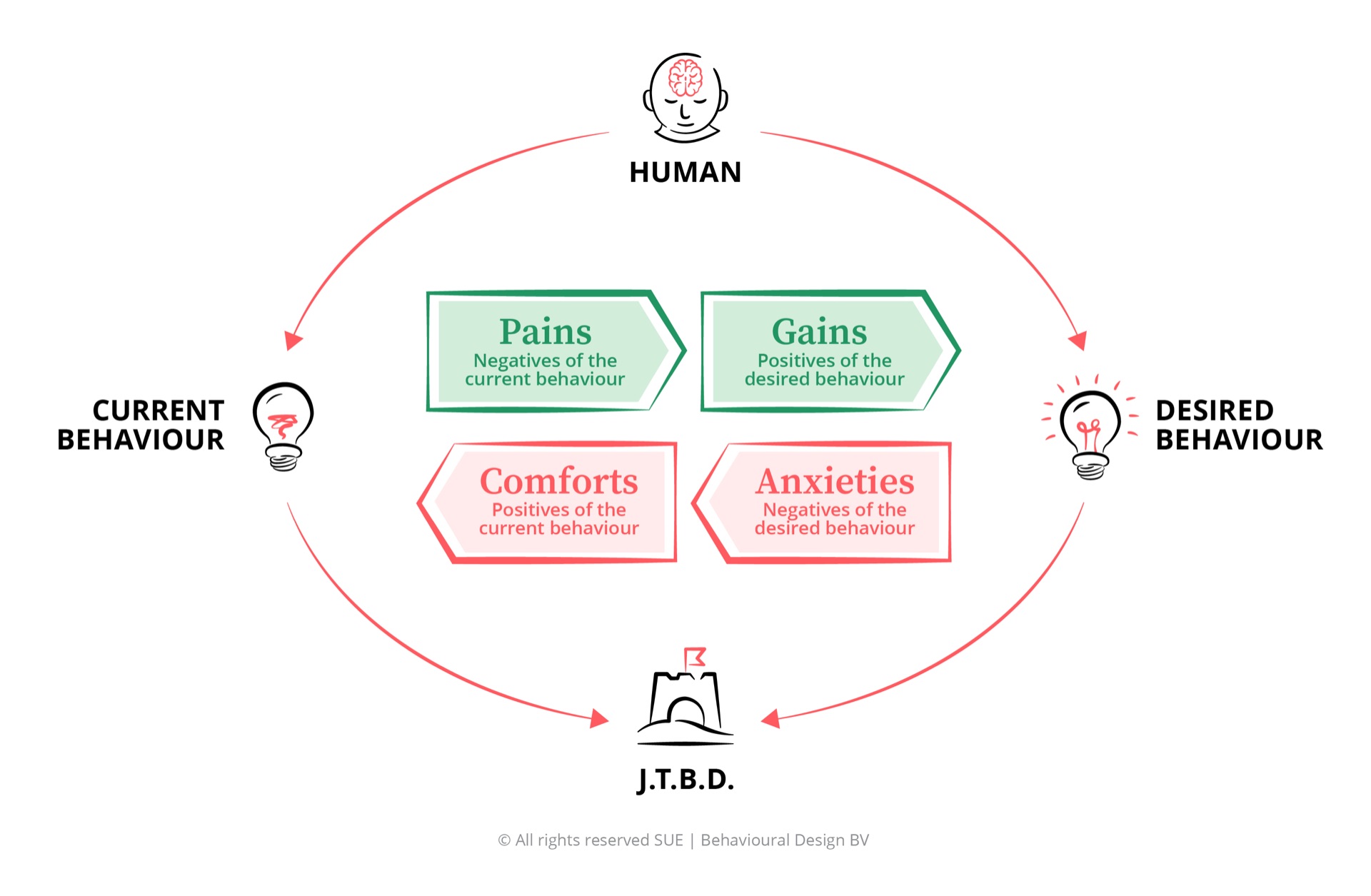
The pains of directive leadership are real: a team that does not think for itself, employees who only move when told, the feeling that everything rests on your shoulders. Most managers recognise this immediately.
The gains of coaching leadership are there too: a team that takes ownership, better decisions because more perspectives count, less pressure on you as a leader. But those gains are abstract. They are in the future. They are uncertain.
The comforts of directive leadership are tangible and immediate: it is faster, you have control, you know it will be done right, it feels productive. These are the positives of the old behaviour. They are there every single day.
The anxieties around coaching leadership are concrete: "What if my team makes the wrong decision?" "What if it takes too long?" "My boss expects results, not processes." "What if I become redundant?"
Look at that balance. The pains and gains push toward change, but the comforts and anxieties pull back. And comforts almost always beat gains, because they are concrete and immediate. That is why a leadership programme works for two days and then fades.
You've read about it. But what if you could apply it yourself, to your team, your organisation, your stakeholders?
As Europe's #1 academy in Behavioural Design, we train professionals in analysing, predicting and influencing behaviour, live, online or in teams. Based in Amsterdam, with over 10,000 alumni from London to Sydney and Singapore to New York.



 EQAC
EQACCertified
Training
How to design coaching leadership that lasts
The solution is not trying harder. The solution is designing the context so that coaching leadership becomes the easiest option. Four interventions that make a structural difference.
1. Change the meeting structure
In most meetings, the manager is the person who talks, decides and delegates. That is the default. And defaults are the most powerful behavioural instrument that exists. According to research by Johnson and Goldstein (2003) on organ donation, the difference between 15% and 90% participation lies entirely in the default.
Change the default. Start every meeting with a round: "What is the biggest risk of the plan we're working on?" Not as a casual question, but as a fixed part of the format. Now speaking is the norm, not listening to the boss. The manager does not need to coach. The structure does the work.
2. Make ownership visible and immediate
Google discovered in Project Aristotle that the best-performing teams were not the teams with the smartest people. They were the teams where everyone spoke equally. Equal speaking time was the strongest predictor of team performance.
The person who speaks up when it matters is not the bravest. It is the person in the safest context.
That is not a soft feeling. It is a structural property of the context. A team where three people do 80% of the talking rewards directive behaviour. A team where speaking time is equally distributed rewards ownership.
Concretely: assign projects to individuals, not the team as a whole. Let that person present the result, not the manager. Publicly celebrate the moment someone makes a decision without consulting you. That is the SPARK that reinforces the behaviour.
3. Redesign the reward system
If you are evaluated on individual output, coaching leadership is a risk. You invest time in growing others while your own targets are under pressure. That is not a lack of motivation. It is a rational response to a perverse incentive.
According to research by Dan Ariely at Intel, a cash bonus had the shortest positive effect on motivation. The day after the cash bonus, workers were 13% less productive than workers who received no bonus at all. Experiential rewards (a team outing, public recognition) worked longer and stronger.
Applied to coaching leadership: evaluate leaders not just on results, but on the development of their team. Make that visible in the performance review. And make it a concrete metric, not a vague part of a competency profile.
4. Start with two minutes
James Clear describes the two-minute rule in Atomic Habits: every new behaviour should take less than two minutes to start. "Read a book per week" becomes "read one page every evening." The threshold must be so low that you cannot fail.
Applied to coaching leadership: don't start with a completely different meeting format. Start with one question. At the end of every one-on-one, ask the same question: "What do you need to be able to do this yourself?" That is two minutes. It costs nothing. And it installs a pattern that grows.
After a few weeks, add a second element: the round at the start of meetings. Then a third: the project presentation by the team member. Step by step you build a context that makes coaching leadership the easiest option.
 Training for professionals
Frequently asked questions about coaching leadership
What is coaching leadership?
Coaching leadership is a leadership style where you don't direct tasks but shape behaviour. You ask questions instead of giving answers, give autonomy instead of instructions, and design the environment so team members make the right decisions themselves. The difference with standard coaching: you don't just change the conversation, you change the context.
Why does coaching leadership often fail?
Because it is usually taught as a conversation technique. Ask open questions, listen actively, don't give advice. But if the work context stays the same (same meeting structure, same reward systems, same time pressure), the system pulls people back to old behaviour. Coaching without context design is a conversation without consequences.
What is the difference between coaching and directive leadership?
Directive leadership directs tasks: what needs to happen, when, how. Coaching leadership focuses on people: what do you need to be able to do this? From behavioural science, the key is that coaching leadership gives autonomy, which creates psychological ownership. People who reach a conclusion themselves execute it. People who receive an instruction check it off.
How do I start with coaching leadership?
Start small. At the end of every one-on-one, ask one fixed question: "What do you need to be able to do this yourself?" That takes two minutes and installs a pattern. After a few weeks, add a second element: a fixed round at the start of meetings. Build the context step by step.
Conclusion
Coaching leadership is not a personality trait or a conversation technique. It is a behaviour pattern that depends on what the context makes easy and what it makes hard. The standard approach, teaching leaders to ask better questions, addresses willingness but ignores capability. And capability is where the real leverage lies.
That means: different meeting structures, reward systems that value team development, and starting so small that failure is impossible. Not because you lack the will to lead differently. But because the context needs to support the behaviour you are trying to adopt.
Want to learn how to apply behavioural science to leadership challenges? In the Behavioural Design Fundamentals Course you learn to apply the Influence Framework and SWAC Tool to coaching, team dynamics, and any behaviour challenge you face. Rated 9.7/10 by 10,000+ professionals.

1,5 minutes of influence
Every week I notice something: a hospital sign, a supermarket shelf, a phrase in a meeting. Always something that perfectly illustrates how context shapes behaviour. I write it down. You get it in your inbox, every Thursday morning. In 90 seconds.
Join 10,000+ readers · Free · Unsubscribe anytime