A new way of working is announced. Management has decided: we're going agile, or we're implementing a new CRM, or we're switching to hybrid work. An intranet post goes up. An email goes out. There's a town hall. The message is clear. The arguments are strong. And yet, very little changes.
Sound familiar? You're not alone. McKinsey research shows that 70% of all change initiatives in organisations fail. The strategy is usually fine. The technology works. But people don't change their behaviour. And the way we communicate internally has everything to do with that.
The question is not whether you need to communicate more. It's whether you need to communicate differently. And the answer doesn't lie in better PowerPoints or prettier intranet pages. It lies in a better understanding of how people make decisions.
Improving internal communication means designing communication that doesn't just inform, but actually changes behaviour. The difference is not in the message, but in understanding what holds people back and what moves them forward. Behavioural science offers a concrete framework for that. More about Behavioural Design for communication →
What does improving internal communication actually mean?
Internal communication is everything an organisation does to share information, meaning and direction with the people who work there. From the weekly newsletter to the personal conversation at the coffee machine. From the strategy presentation to the Slack message.
Improving internal communication is about redesigning that communication so it's not only read or heard, but so it actually leads to different behaviour. And that's exactly where most organisations go wrong.
The standard approach to internal communication is built on an assumption that was debunked decades ago: that if people receive the right information, they will do the right thing. More information, therefore more understanding, therefore more buy-in, therefore different behaviour. A neat linear model. It just doesn't work that way.
Heart of Amsterdam
Why the standard approach doesn't work
Daniel Kahneman and Amos Tversky discovered that people have two modes of thinking. System 1 is fast, automatic and unconscious. System 2 is slow, deliberate and analytical. Roughly 96% of our daily decisions run through System 1.
Most internal communication targets System 2. The rational presentation. The factual argument. The logical case. But the system that decides behaviour is System 1. And System 1 is not reached through information. It's reached through context, ease, social norms and emotion.
Informing is not a strategy for behaviour change. It is, as we call it at SUE, a design for disappointment.
That may sound harsh. But look at how most change initiatives are communicated internally:
- There's a town hall with a strategic presentation. Everyone nods. Nothing changes.
- An intranet post goes out with the new way of working. Nobody reads it to the end.
- An e-learning module is launched. Employees click through it as fast as possible.
- An FAQ is drafted. It answers questions management has, not questions employees have.
All of these communication tools share one trait: they assume the problem is an information deficit. And it almost never is.
The real problem is that employees don't know how to perform the new behaviour. Or they're afraid of what will change. Or their current way of working feels good enough not to give up. Or nobody around them is doing it yet.
Those are behavioural problems, not information problems. And behavioural problems are not solved with communication that talks about change. They are solved with communication that makes change easier.
Behavioural science as a lens on internal communication
Behavioural science asks a different question than most communication professionals are used to. Not "how do we convince people?", but "what holds them back, and what drives them forward?"
The first question leads to more arguments, more presentations, more volume. The second leads to removing obstacles. And that is what effective internal communication does.
An example. In change initiatives that fail, we often see management assuming employees don't want to change. "They're not motivated." "They don't get it." But behavioural science teaches us the opposite. The problem is almost never willingness. It's the situation.
This is the Fundamental Attribution Error: we attribute behaviour to the person ("they don't want to"), when the circumstances are what's shaping the behaviour ("it's too hard, too unclear, too uncertain"). For internal communication that means: not communicating harder, but redesigning the situation.
Good person, bad circumstances. That's the lens through which to look at behaviour.
The SUE Influence Framework applied to internal communication
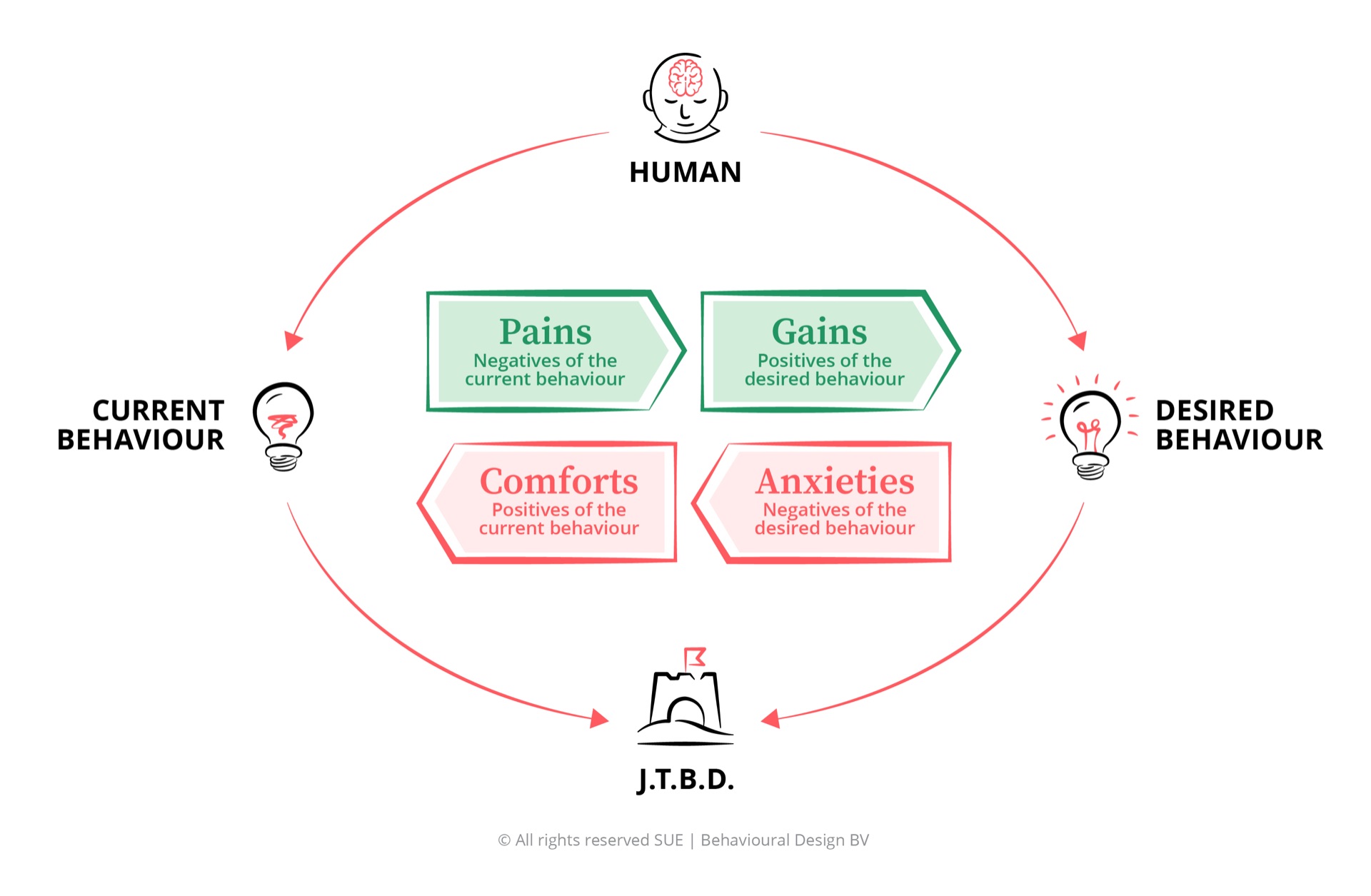
The SUE Influence Framework© is a diagnostic tool that maps which forces determine whether someone changes their behaviour. It's based on Kurt Lewin's Force Field Analysis and distinguishes four forces:
Pains are the things that aren't working in the current situation. For employees: frustrations about the current workflow, lost time, double work, unclear processes. When you name these pains in your communication, people feel understood. "Finally someone who says what I'm experiencing."
Gains are the benefits of the new behaviour. Not the benefits for the organisation, but for the employee themselves. How does the change make their work easier, more enjoyable or more meaningful? How does it help them with what they're trying to achieve?
Anxieties are all the reasons someone doesn't want to embrace the new behaviour. Whether it's uncertainty ("can I do this?"), lack of trust ("is this really happening?"), or fear of losing status ("will I become less relevant?"). Without resolving anxieties, nobody moves.
Comforts are the positive sides of the current situation. The familiar workflow, the known system, the existing routines. Even when the current situation isn't objectively optimal, it feels safe and familiar. And we choose comfort over effort.
Most internal communication focuses exclusively on gains: "This is what we're doing and these are the benefits." But if you don't address anxieties and comforts, you're talking to a wall. The forces keeping people where they are outweigh the forces pulling them toward the new.
Lewin's discovery, the foundation of the Influence Framework, is that the most effective strategy is not to strengthen the driving forces (push harder), but to weaken the restraining forces. For internal communication: spend less time explaining why the change is good, and more time removing what's holding people back.
You've read about it. But what if you could apply it yourself, to colleagues, teams, or your entire organisation?
As Europe's #1 academy in Behavioural Design, we train professionals in analysing, predicting and influencing behaviour, live, online or in teams. Based in Amsterdam, with over 10,000 alumni from London to Sydney and Singapore to New York.
EQACCertified
Training
How to design internal communication that changes behaviour
If informing isn't enough, what should you do instead? Here are five principles from behavioural science you can apply to your internal communication right away.
1. Start with the anxiety, not the ambition
Most change communication opens with the vision. "We're building an agile organisation." "We're becoming data-driven." Fine. But for the employee on the floor, that vision mainly raises questions. What does this mean for me? Can I do this? Will my role change? Does my experience still matter?
Effective communication starts by acknowledging those questions. Not as an FAQ at the bottom of an intranet page, but as an opening line. "We know this raises questions. We understand this feels uncertain. Here's what we know, what we don't know yet, and how we'll move forward together."
Amazon did something similar when large enterprises refused to move their data to the cloud. The anxiety wasn't technical, it was psychological: "I don't want to send sensitive data over the internet." Amazon's solution? The Amazon Snowmobile: an armoured truck that drove to the company to physically collect data. No extra argument. A solution for the anxiety.
2. Make the desired behaviour easy, not just desirable
The most underestimated insight from behavioural science: if something is easy, you need far less convincing. Capability beats willpower.
Applied to internal communication: don't just communicate what is changing, design the first step so it takes almost no effort. Want people to use a new system? Make sure it's already logged in on their laptop. Want teams to reflect weekly? Put a recurring calendar invite with a template in it.
This is the principle of defaults: make the desired behaviour the standard, so people have to actively choose not to do it. Netflix understands this. The next episode starts automatically after five seconds. You have to actively intervene to stop.
3. Use social norms instead of management directives
People look at what others do. Not at what management says. This isn't cynicism, it's biology. Social proof is one of the most powerful drivers of human behaviour.
In a Facebook experiment, 61 million users were shown a message on election day. The version that showed which friends had already voted led to 340,000 additional votes. The information-only version had no effect. Same message, fundamentally different result, through the addition of social proof.
For internal communication this means: show who's already doing it. "Team X has been working with the new system for three weeks. Here's what they discovered." That's more powerful than any policy memo. Because it answers the unspoken System 1 question: "Are other people like me doing this too?"
4. Give people ownership by asking questions
When people feel something is being imposed on them, they resist. Psychologists call this reactance. The antidote is not softer persuasion. It's restoring autonomy.
A case that illustrates this well: at Sherpa Prep, a GMAT preparation school, the instructor didn't tell students how many hours they needed to study. Instead, he asked questions: "Why do you want to go to graduate school? What GMAT score does your target university require?" Students arrived at the answer themselves. And when the instructor told them how many hours it would take, they all accepted without protest.


Apply this to internal communication: ask questions instead of giving answers. "What frustrates you most about our current process?" "What would help you do this faster?" Anyone who reaches a conclusion themselves doesn't argue against it.
5. Design for repetition, not for launch
Most internal communication campaigns have a clear starting point: the launch. And then it goes quiet. But behaviour change is not an event. It's a process that takes 2 to 8 months, depending on the complexity of the new behaviour.
You need repetition. Not repetition of the same message, but repeated moments where the desired behaviour is facilitated, reinforced and made visible. A weekly Slack message with a small win. A monthly check-in. A recurring moment where the team reflects on what's working and what's not.
This is the AGAIN principle from the SWAC model: behaviour doesn't happen spontaneously. It needs to be triggered again and again, until it becomes a habit.
Training for professionals
Frequently asked questions about improving internal communication
Why does internal communication often fail?
Because most internal communication assumes a rational model of human behaviour: if people receive enough information, they'll change. But behavioural science shows that 96% of our decisions are made unconsciously through System 1. Information alone activates the wrong thinking system. Effective communication designs the context, not just the message.
How can you improve internal communication with behavioural science?
By first understanding the unconscious forces that hold employees back (anxieties, habits) and the forces that drive them (frustrations with the current situation, benefits of the new). The SUE Influence Framework helps you map those forces systematically and design communication that addresses them, rather than relying on information alone.
What is the difference between informing and changing behaviour?
Informing addresses conscious, rational thinking (System 2). But behaviour is driven by the automatic brain (System 1). Effective internal communication designs the context so that the desired behaviour becomes the easiest option. That can mean: setting the new behaviour as the default, using social norms, or removing anxieties before asking for action.
What is the SUE Influence Framework?
The SUE Influence Framework© is a diagnostic tool based on Kurt Lewin's work. It maps four forces that determine whether someone changes their behaviour: Pains (what's not working), Gains (what the change delivers), Anxieties (what holds people back) and Comforts (what keeps them where they are). The framework is used by over 10,000 professionals worldwide.
How do you make change communication more effective?
By communicating smarter, not harder. Make the desired behaviour easy (work on capability), use social norms instead of management directives, and take employee anxieties seriously before asking them to change. The most effective change communication removes obstacles rather than adding arguments.
PS
At SUE we see it every week. An organisation that communicates a change brilliantly internally, with a solid strategy and a convincing presentation. And then, six months later, has to admit very little has actually changed. Not because the message was wrong. But because the message only reached System 2. And System 2 is not the one making the decisions. Once you understand that, you don't just change how you communicate. You change how you think about communication.
1.5 minutes of Influence
Every week I spot something: a hospital sign, a supermarket shelf, a sentence in a meeting. Always something that shows exactly how context shapes behaviour. I write it down. Every Thursday morning, it lands in your inbox. In 90 seconds.
Read by 10,000+ professionals · Free · Unsubscribe anytime