Your plan is sound. The management team does not move.
You worked on it for weeks. The analysis is complete, the numbers add up, the risks are covered. You present it to the management team and get compliments on the work. Then someone says it would be good to look at it once more, and a month later your plan is back on the agenda. Or gone from it.
The reflex is predictable. You tighten the case, add a scenario and polish the slides. More persuasive power, you think, comes from a better story.
But your story was never the problem. A board that does not move rarely doubts your numbers. It is weighing something that is not in your presentation. Influencing upwards is therefore mostly that: influence. Understanding how the people at that table choose, and designing your proposal around it.
Influencing upwards is getting your manager, management team or board behind an idea, proposal or decision. Good arguments are necessary and rarely enough. Senior management moves when you know what makes saying yes hard for them and take that away: the risk, the timing, the fit with what is already under way. More on persuasion →
What is influencing upwards?
Influencing upwards is getting people with more formal power than you to act on something you propose. Competency profiles describe persuasiveness as arguing clearly and presenting firmly. That is half of it. The other half is knowing what is going on for the other person at the moment you make your case.
Anyone who wants to persuade someone usually thinks about their own side of the table: what do I say, in what order, with what evidence. People who are good at it start on the other side. What does this person have to give up by saying yes? What can go wrong for them? Whom do they then have to persuade in turn?
That applies to every conversation, and most strongly when you persuade upwards. Your manager, the management team and the board have more to lose from a wrong decision than you have from a rejected proposal. The general principles of persuasion are in the guide to persuasion and influence. This article is about one situation: your plan is sound and nothing happens above you.
Why does the management team not move when your plan is sound?
The management team does not move because a sound plan only strengthens the forces in favour of the decision. What holds the decision back stays in place. That distinction comes from psychologist Kurt Lewin, and in 2017 Nobel laureate Daniel Kahneman called it the best idea he had ever heard in psychology.[1]
Lewin saw behaviour as an equilibrium between driving forces and restraining forces. If you want to change something, you can push harder with arguments, incentives and pressure. Or you can take away what is holding it back. According to Kahneman the second is a completely different kind of activity, and it starts with a different question:
"What can I do to make it easier for that person to move?"
Daniel Kahneman, Freakonomics Radio (2017)
A presentation to the management team almost never asks that question. It answers the question of why the plan is good.
And what holds a management team back? Things you rarely hear in a meeting. A director who chose the current approach last year. A budget that has already been promised three times. The judgement that this would be the fourth major project in an organisation that can handle two. For an executive, doing nothing is often the safest choice, because you are rarely held to account for a decision you did not take.
Which way of persuading works upwards?
Upwards, persuading with arguments works best and pressure works worst. In 1992, organisational psychologists Gary Yukl and Bruce Tracey studied nine ways in which managers influence others.[2] Each manager's subordinates, peers and boss filled in a questionnaire. Three tactics worked best: rational persuasion, appealing to what someone cares about, and consulting people on the plan. Three worked worst: pressure, forming a coalition to overrule someone, and appealing to rules or authority.
For anyone persuading upwards, that study contains two things. The first is that people mostly use rational persuasion towards their boss. That is the presentation you already gave. The second is that two tactics which work reasonably well with peers and subordinates did not work with the boss: ingratiation and exchange. So you have fewer tools upwards than sideways or downwards.
What remains is how you bring the substance. Jane Dutton, Susan Ashford and their colleagues asked 42 middle managers at a hospital about the times they had tried to get an issue onto the agenda of top management, successfully and unsuccessfully.[3] They found three kinds of moves. How you package the issue: in the logic of a business plan, tied to goals the top already has. Whom you involve, formally and informally. And how you handle the process: your preparation, the channel and above all the timing.
What stands out in the discussion of that research in MIT Sloan Management Review is how conservatively the successful managers went about it. They toned down radical ideas, introduced an issue step by step and matched their story to the organisation's strategy and culture.
That is the opposite of how a good plan is usually presented: big, complete and all at once.
What does a board weigh up? Four forces
A board weighs up four forces, and your presentation usually covers two of them. At SUE we map them with the SUE | Influence Framework©, the model from Behavioural Design that turns Lewin's force field into four forces you fill in per decision maker.[4]
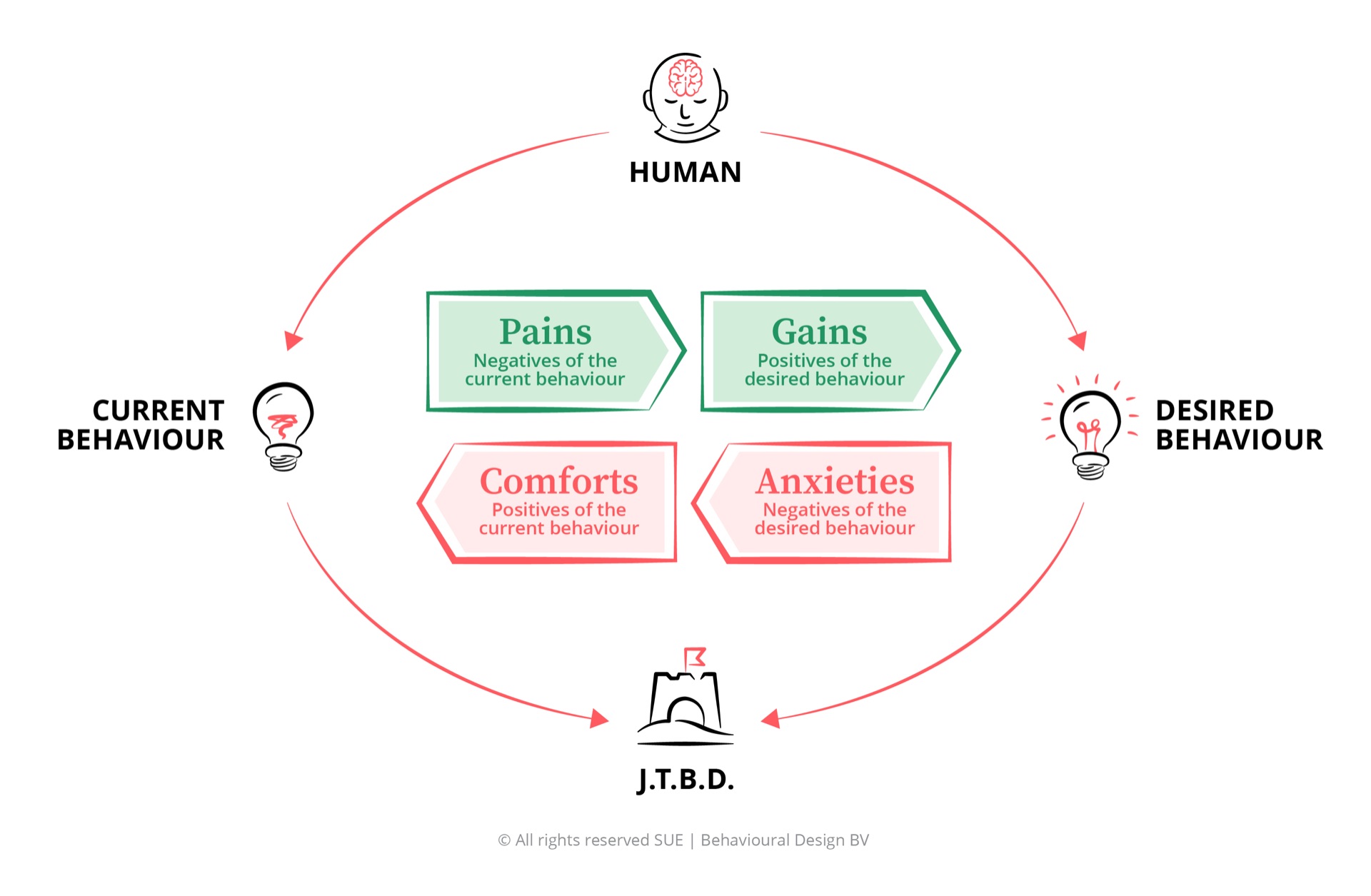
The two forces that move towards yes are the pains and the gains. What is bothering this executive now, and what does your plan give them? Fill that in for the person and not for the organisation. A finance director and an operations director are bothered by different things, even when they decide on the same plan.
The two forces that keep people at no, or at not yet, are the comforts and the anxieties. The comforts: the current approach is running, this table once chose it and nobody has to explain anything. The anxieties: what if this fails with my name on it? What will the supervisory board say? Can the organisation take this on as well?
The strength of this breakdown is that it forces you to fill in the restraining forces before you walk into the room. If you cannot write down your board's anxieties, you are not ready to present.
Delay in the management team is rarely about your arguments and almost always about a risk nobody has named.
How do you influence upwards?
Five things you can do before the next meeting.
1. Speak to each decision maker beforehand, separately
Ask each person what they need in order to say yes and what holds them back. You will not hear that in a meeting. In a ten-minute conversation you often will. That way you walk into the room with the objections already on the table.
2. Tie your plan to something the top already wants
This is the packaging from Dutton's research. A proposal that connects to a goal the board has set itself does not have to fight its way onto the agenda. It is already on it.
3. Make the first step small and reversible
Do not ask for the whole programme. Ask for a three-month trial with one team and an agreed moment to stop or continue. That removes the largest anxiety: being stuck with a decision that turns out to be wrong.
4. Name what can go wrong yourself
Put the risk in your story before someone else does, together with what you are doing about it. Then it is a risk you have thought through, and not a hole someone else finds in your plan.
5. Choose the moment
The managers in the hospital study paid attention to timing: when to raise it, when to persist and when to wait. A proposal that collides with the budget round or a reorganisation loses to the calendar, however good it is.
Does this also apply when you only need to persuade your boss?
Yes, and it is simpler then, because you have one person to understand. The forces are the same. Your manager has a boss, a budget and a reputation of their own. A proposal that creates extra work for them, or that they have to defend higher up, asks something of them. Make that as small as possible. Supply the case they need to take it further themselves.
If you have no formal line to the people you need on board, influence without authority is the related subject. If you want to know why a stronger story so rarely makes the difference, read why facts and arguments rarely persuade. And if you are an adviser whose client does not follow your advice, there is the article on becoming a trusted advisor.
Frequently asked questions about influencing upwards
What does influencing upwards mean?
Influencing upwards means getting people above you in the organisation, such as your manager, the management team or the board, to act on your idea or proposal. It consists of arguing clearly and of understanding what the other person weighs up. The second part is skipped most often.
What is the psychology of persuasion?
The psychology of persuasion shows that people rarely decide on arguments alone. Behaviour is an equilibrium between forces that move someone and forces that hold them back, such as habit, risk and doubt. Removing those restraining forces achieves more than adding extra arguments.
How do you persuade someone to do something?
You persuade someone to do something by first finding out why they are not doing it yet. Ask what makes it hard, remove that obstacle and make the first step small. Good arguments help, but they only work once what holds someone back has been dealt with.
How do you persuade senior management of your plan?
Speak to each decision maker separately beforehand, tie your plan to a goal senior management already has and ask for a small, reversible first step. Name the risks yourself. Research by Yukl and Tracey (1992) shows that pressure and appeals to authority are the least effective tactics.
Can you learn to be more persuasive?
Yes. Persuasiveness is a skill and not a character trait. You develop it by learning how people choose and by mapping, before every important conversation, what moves the other person and what holds them back. The SUE | Influence Framework© gives you a fixed structure for that.
Conclusion
Your plan was sound and the management team did not move, because being right and getting movement are decided by different things. Your arguments made the yes stronger. The delay came from what was not in there: the risk for the people at the table, the approach they once chose themselves, the timing.
Influencing upwards is influence. You map how the decision makers choose and you design your proposal so that saying yes becomes easier than putting it off. In The Art of Influence© online you learn how people choose and how to build your plan, your presentation and your conversations around that.
If you know what saying yes costs a management team, a good plan is enough.