Leadership Development That Works: The Behavioural Science Behind It
Every organisation invests in leadership development. Two-day workshops, executive coaching, 360-degree feedback sessions, six-month leadership programmes. And yet - ask any HR director how satisfied they are with the return on that investment, and you hear the same thing, almost every time.
"It's inspiring. But then people go back and nothing really changes."
This is not a coincidence. It is a structural problem that behavioural science has known about for decades, but that most leadership programmes systematically ignore. In this article, I want to explain what goes wrong - and how to design leadership development that actually sticks.
Leadership development is the systematic strengthening of leadership behaviour in managers and executives through learning, practice and behavioural design. The goal is that new behaviour sticks in everyday work, not only during training. The difference from a leadership course: a course provides knowledge, leadership development changes behaviour. Explore our leadership training programmes →
What is leadership development?
Leadership development is broader than a course or training. It is about systematically building leadership behaviour: the ability to guide teams, make decisions under uncertainty, influence others without formal authority, and create an environment where people give their best.
Good leadership is not a personality trait. That is the first and most underestimated lesson from behavioural science. Leadership is a set of behaviours. And behaviours can be designed. That means the leader you want to become is not dependent on innate talent, but on building the right habits, in the right environment, with the right feedback.
That sounds simpler than it is. Because this is where the real problem starts. For a comprehensive overview of what current research says, see our complete guide to leadership.
Why most leadership training programmes don't work
In 1988, Baldwin and Ford published their classic research on transfer of training.[1] Their conclusion: less than 10% of what people learn in a training actually transfers to the workplace. Ten percent. After more than thirty years of additional research, that figure has barely improved.
McKinsey identified in a report on leadership development programmes that the four most common causes of failure all trace back to the same problem: organisations treat leadership development as a knowledge-transfer question, when it is actually a behaviour-change question.[2]
"You can spend two days teaching a manager to listen better. But when they come back on Monday, into the same team, the same meeting culture, the same time pressure - they listen exactly as they always did."
This is what behavioural scientists call the transfer problem. Knowledge and intention are not enough to change behaviour. Behaviour is determined by environment, habit and unconscious automatisms - not by conscious choices. And leadership training almost always targets that conscious level.
Your manager goes to a training, learns about psychological safety, decision-making biases and coaching leadership. They're enthusiastic. They have good intentions. Then they go back to the office. Where the meeting agenda is packed, the pressure is high, and the most readily available behaviour is the old one. That's the moment it falls apart. Not through bad will. But because old behaviour costs the least energy.
This is also why leadership training often doesn't work - and what you can do differently.
What actually works: the behavioural science behind lasting leadership development
Behavioural science shows that behaviour change requires three things: a clear understanding of the current behavioural drivers, interventions that make the new behaviour easier than the old, and repetition in the real work context. Not in a training room. On the shop floor.
What does this mean concretely for leadership development? It means you must start with diagnosis. What are the actual barriers to the desired leadership behaviour? Are they fears, habits, environmental cues, social norms? What are the forces that maintain the current behaviour?
Only when you've answered that question can you design. Coaching leadership doesn't work because you "learned it" in a training. It works when the environment is designed so that coaching behaviour is the path of least resistance - when the manager structurally has the time, space and social support to operate differently.
That also requires looking at the team. Building support for change goes well beyond inspirational sessions. Leadership development that only targets the leader and leaves the team dynamics intact only solves half the problem. The system - the environment - co-determines which behaviour sticks.
The SUE | Influence Framework applied to leadership
At SUE, we use the Influence Framework as a diagnostic instrument before designing any leadership programme. The framework asks the question most organisations skip: what exactly are the forces that maintain the current leadership behaviour?
The SUE | Influence Framework distinguishes two sides. On one side, the forces that hold back the desired new behaviour: the Pains (what does it cost the manager to do things differently?) and the Anxieties (what do they fear will go wrong if they try?). On the other side, the forces that make the current behaviour attractive: the Gains (what does it deliver?) and the Comforts (what makes it familiar and easy?).
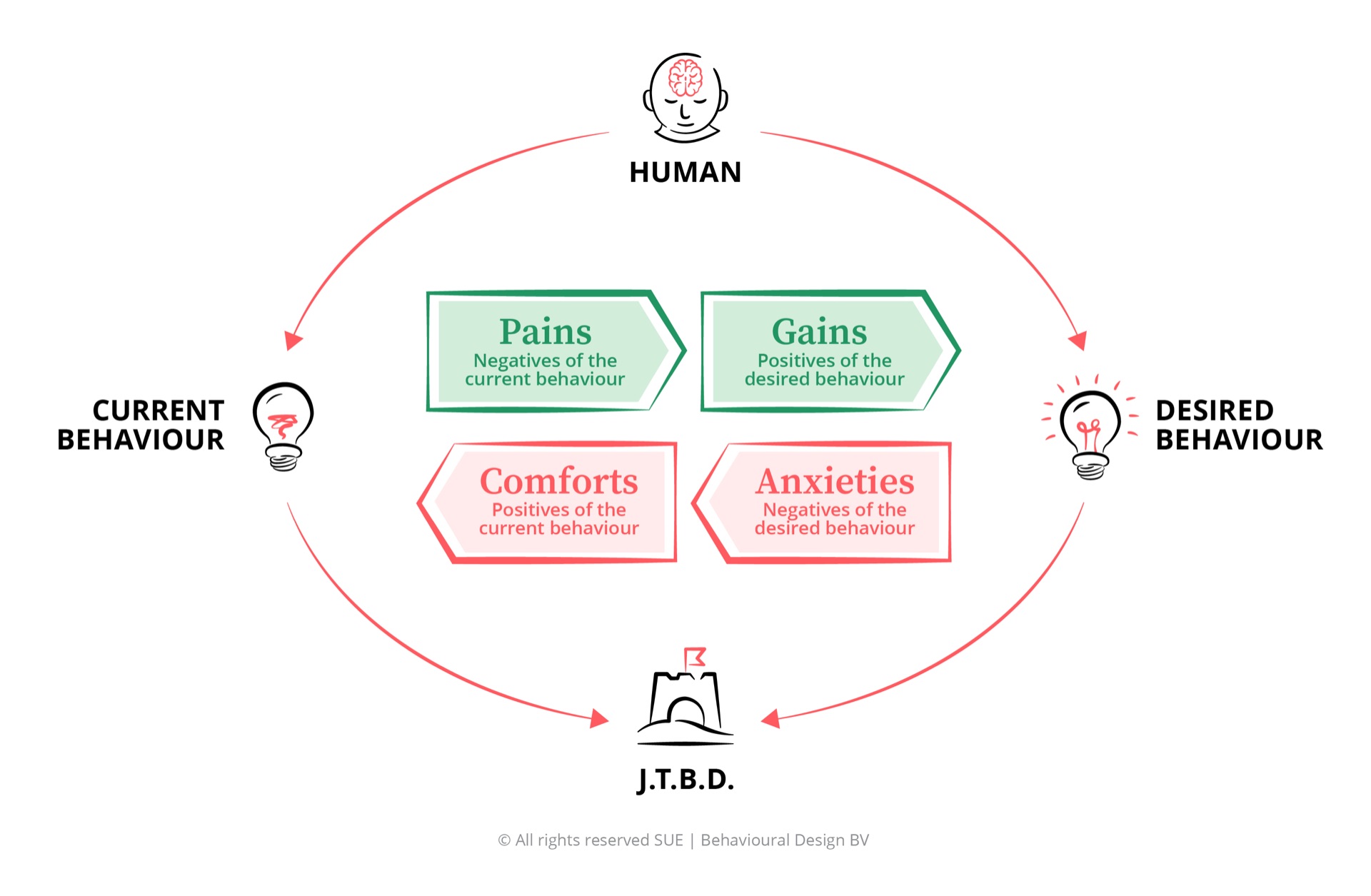
Say a management team wants to move from directive to coaching leadership. What's in the way? The Pain: asking coaching questions takes more time than giving quick answers. The Anxiety: if I express my opinion less readily, I'll lose my authority. The Comfort: the current pattern works - decisions get made, the manager feels in control. And the Gain from the old behaviour: speed, clarity, no ambiguity about who decides.
Only when you have mapped this can you design meaningful interventions. Not "give managers more insight into coaching leadership". But: make coaching behaviour easier than directive behaviour in the specific contexts where it matters most. Lower the pains. Reduce the anxieties. Create new gains for the desired behaviour.
That is a different conversation from the one most leadership programmes have. And that is precisely why it makes the difference. For a deeper look at what behavioural design is and how it applies to organisational challenges, read our foundational guide.
Four moments where leadership really matters
There are four recurring situations in a manager's work where leadership behaviour has the greatest impact. Not in the big quarterly strategy session, but in the ordinary week.
The feedback conversation. Giving feedback is one of the skills managers most often name as "something I want to get better at" - and one of the skills they improve least after a training. Because giving feedback is a habit, not a technique. The way you give feedback is in your muscles. Change requires new reflexes, not new models.
The meeting. How a manager runs meetings determines team culture more than any values workshop. Who gets the floor? Who gets interrupted? Who decides? Cognitive biases play a major role here, and most managers are unaware that they actively maintain those biases through the way they run meetings.
The difficult decision. Under time pressure, people fall back on autopilot. For managers, that means returning to the most familiar decision-making pattern, even when that pattern doesn't produce the best result. Leadership development that doesn't address this doesn't solve the problem.
The moment of resistance. When a team member pushes back, when a change isn't landing, when the energy drains from a project - these are the moments when leadership becomes truly visible. And these are also the moments when most managers fall back on their most instinctive behaviour. Applying pressure, or avoiding. Leadership that sticks is designed for exactly these moments. That's also the argument for understanding what makes leadership training fail.
How to design leadership development that lasts
If you want to design leadership development that sticks, there are a few non-negotiable building blocks.
Start with diagnosis, not content. What is the concrete behaviour you want to change? In which situations? And what are the actual barriers? Only then do you know what your programme needs to address.
Design the environment, not just the person. This is the most underestimated intervention. If you want managers to run meetings differently, change the meeting structure. If you want leaders to coach more, give them structural time and space to do so. Environmental changes are stronger than intention training.
Build in repetition and accountability. Behaviour change is not a one-off event. It is the result of small, repeated actions over time. A five-month programme with regular check-ins, peer learning and concrete practice moments works structurally better than an intensive two-day training.
Make measurement concrete. What is the observable behaviour you want to see? Not "more psychological safety", but: what specific things will a manager do differently in next week's meeting? What you cannot measure, you cannot improve.
Frequently asked questions about leadership development
What exactly is leadership development?
Leadership development is the systematic strengthening of leadership behaviour through learning, practice and behavioural design. The goal is that new behaviour sticks in everyday work practice, not only immediately after training. The difference from a leadership course: a course provides knowledge, leadership development changes behaviour.
Why do most leadership training programmes not work?
Because they don't solve the transfer problem. Knowledge is transferred, but new behaviour requires more than insight: it requires different environments, different habits, and repeated practice in the real work context. Baldwin and Ford showed in 1988 that less than 10% of training content actually transfers to the workplace.
How long does effective leadership development take?
Behaviour change in leaders takes a minimum of three to six months. A two-day training can inspire, but structural behaviour change requires repetition, feedback and an environment that rewards the new behaviour. SUE's leadership programme runs for five months.
What is the difference between a leadership course and leadership development?
A leadership course provides knowledge and models. Leadership development focuses on actually changing behaviour in work practice. The difference lies in what happens after the training: behavioural design, follow-up, environmental adjustments, and repetition over time.
How do I approach leadership development as an HR professional?
Start with the question: what concrete behaviour do you want to change? Not "better leaders", but: what observable behaviour needs to be different? Only then can you design a programme that addresses it. And always build in an environmental component: which structures, rituals and cues in the work context support the new behaviour?
Conclusion
Leadership development works when you treat it as a behavioural design problem, not a knowledge-transfer question. The science is clear: inspiring people is not enough. Transfer from knowledge to behaviour requires diagnosis of the actual barriers, environmental interventions, and repetition over time.
The organisations that do this best treat leadership development as an ongoing design question. They measure which behaviour needs to change, design the environment that supports that behaviour, and build in structural feedback and repetition. That's what sticks.
Want to turn this into a concrete programme? See our leadership training that changes behaviour, or read more about the Influential Leadership training for management teams.
