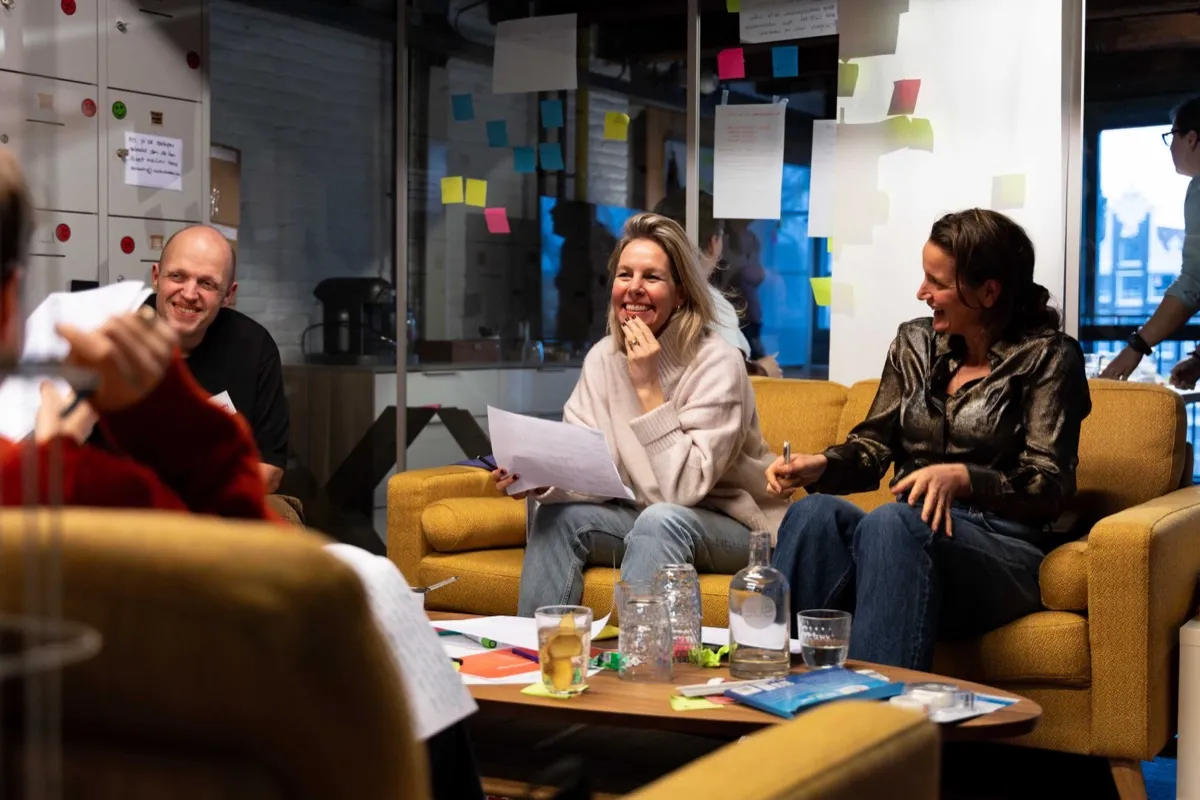
The team is in the meeting. The manager asks: "Any concerns?" Silence. A few nods. "Good, let's move on."
Three weeks later, the project fails at exactly the point two people had already seen coming. They just never said anything.
This plays out daily in organisations that invest in openness. Team days about giving feedback. Workshops on vulnerability. Posters declaring "you can say anything here." And still: the team stays silent. Because the context tells a different story than the poster.
Psychological safety is the shared belief within a team that you will not face punishment or humiliation for speaking up, admitting a mistake, or sharing a dissenting view. The concept was defined in 1999 by Amy Edmondson (Harvard Business School) and emerged as the strongest predictor of team performance in Google's large-scale research project Project Aristotle - more important than talent, experience, or team composition. More on Behavioural Design for HR →
What is psychological safety?
Amy Edmondson stumbled onto psychological safety almost by accident. She was researching the relationship between team cohesion and medical errors in hospitals. She expected better teams to make fewer mistakes. The opposite turned out to be true: better teams reported more mistakes.
The reason was simple: in safe teams, mistakes were discussed. In less safe teams, they were buried. Edmondson realised she wasn't measuring error rates at all - she was measuring the willingness to report them. That insight changed her research entirely.
In 2016, Google published the findings of Project Aristotle, a five-year study into what distinguished the best-performing teams at Google. Researchers analysed 180 teams and hundreds of variables - from team size to educational background to introvert/extrovert balance. The outcome was strikingly clear: none of these characteristics predicted team performance. Psychological safety did, as by far the strongest factor.
Better teams made more mistakes. Not because they were worse, but because they were safe enough to learn.
What makes psychological safety so powerful? It determines whether people share the information an organisation needs to function well. Bad ideas get challenged. Risks get flagged. Mistakes get corrected quickly. Without those information flows, an organisation is blind to its own blind spots.
 Heart of Amsterdam
Why standard approaches don't work
Most organisations respond to a lack of openness with communication. They announce that "you can say anything here." They run training on giving feedback. They send a message from the director valuing vulnerability.
That is a recipe for disappointment.
Not because the intention is wrong, but because it asks the wrong question. The question is not "do employees know they can speak up?" They know. The question is: does the context make speaking up easier than staying silent?
In behavioural science, we distinguish between two types of barriers to behaviour: willingness (WANT) and capability (CAN). Training on psychological safety addresses the WANT side: it tries to convince people that speaking up is good. But the real barrier is in the CAN side. The structure of the situation makes speaking up risky and silence comfortable. No amount of motivation compensates for a context that discourages you every single time.
The Fundamental Attribution Error is at work here too: we attribute silence to the person ("he lacks confidence," "she isn't assertive enough") when the situation is the real explanation. If the same person speaks up freely in a different team, it was never about them. It was about the context.
What behavioural science tells us about speaking up
Why is speaking up so difficult in many teams? Behavioural science gives a sharp answer.
The core is loss aversion. Research by Kahneman and Tversky shows that loss is approximately twice as painful as gain is pleasurable. This principle applies in social situations too. When you raise an uncomfortable idea in a meeting, the potential loss (rejection, embarrassment, a painful moment) is concrete and immediate. The potential gain (the idea is embraced, you contribute meaningfully) is abstract and uncertain. Rationally, you should raise the idea once the chance of success is above fifty per cent. Psychologically, you need a much higher probability before you take the risk.
On top of that: silence is the social norm in many meetings. And social norms are powerful comforts. If nobody speaks, silence is the safest path. Not speaking is invisible. Speaking and being dismissed is painfully visible.
System 1 - our automatic thinking system - responds to social threat just as it responds to physical threat: freeze. Someone who wants to say something but senses the room is not safe experiences a micro-moment of freeze response. That lasts just a second, but that is often enough to miss the moment - and to confirm silence as the right choice.
The forces surrounding speaking up in your team
To design psychological safety, we first need to understand which forces block and enable speaking up. The SUE | Influence Framework offers a useful diagnostic structure for this.
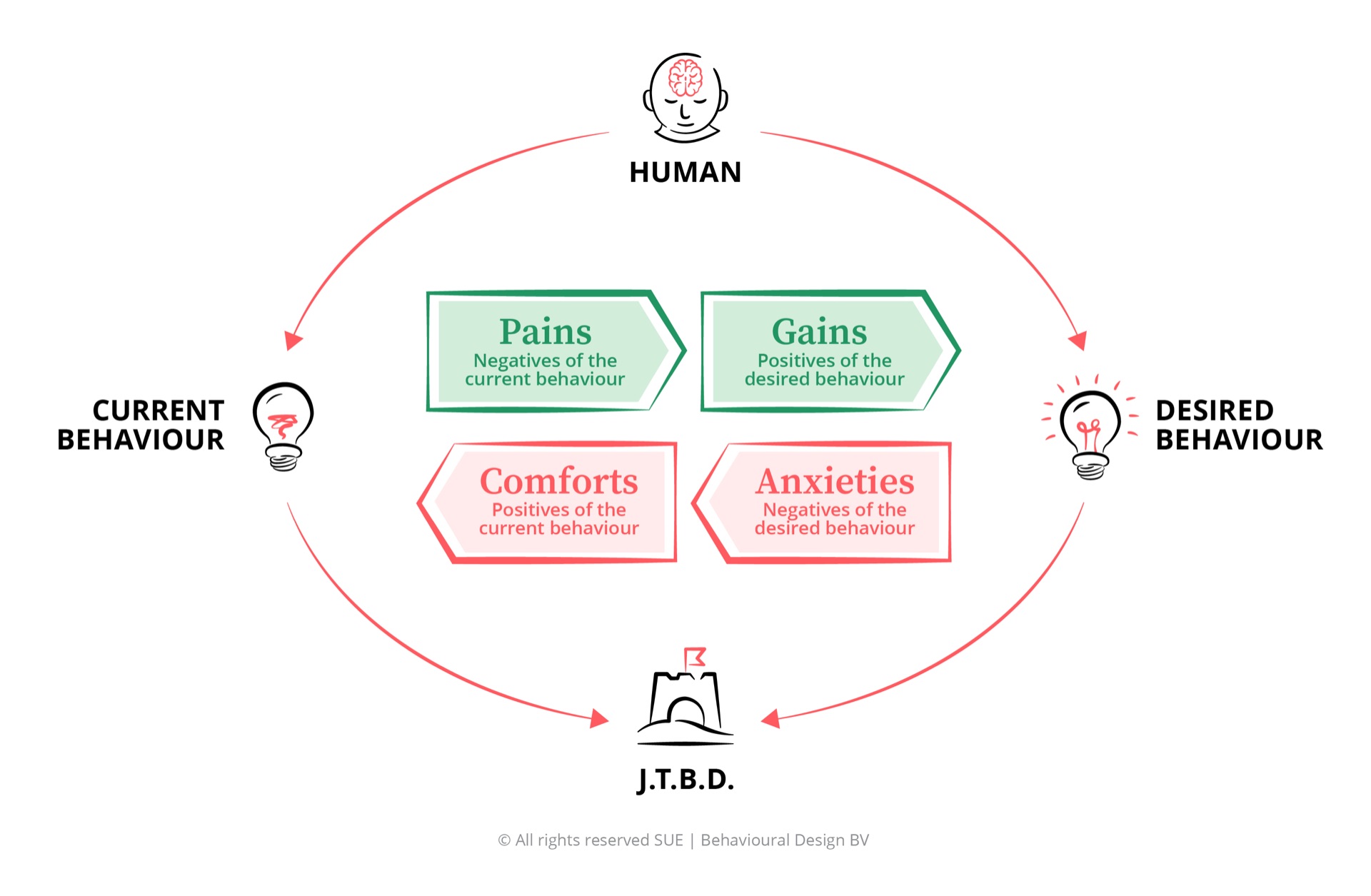
The pains that push people toward speaking up are real: the team knows things are going wrong but nobody says it. The energy required to carry an unspoken idea. The feeling that meetings are theatre, not genuine decision-making.
The gains of speaking up are clear too: better decisions, fewer mistakes, faster learning as a team. But those gains are abstract and uncertain - they lie in the future.
The anxieties are concrete and immediate: "What will the manager think of me?" "Did everyone already know this and am I the only one who didn't?" "Will my idea be ridiculed?" "I said something once before and nothing happened with it - why would I try again?"
The comforts of staying silent are powerful: you don't stand out, you take no risk, you conform to what everyone else is doing. Silence is the default behavioural option in most teams.
Designing psychological safety means: reducing the anxieties, breaking the comforts of silence, and making speaking up the easiest option. Not through persuasion, but through context design.
You've read about it. But what if you could apply it yourself — to colleagues, teams, or your entire organisation?
As Europe's #1 academy in Behavioural Design, we train professionals in analysing, predicting and influencing behaviour — live, online or in teams. Based in Amsterdam, with over 10,000 alumni from London to Sydney and Singapore to New York.


 EQAC
EQACCertified
Training
How to design psychological safety
Now we understand the forces, we can influence them deliberately. Here are four interventions that structurally change the context.
1. Change the meeting default
In most meetings, speaking is an active choice. You raise your hand, you interrupt the process, you draw attention to yourself. That is a high threshold. Change the default: make speaking the norm and silence the exception.
The simplest way is a round-robin: everyone says something, in a fixed order. "Let's go around the table - what is your biggest concern about this plan?" Now the question is no longer whether you speak, but what you say. The social norm shifts from silence to contribution. For more sensitive topics, anonymous input via a simple tool like Mentimeter or a shared document works well - someone who writes something processed anonymously has less to lose than someone saying the same thing by name.
2. Make the manager the first to name mistakes
Every time the manager names their own mistake or uncertainty out loud, the team receives information: it is safe to be human here. Every time that does not happen, the opposite signal is given.
This is not a vulnerability exercise - it is context design. The manager who says in an evaluation: "I should have seen this risk earlier, I knew about it and let it go anyway," installs a norm. That norm is: naming mistakes is valued here, not punished. Equally powerful is an explicit response when someone brings bad news. Not a polite nod, but visible appreciation: "I'm glad you said this - this is exactly the information we needed." That response is a SPARK that reinforces the behaviour. The team learns: speaking up pays off.
3. Use the pre-mortem technique
The pre-mortem is a technique from Gary Klein: imagine the project has failed in six months - what went wrong? This reframing changes the social context completely. You are no longer asking who has criticism of the plan (which feels like attacking). You are inviting everyone to analyse the future failure together (which is a shared exercise).
The effect is that objections that would normally remain unspoken are now legitimate. The pre-mortem gives permission to be negative. It reduces the anxiety around giving criticism by reframing it as a valuable contribution.
4. Design the response to vulnerable behaviour
Psychological safety is built or destroyed in the first seconds after vulnerable behaviour. Someone says something uncomfortable. Someone admits a mistake. Someone raises an idea that differs from the consensus.
What happens next determines whether the next vulnerable moment ever comes. A sigh, an eye-roll, a polite "yes but..." - these are sufficient signals for System 1 to register: that was not safe. Design that response deliberately. That does not mean embracing every idea. It means thanking the person for speaking up before evaluating the idea. That order makes a significant difference.
 Training for professionals
Frequently asked questions about psychological safety
What is the difference between psychological safety and friendliness?
Psychological safety is not the same as friendliness or harmony in a team. In a psychologically safe team, more difficult conversations happen, not fewer. Friendliness avoids conflict; psychological safety makes conflict productive. You can measure it through behaviour: are mistakes discussed openly? Are bad ideas challenged? Those are signals of safety, not hostility.
How do you measure psychological safety in a team?
Amy Edmondson developed a seven-item questionnaire, including statements like "If you make a mistake in this team, it is held against you" and "It is safe to take risks on this team." Behavioural observation is equally reliable: who speaks in meetings? Who doesn't? How many mistakes are reported? How many ideas are raised? Behaviour tells you more than a survey score.
What is the role of the manager in psychological safety?
The manager is the most important context designer. Not through words ("you can say anything here") but through behaviour: naming their own mistakes openly, actively asking for dissenting views, giving explicit appreciation when someone brings bad news. Every response to vulnerable behaviour is a data point the team stores. That is how the manager becomes the architect of the safety culture.
How long does it take to build psychological safety?
You cannot build psychological safety in a day, but the first shift can be visible within weeks when the context changes consistently. Teams learn quickly which behaviour gets rewarded or punished. When the manager consistently responds to speaking up with appreciation and action, the behavioural pattern shifts. Consistency over at least two to three months is needed for structural change.
Conclusion
Psychological safety is not a culture issue you solve with a team day and a poster. It is a behavioural pattern that depends on what the context makes easy and risky. The fear of speaking up is real and rational as long as the situation punishes it. Changing that situation is the work.
That means: different meeting structures. A manager who is the first to be vulnerable. A culture of explicit appreciation for bad news. Techniques that lower the threshold for speaking up, like the pre-mortem and anonymous input. This is not soft people management. It is precise context design. And it produces teams that perform better - not despite the difficult conversations, but because of them.
Want to learn how to apply behavioural science to HR challenges? In the Behavioural Design Fundamentals Course you learn to apply the Influence Framework and SWAC Tool to employee happiness, psychological safety, and any behaviour challenge you face. Rated 9.7/10 by 10,000+ professionals.

1,5 minutes of influence
Every week I notice something: a hospital sign, a supermarket shelf, a phrase in a meeting. Always something that perfectly illustrates how context shapes behaviour. I write it down. You get it in your inbox, every Thursday morning. In 90 seconds.
Join 10,000+ readers · Free · Unsubscribe anytime