How do you design a school children actually want to walk into on Monday?
When a school struggles, the fixes are always about content. Better teachers, a stronger curriculum, more testing, extra tutoring. All of it aimed at what is taught. None of it at the place where the teaching happens. And the place is sending its own message, all day long. Sit still. Wait your turn. Do not ask a question if you are not sure of the answer. That message says something quietly devastating: that learning is an obligation to be endured, not a thing to chase.
Children arrive at school as the most naturally curious creatures on earth. They learn to walk with no instruction and to talk with no lessons. Then we put them in rows and, over twelve years, methodically train the curiosity out of them, until we are surprised that adults are so afraid of getting things wrong. So here is a better question than how to raise test scores. How do you design a school a child wants to be in on a Monday morning? A school in Stockholm went and built the answer.
What Vittra did
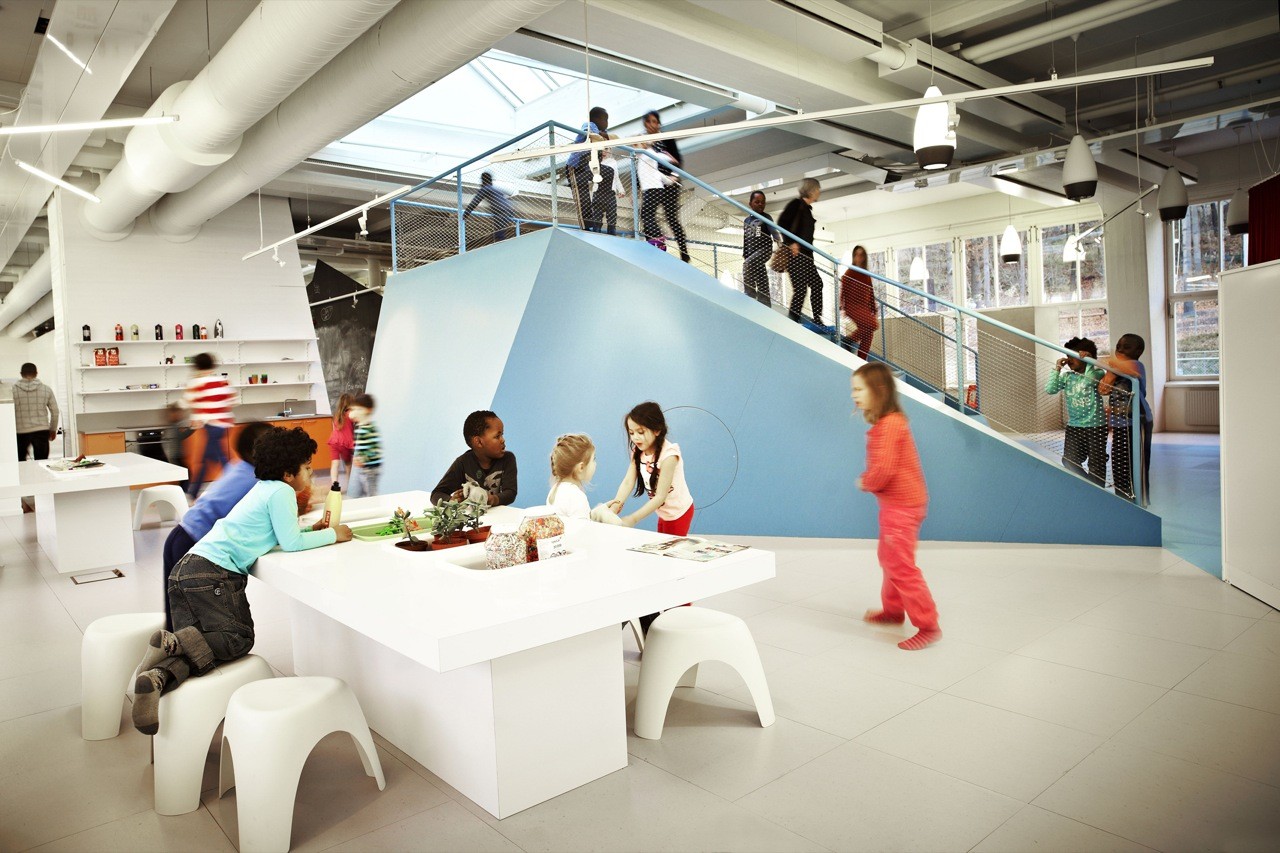
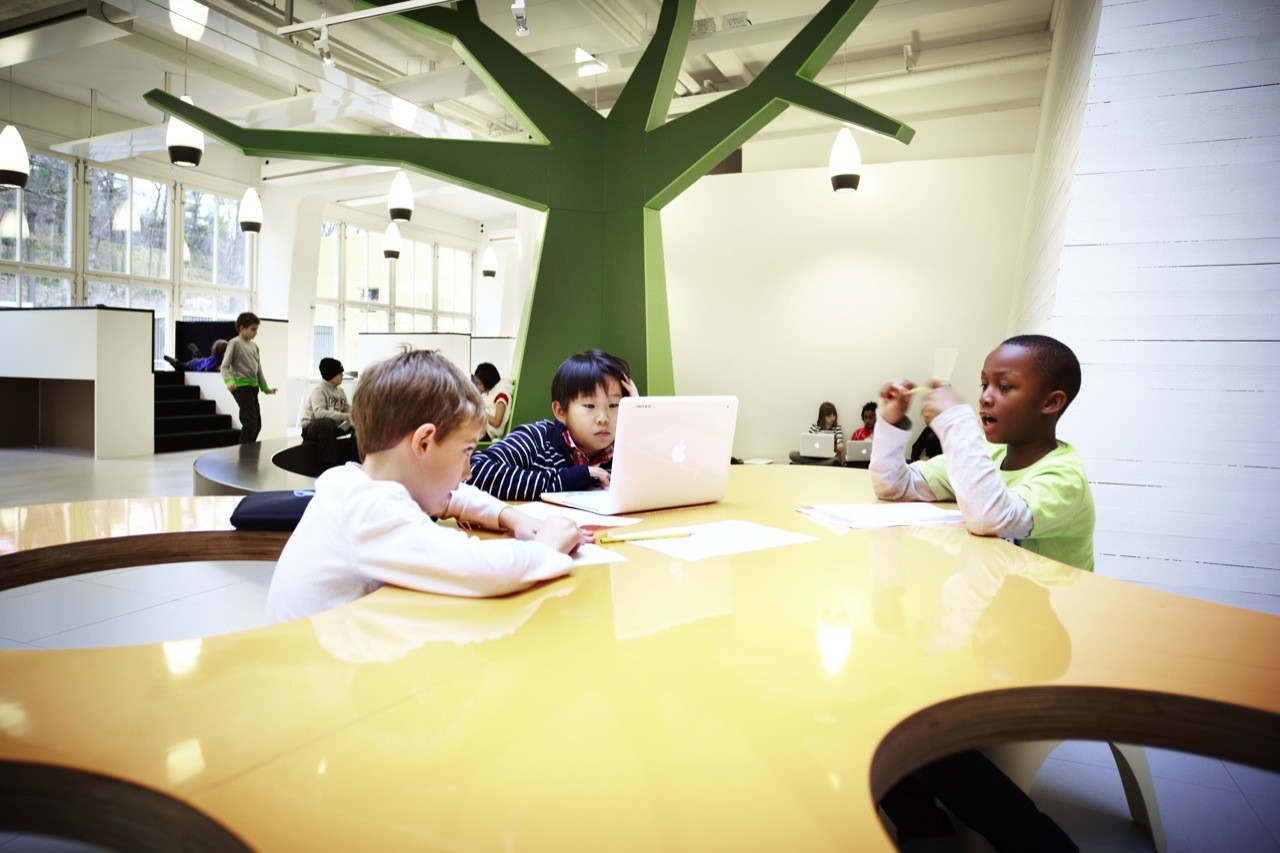
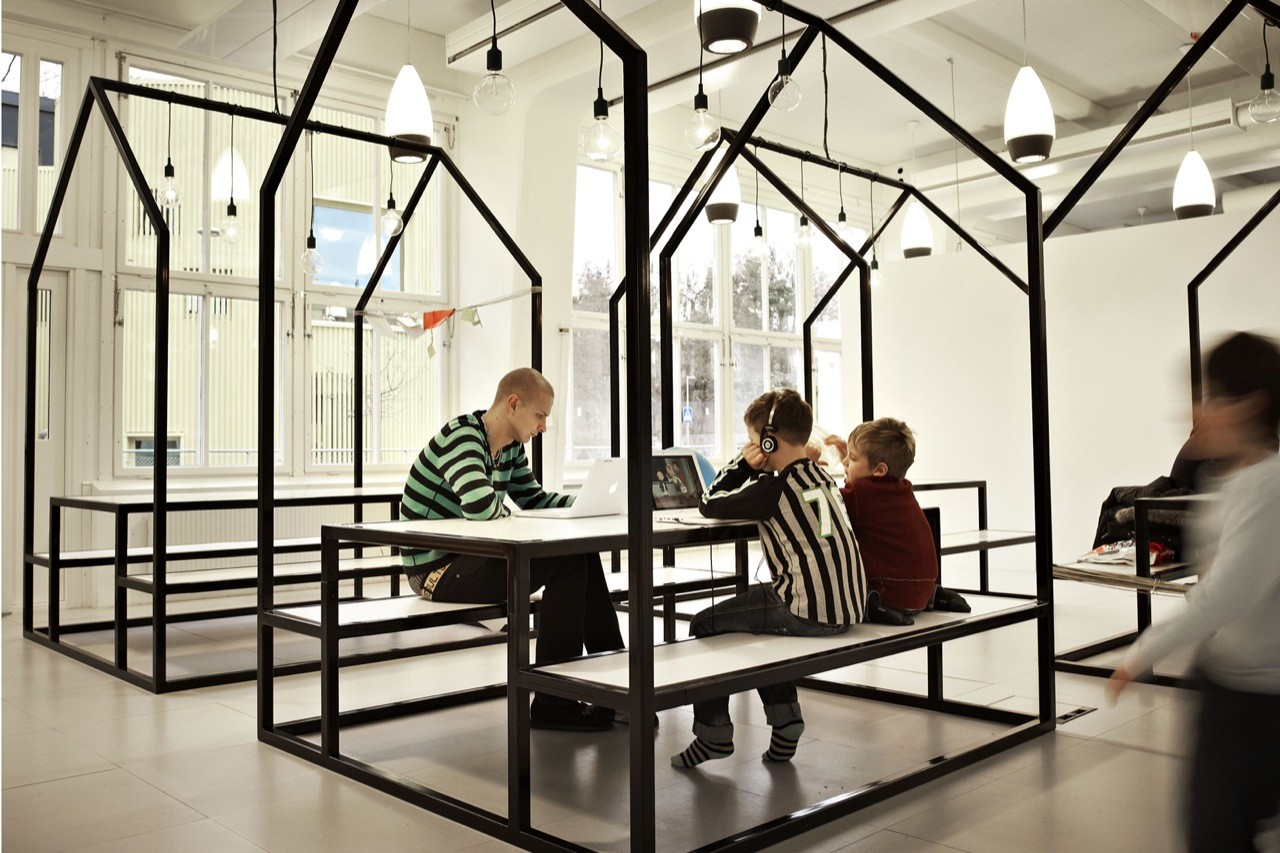
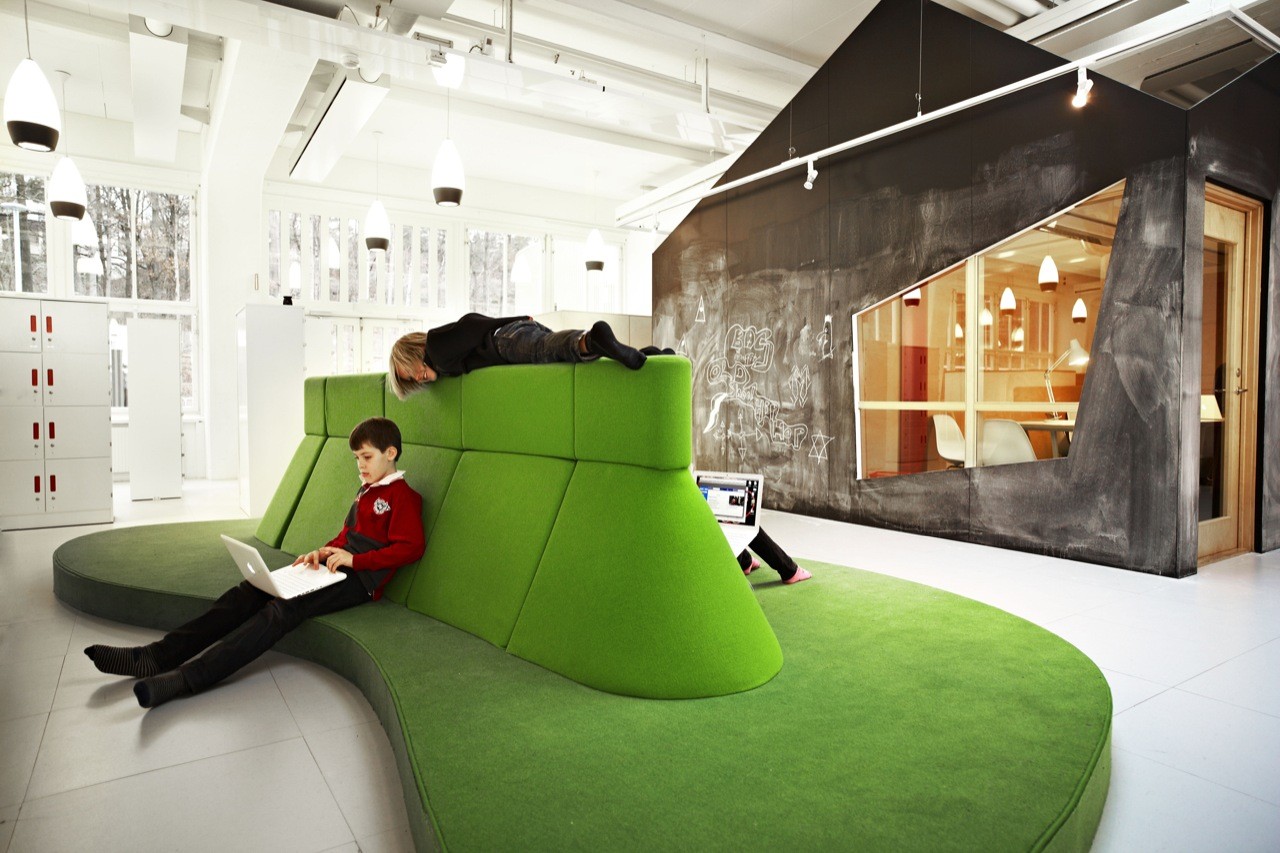
Vittra Telefonplan in Stockholm, designed by Rosan Bosch, has no classrooms at all. No rows of identical chairs facing a board. Instead the school is a landscape of different kinds of space, each suited to a different way of learning. There is a quiet cave-like nook for deep concentration. A campfire-style spot where a group gathers around to work together. A laboratory for making and testing. A stage for performing. A relaxed area for rest. Children move between them, choosing the space that fits what they are doing.
There are no grades in the conventional sense, and each child has a personal learning plan. The design starts from a different question than most schools ask. Not how do we arrange children efficiently in one room, but what range of spaces does a child actually need in order to learn. The answer it landed on was not one space. It was five.
Why this is design, not discipline
The usual story about engaged pupils is that they have better teachers or more motivated families. Vittra suggests the room is doing more than we credit. Put a child in a rigid grid of desks and you get the behaviour the grid asks for: passivity, clock-watching, waiting. Give the same child a choice of spaces suited to real learning, and a different child seems to show up - one who wants to be there. Nothing changed inside the pupil. The environment changed, and the engagement followed.
Which means a lot of what we read as a motivation problem in education is really a design problem wearing a motivation costume.
The science: the classroom explains more than we think
There is hard evidence that the physical design of a learning space matters, and matters a lot. Peter Barrett and colleagues ran a large study, known as the HEAD project, across 153 classrooms in 27 UK primary schools, tracking the progress of 3,766 pupils over a year.[1] They found that the physical design of the classroom explained around sixteen per cent of the variation in how much those children progressed. That is a striking share for something we usually treat as a neutral backdrop.
They broke the effect into three principles, grouped under naturalness, individualisation and stimulation. Naturalness - things like light, temperature and air quality - accounted for roughly half of the impact. The rest came from how much the space felt owned and flexible, and from a considered, not overwhelming, level of stimulation. Notably, these classroom-level features mattered more than school-wide factors. The room a child actually sits in, day to day, is doing real work on how they learn.

Through a Behavioural Design lens: designing for curiosity, not compliance
It is worth naming the discipline here, because the traditional classroom is a clear example of a context engineered, without anyone quite intending it, for the wrong behaviour. A grid of forward-facing desks is not neutral. It is a powerful set of cues that say one person talks and the rest stay still and quiet, and children read those cues and behave accordingly. We then aim our hopes at their conscious motivation, urging them to be curious and engaged, while the room itself is quietly instructing them to do the opposite.
Vittra works because it changes the cues rather than the exhortation. A space that offers a choice of how and where to work signals that learning is something you actively do, not something done to you. A nook for focus, a circle for collaboration, a stage for sharing - each invites a different, engaged behaviour, without a word of instruction. The behavioural design move is to stop telling children to be curious and instead build a space whose every cue makes curiosity the natural response. You design the environment for the behaviour you want, rather than demanding the behaviour while the environment argues against you. At SUE, the Influence Framework and SWAC are the methods we teach in The Art of Influence© to systematically analyse how an environment builds in curiosity and engagement.
What this means in practice
Start with your own spaces and what they are quietly training you to do. If you do all your work in one undifferentiated setting, you are fighting your own environment every time the task changes. The useful move is to match the space to the mode: a genuinely distraction-free spot for focused work, a different setting for collaboration, somewhere else again for thinking loosely. You are not lacking discipline when you cannot concentrate in a noisy open space. You are sitting in the wrong room for the task.
For anyone who leads or teaches, Vittra is a lesson in how much behaviour the environment sets before anyone opens their mouth. The instinct, when a group is disengaged, is to work on motivation - the pep talk, the incentive. Often the higher-leverage move is to change what the space is asking of them: whether the setup invites participation or passivity, whether people can choose the mode that fits the work, whether the room signals do as you are told or take part. Design the cues and much of the engagement follows.
And at the level of the organisation, this challenges the one-size-fits-all environment. The single open-plan floor, the identical meeting rooms, the assumption that one kind of space serves every kind of work - all quietly flatten behaviour towards whatever that one space happens to encourage. The skill this teaches is to ask what range of behaviours you actually want - focus, collaboration, rest, creation - and to design distinct spaces that each make one of them easy, rather than expecting a single environment to produce them all.
Learn to apply this yourself
What makes Vittra's approach powerful is that it works by changing what the environment asks of people before any instruction, motivation or willpower enters the picture. A different space cues a different behaviour, reliably and without effort from the individual. In The Art of Influence© you learn to use the Influence Framework and SWAC to map exactly which environmental cues are shaping behaviour in your own context, and to redesign them so the behaviour you want becomes the natural response.
View The Art of Influence© onlineWhat you can design this week
You will not be rebuilding a school, but the underlying move works on any space where you want a particular kind of behaviour. Three ways to start:
Match the space to the mode. Stop expecting one setting to serve every task. Create or seek out distinct spaces for focus, for collaboration and for rest, so the environment supports the behaviour each one needs.
Give people a real choice of where to work. Vittra works partly because children choose their space, which gives them ownership. Where you can, let people pick the setting that fits the task rather than assigning one for everything.
Read the cues your space is sending. Before you work on anyone's motivation, look at what the layout silently instructs. A room arranged for passivity will produce passivity, whatever you say over the top of it.
Vittra did not order children to be curious. It built a school whose every space invited a different kind of active learning, and let the engagement follow. That is the difference between demanding a behaviour and designing for it - and it applies to an office, a workshop or a single desk as much as to a school.
If you want to learn how to design for behaviour rather than trying to motivate it, that's exactly what The Art of Influence© covers. View upcoming dates →
Frequently asked questions
What is Vittra Telefonplan?
Vittra Telefonplan is a school in Stockholm, Sweden, designed by Rosan Bosch Studio. It has no conventional classrooms - instead the building is a landscape of five different kinds of learning space: a quiet nook for deep concentration, a campfire-style area for group work, a laboratory for making and testing, a stage for performing, and a relaxed area for rest. Children move freely between them and each follows a personal learning plan.
Does the physical design of a classroom affect how well children learn?
Yes, substantially. Peter Barrett and colleagues found, across 153 classrooms in 27 UK primary schools, that classroom design explained around sixteen per cent of the variation in pupils' learning progress over a year. Natural light, air quality, temperature, and whether the space felt owned and flexible were among the strongest factors - all things that most school refurbishments do not prioritise.
How does school design relate to behavioural design?
School design is one of the clearest examples of how environments shape behaviour before anyone opens their mouth. A grid of forward-facing desks cues passivity, silence and deference to one speaker. Vittra redesigned those cues: a choice of spaces signals that learning is active and self-directed. This is the core move in Behavioural Design - instead of telling people to behave differently, you change what the situation makes easy and obvious.