That is not a flaw to correct, but a given to design with. Behavioural Design shows which shortcuts shape your client's judgement, why rational advice rarely lands, and how to structure the choice environment so that the right decision becomes the easiest one.
"Our pension clients know they should save more. They still don't."
Documented by Kahneman, Thaler and Shiller. They apply to your clients, your employees and your boardroom. And all of them are designable.
Saving for retirement, building a financial buffer, investing in sustainability: clients know it makes sense. The reward feels too far away. Present bias makes every decision that delays gratification harder than it needs to be.
Kahneman and Tversky showed that a loss feels twice as painful as an equivalent gain feels pleasant. In investment portfolios, this drives panic selling in corrections and holding on to losing positions.
Clients choose the default option, even when it is suboptimal. The effort of switching feels larger than the benefit. Whoever designs the default is, in effect, designing the behaviour of most clients.
The first price, the first interest rate, the first offer: they anchor perceptions of what is reasonable. In negotiations, in product presentations, in risk assessment.
What others do is the most powerful signal that something is right. In markets, this produces bubbles and crashes. In product design, it can be deployed as social proof.
The more expertise someone has, the stronger their belief that they can assess risk. In boardrooms especially, this leads to systematic underestimation of uncertainty.
Holiday pay, bonuses and tax refunds are spent differently from regular income, even when the amounts are identical. Richard Thaler won the Nobel Prize for this insight.

Behavioural Design for financial services is the application of behavioural science to financial behaviour: from pension decisions and investment choices to risk management and boardroom dynamics. The method helps you understand why clients, employees and executives behave the way they do, and how to design environments so that desired financial behaviour becomes the natural path.
The financial professionals among our 10,000+ alumni share one thing in common.
Two fantastically enjoyable, intensive, innovative, useful and above all relevant days under the excellent guidance of Tom & Astrid. They managed to get the magic of behavioural design fully into my head in just two days.

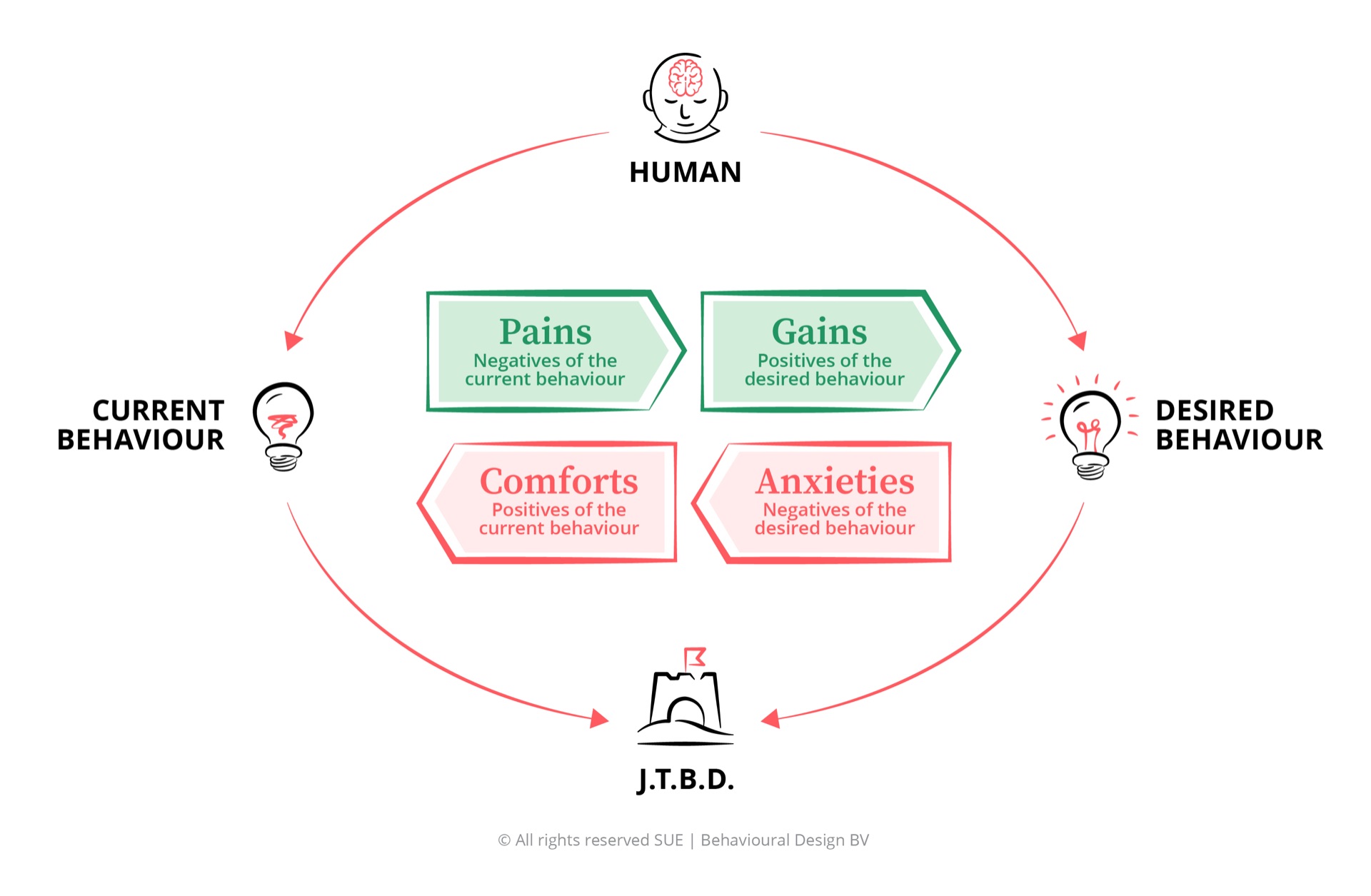
It was a joy to follow SUE's Behavioural Design training with our entire team. Happy clients at Centraal Beheer. Thinking from and searching for the underlying jobs-to-be-done was a real eye-opener for me.

I was impressed by your skills. You can simultaneously facilitate a workshop, come up with fresh ideas, build prototypes and write copy. I have never encountered all this expertise in one person anywhere else.

Take the Fundamentals Course and learn the techniques and principles for designing financial choices. Two live days, or 33 online lessons at your own pace.
Want to train your entire finance team? See our team formats ↓
Three formats, depending on how deep you want to go and how long you want to build.
Most behavioural science knowledge is locked in academic papers. SUE built the Influence Framework, a practical step-by-step method that any financial professional can apply without a scientific background. Proven in masterclasses at KBC, Rabobank and ABN AMRO.
“ A good strategy? Check. Client-centred ideas? Check. Cialdini principles applied? Check. And yet the target audience didn't do what I wanted. SUE taught me that people make decisions based on feeling, and that these Animal Spirits are not swayed by my logic. SWAC is no longer a tool for me - it's an automatic reflex.
In-depth articles on the psychology of financial behaviour, written from the practice of SUE's masterclasses at financial organisations.
Why rational financial advice rarely works, and how behavioural science makes the difference in product design and client communication.
Read article →How SUE's method is applied at banks, insurers and asset managers on client and organisational behaviour.
Read article →Richard Thaler's concept explained: how mental buckets shape financial behaviour and how to use that in product design and communication.
Read article →Loss aversion, prospect theory and the availability heuristic: how risk perception works and how to design financial decisions with it in mind.
Read article →Behavioural finance is the field that applies behavioural science to financial decision-making. Its starting point: people are not rational decision-makers. They are driven by present bias, loss aversion, herd behaviour and anchoring. Behavioural finance helps financial professionals understand why clients behave the way they do, and how to design products and communication so that desired financial behaviour becomes the natural default.
You learn the SUE Influence Framework: a method for analysing why clients, employees or board members behave the way they do, and for designing interventions that actually change behaviour. During training you work on your own financial challenge, from pension products to risk policy, and leave with a fully developed strategy you can apply the next day.
Yes, precisely. Risk management and compliance are fundamentally about behaviour: the compliance officer who communicates the rules clearly but sees no change in adherence, the risk committee that fails to spot groupthink, the boardroom that makes sunk-cost decisions. Behavioural Design gives you the framework to recognise and break those patterns.
SUE has delivered trainings and masterclasses for organisations including KBC, Rabobank, ABN AMRO, Centraal Beheer and Allianz. Both for individual professionals taking the Fundamentals and for full teams via in-company programmes and Learning Journeys.
Start with the Behavioural Design Fundamentals. It gives you the complete framework: the Influence Framework, the JTBD method and all core tools, applied directly to a real financial sector case. The Behavioural Economics Deep Dive is the natural next step for those who want to go deeper into financial behaviour specifically.
From client behaviour to boardroom dynamics. The Behavioural Design Method gives you the framework to design it.