How do you design a city to need less traffic?
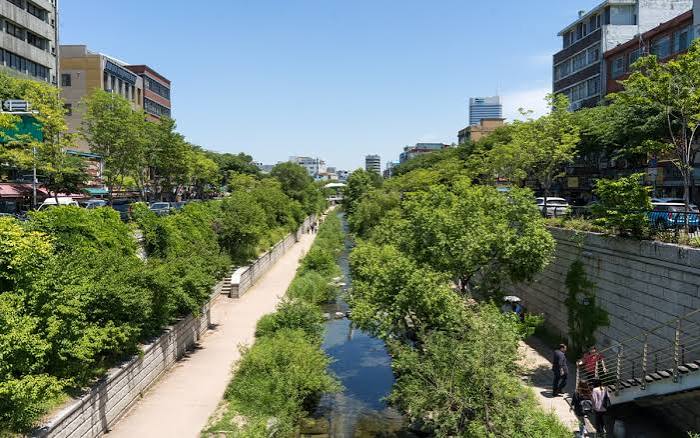
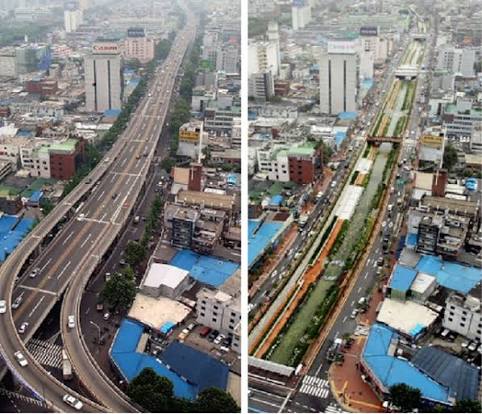
In the heart of Seoul there used to be an elevated motorway carrying enormous volumes of traffic. By the early 2000s it was ageing, and the city made a decision that sounded like madness: rather than repair it, tear it down. Underneath ran a buried stream, the Cheonggyecheon, covered over decades earlier to make room for the road. Seoul uncovered it, cleaned it, and built walking paths along its banks. Almost everyone predicted gridlock, on the obvious logic that the cars had to go somewhere.
The image is a clean before-and-after: a roaring concrete flyover, then a daylit stream with people walking beside it where the traffic used to be. And the gridlock everyone braced for never arrived, which points at one of the most counterintuitive truths in how systems work.
What Seoul actually did
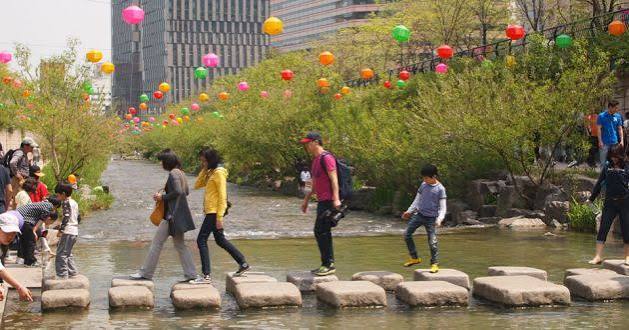
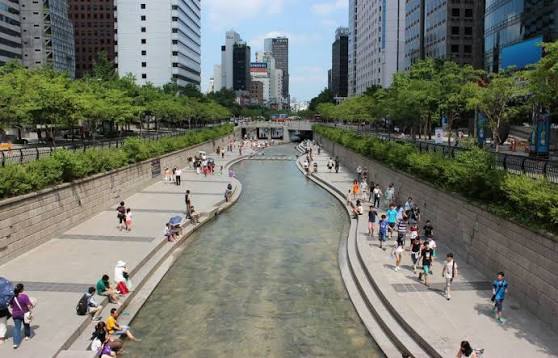
In 2003 Seoul began demolishing the Cheonggyecheon elevated motorway and restoring the stream beneath it. The road had carried a large share of the city's traffic, and the prediction was straightforward: remove that capacity and the cars would flood the surrounding streets. It did not happen. A significant share of the traffic simply did not reappear elsewhere. People adjusted, their routes, their departure times, their modes of travel, and within a few years speeds on nearby roads had returned to roughly where they were before. Meanwhile the restored stream cooled its surroundings by a measurable few degrees, improved air quality, and became one of the most visited public spaces in the city, drawing tens of thousands of people on a typical day.
The traffic did not relocate. A good part of it dissolved. The capacity had been generating the very demand that filled it.
The road was making the demand
No one persuaded drivers out of their cars. There was no campaign about congestion or emissions, no appeal to civic duty. The behaviour changed because the situation changed. When the road was there, driving through the centre was the rational choice, so people drove. When it was gone, that particular journey stopped making sense, and people quietly made different ones.
This is the difference between motivation and design, and it cuts against a deep intuition. We assume demand is fixed, a set amount of traffic that must be accommodated somewhere, and that the only way to change behaviour is to convince people. Seoul shows that much of the demand was not fixed at all. It was created by the supply. The road did not just serve traffic; it generated it, because its existence made driving the sensible option. Remove the supply and a chunk of the demand it had created simply evaporated, with no one having to be talked into anything. The behaviour followed the infrastructure, not an argument.
The science: induced demand, in reverse
The principle underneath Seoul is induced demand, run backwards. Induced demand is the well-documented finding that building more road capacity tends to generate more traffic to fill it: the new lanes make driving more attractive, so more people drive, and congestion returns. The uncomfortable corollary, which Seoul demonstrated, is that the reverse also holds. Remove capacity and a portion of the demand it was inducing disappears rather than relocating, because the supply was creating the demand in the first place.[1]
This reaches far beyond roads, and that is what makes it powerful. In all sorts of systems, capacity generates the very demand it was meant to relieve. The extra meeting slot fills with meetings. The bigger inbox fills with mail. The new report generates new reporting. The additional storage fills with things you will never use. We keep trying to relieve pressure by adding capacity, and the capacity quietly manufactures more of the pressure. Seoul's lesson is that subtraction is a real design move, often a more powerful one than addition: sometimes you relieve a system not by giving it more, but by taking something away, and watching the demand it was feeding shrink to fit.
Through a Behavioural Design lens
It is worth slowing down on Seoul, because it is a clean example of changing behaviour by changing what the situation offers rather than what people want.
Start with the person. A commuter in Seoul is not trying to "drive"; they are trying to get to work with the least hassle. Driving was simply the easiest answer the city offered. The forces here are not about willingness at all: what made people drive was that the road made driving the path of least resistance, and what made them stop was that, once it was gone, driving that route became the hard option and other choices became easier. No one's attitude to cars changed. Their situation did. Reading behaviour by the forces the environment creates, rather than by people's motives, is what we call the Influence Framework at SUE, and in Seoul it points entirely at the supply, the road was the thing producing the behaviour.
Now the fix, and it is the counterintuitive one. Of the levers you can pull to change behaviour, the most overlooked is to make the unwanted behaviour harder by removing what made it easy, rather than adding something to encourage the alternative. We almost always reach for addition: another lane, another incentive, another campaign. Seoul reached for subtraction. By taking away the road, it made the easy, default choice, driving through the centre, no longer easy, and the demand that the road had been generating simply shrank. This works because so much of our behaviour follows whatever the environment makes effortless; change what is effortless, and the behaviour changes without anyone being persuaded. That focus on making a behaviour harder or easier by redesigning the situation is what we call working on capability in the SWAC Tool, here used in reverse, by subtraction.
The lesson travels into any overloaded system you run. Before you add capacity to relieve pressure, ask whether the capacity is generating the very demand it is meant to absorb. You do not argue people into using less, you change what the situation offers, and the demand follows the new shape. At SUE, the Influence Framework and SWAC are the methods we teach in The Art of Influence© to systematically analyse how the built environment triggers behaviour and where you can redesign the path.
What this means in practice
Seoul is about a motorway, but the deepest use is on your own overloaded life. When something feels relentless, the meetings, the messages, the commitments, the instinct is to manage it better, to find more capacity. Seoul suggests the opposite move: remove something and watch how much of the demand was only there because you were feeding it. Cancel the standing meeting for a month and see what actually breaks. Often the predicted chaos never comes, because the demand was never as fixed as it looked.
For anyone leading a team, this is a permission and a warning. The permission: you can relieve an overloaded team by subtracting, killing a report, removing a process, cutting a meeting, not only by adding people or tools. The warning: every bit of capacity you add tends to generate its own demand, so the new system, the new channel, the new headcount may quietly create more of the load it was meant to relieve. Before you optimise the recurring meeting or the report, try removing it and watching what happens.
And for the organisation, this reframes the reflex to solve every problem by addition. More tools, more processes, more capacity, each one generates new demand to fill it, and the pressure returns. The question is not how do we add enough capacity to cope, but what are we supplying that is generating the very demand we are drowning in, and what would shrink if we took it away.
Learn to apply this yourself
What makes Seoul so instructive is that the behaviour changed without any persuasion: the road removal made an entire pattern of demand disappear by redesigning what the situation offered. In The Art of Influence© you learn to use the Influence Framework and SWAC to map exactly which forces in an environment are generating unwanted behaviour, and how to redesign the situation so the right choice becomes the easiest one.
View The Art of Influence© onlineWhat you can design this week
The move works on your own overload, a team you lead, or a system you run. Three ways to start:
Run the Seoul test on your busiest load. Take the thing you are working hardest to serve, a meeting, a report, a channel, and ask whether the demand existed before you built the capacity for it, or whether the capacity created the demand. That question alone reframes a lot.
Try removing, not reforming. Before you optimise the recurring meeting or the report, cancel it for a month and watch what actually happens. Often the predicted gridlock never comes, because the demand was never as fixed as it looked.
Stop adding by reflex. The next time the instinct is to solve a problem with one more tool, slot or process, ask whether subtracting something would do more. Less capacity sometimes means less load, not less done.
Seoul tore down a motorway and the traffic it carried did not relocate; much of it disappeared, because the road had been generating the demand that filled it. Before you add capacity to relieve pressure, ask what the capacity itself is creating, and what would shrink if it were gone.
If you want to learn how to spot where subtraction beats addition in an overloaded system, that is exactly the kind of work our Behavioural Design training is built around.
If you want to learn how to design for behaviour rather than trying to motivate it, that's exactly what The Art of Influence© covers. View upcoming dates →
Frequently asked questions
What is induced demand in traffic planning?
Induced demand is the finding that building more road capacity tends to generate more traffic to fill it - the new lanes make driving more attractive, so more people drive, and congestion returns. Seoul's Cheonggyecheon restoration showed the reverse: remove capacity and a portion of the demand it was inducing disappears rather than relocating, because the supply was creating the demand in the first place.
What happened to the traffic when Seoul demolished the Cheonggyecheon motorway?
Despite predictions of gridlock, a significant share of the traffic simply did not reappear elsewhere. People adjusted their routes, departure times, and modes of travel. Within a few years, speeds on nearby roads returned to roughly pre-demolition levels. The expected gridlock never arrived - illustrating that much of the demand had been created by the road itself.
How does the Seoul lesson apply outside urban planning?
In all sorts of systems, capacity generates the very demand it was meant to relieve: the extra meeting slot fills with meetings, the bigger inbox fills with mail, the new report generates new reporting. Before adding capacity to relieve pressure, ask whether the capacity is generating the demand you are trying to manage. Sometimes subtracting something - cancelling a meeting, removing a process - reduces the load more effectively than adding more resource.