Cognitive biases in management decisions: the complete guide for leaders
An executive team sits around the table for three hours to decide whether the failing IT platform will be definitively written off or get one final round of investment. Everyone knows the project is behind schedule, the tech debt is unsustainable, and the original business case no longer holds. And yet the team unanimously decides to continue. The argument: 'we have already invested so much that stopping now would make the loss definitive'.
Two weeks later, in the same boardroom, the same executive team reviews the annual figures of six business unit managers. The manager who gave a great presentation in January and quietly underperformed afterwards is judged remarkably leniently. The manager who consistently delivered better numbers all year but never appears on LinkedIn gets 'room for growth' in his development plan. Nobody notices the pattern.
This is what cognitive biases in management decisions do when you don't deliberately design the decision process. They are the silent distortions that cause smart leaders to make systematically wrong decisions, repeat the same mistakes and afterwards fail to understand what went wrong.
Cognitive biases in management decisions are the systematic, unconscious thinking errors leaders make when deciding on projects, employees, budgets and strategy. They drive which initiatives are continued, which employees are promoted and which risks are underestimated, often without the manager noticing. The six most damaging biases in management are anchoring bias, the halo effect, confirmation bias, the sunk cost fallacy, the availability heuristic and social proof in group decision-making. Behavioural Design tackles them through process design, not through awareness.
What are cognitive biases in management decisions?
Managing is, at its core, a stack of decisions made under uncertainty. Which project do we fund? Which employee do we promote? Which strategic initiative do we launch? Which team conflict do we address? Under that uncertainty, the brain reaches for mental shortcuts that produce a fast answer and almost always land just off the optimal decision.
The behavioural sciences call these shortcuts cognitive biases. Daniel Kahneman summarised them in Thinking, Fast and Slow as the price we pay for a System 1 that can produce decisions instantly.[1] In most situations that price is negligible. In management decisions the price is structural: continued loss-making projects, unfairly evaluated employees, late strategic pivots and team dynamics where nobody dares to push back.
The Bain & Company analysis of 1,048 major business decisions showed that the quality of the decision process predicted financial performance more strongly than the quality of the strategy itself.[2] Not what management teams decide, but how they decide largely determines whether organisations outperform. And the how is almost entirely determined by which biases the process neutralises or fails to neutralise.
Why management training about biases doesn't make your decisions better
The most stubborn misconception in management development is that classic training about cognitive biases solves the problem. The reasoning sounds logical: teach managers what the biases are, and they will be less affected by them. The data tells a different story. Meta-analyses of bias training show that participant awareness rises but actual decision-making behaviour barely changes.[3] A manager can perfectly explain what the sunk cost fallacy is, and the next day make the same mistake in a meeting about a failing initiative.
The reason is structural. Cognitive biases are System 1 mechanisms: fast, automatic, below conscious awareness. Awareness activates System 2 (slow, deliberate), but System 2 is expensive in cognitive energy. Under time pressure or overload, the brain always falls back on System 1. For managers, who operate under time pressure and overload all day, that is literally always.
The Behavioural Design line is fundamentally different. Stop investing in training that tells managers which biases exist. Start redesigning the decision processes in which the biases arise. The rest of this article shows how.

The six most damaging biases in management decisions
At least fifty cognitive biases have been documented. In management, six of them do most of the work. They reinforce each other, they appear at different stages of the decision cycle, and they can all be designed out of the system.
Anchoring bias in budgets, deadlines and management negotiations
The first number that lands in a management discussion defines the playing field of the entire decision. If the CFO asks first how much an initiative is allowed to cost, that number becomes the anchor for all subsequent estimates, even when it is entirely arbitrary. If a project manager proposes a deadline first, the whole team anchors on it, even when the actual complexity demands a fundamentally different timeline. This explains why IT projects systematically deliver later than planned: the first estimate, made when information is most incomplete, carries the most weight.
The fix is structural. Have team members write down an estimate independently before any group discussion. Use reference class forecasting: how long did comparable projects take in the past? Open negotiations yourself with a substantiated position rather than waiting for the counterparty's anchor. Read more about how the mechanism works in anchoring bias at work.
Halo effect in promotions, talent assessment and performance reviews
One positive trait colours the perception of all other traits. An employee who is visible, presents well and frequently speaks up in meetings picks up a halo of general competence. Their actual performance is judged in that light. An employee who quietly delivers consistently excellent work but is rarely visible gets no halo and is systematically undervalued.
For managers this is one of the most damaging biases, because it skews the entire talent pipeline. Who gets promoted, who gets high-visibility projects, who gets nominated for leadership programmes: all three decisions are clouded by who has a halo, not by who is best. The fix is procedural: structured scoring per competency on a pre-defined scale before managers form an overall judgement. For the full analysis: halo effect at work.
Confirmation bias in performance reviews and hiring decisions
Once a manager forms an initial hypothesis about an employee (strong or weak), the rest of the assessment goes hunting for evidence to confirm that hypothesis. Strong performance from a 'weak' employee is seen as an exception or fluke. Weak performance from a 'strong' employee is seen as understandable given the circumstances. The review confirms the existing perception rather than testing it.
The same applies in hiring decisions. A first impression in the first two minutes of an interview often determines which questions get asked next and how the answers are interpreted. Confirmation bias makes management decision-making circular: you get the outcome you already expected. The fix: structured review templates with pre-defined criteria, separated from the general impression. Deeper exploration: confirmation bias at work.
Sunk cost fallacy: why managers keep investing in failing projects
This is the bias that costs organisations the most money. A project is behind schedule, the business case no longer holds and the original assumptions turn out to be wrong. Rationally, you would stop. Yet management decides to continue, with the argument: 'we have already invested so much that stopping now would mean we have to definitively acknowledge the loss'. The invested time, money and political energy weigh into the decision, even though they should not have. Sunk costs are by definition unrecoverable. Yet they steer future decisions.
The bias is persistent because acknowledging the need to stop also means acknowledging that you previously invested wrongly. That feels like loss of face, especially for the person who made the original decision. The fix is procedural: pre-define stop criteria that are independent of who originally sponsored the project. Use stage gates where projects are evaluated on actual progress, not on what they have already cost. For the complete mechanism: sunk cost fallacy at work.
Availability heuristic: why recent events dominate your judgement
The brain judges chances and risks based on what it can most easily recall. For managers this means recent successes and failures weigh disproportionately. The employee who gave a great presentation last week gets a glowing review. The mistake made three weeks ago feels more current than a hundred successes over the past year. The recent competitor launch feels like an existential threat, even when the actual data shows market share isn't threatened.
This explains why management teams overreact to the latest customer complaint and underreact to structural patterns that have been unfolding for years. What's vivid in working memory weighs more than what sits in data. The fix: drive your decisions through dashboards and historical trends, not through the story most recently told. Evaluate employees on the full year, not on the last month. Dive deeper into availability heuristic at work.
Social proof and the bandwagon effect: how groupthink paralyses management teams
When two senior managers in a meeting voice a position aloud, the remaining six members tend to agree. Nobody wants to be the dissenter. Independent judgements vanish into group dynamics. What remains is an apparent consensus that in reality reflects the judgement of the first two speakers, not the average wisdom of the group.
This is groupthink in its classic form. Irving Janis described it in 1972 as the cause of strategic disasters ranging from the Bay of Pigs invasion to the Challenger disaster.[4] In modern management teams it produces strategic decisions that are unanimously approved and predictably wrong in hindsight. The fix: have team members take a written position before discussion begins. Rotate who speaks first. Explicitly assign a devil's advocate. For the full mechanism: bandwagon effect at work and social proof at work.
How biases in management decisions connect through the SUE Influence Framework
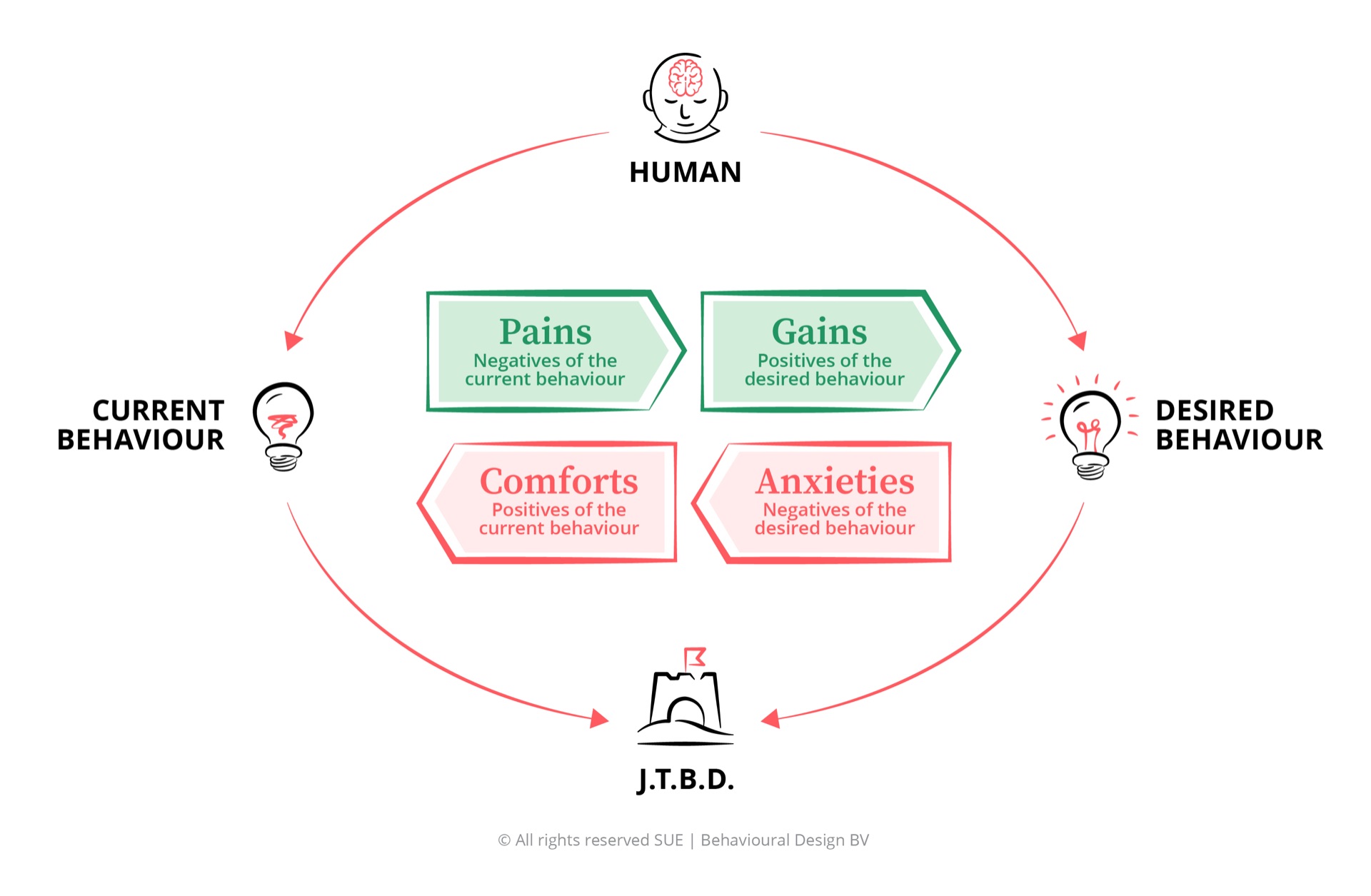
The six biases don't operate in isolation. They reinforce each other in a pattern made visible by the SUE Influence Framework. The Framework describes four forces that drive every behaviour: Pains, Gains, Anxieties and Comforts. In management decisions, Comforts and Anxieties consistently dominate.
Comforts drive the system. A fast decision based on a first impression takes little energy. Extrapolating a halo is mentally cheap. Continuing a failing project because stopping feels uncomfortable is more comfortable than honestly evaluating. Managers operate under permanent time pressure and cognitive overload. Their brains reach for the shortcuts that keep the work feasible. The Comfort of a fast judgement is the engine behind every management bias.
Anxieties reinforce the pattern. Disagreeing with the group verdict in an executive team feels socially risky. Killing a failing project feels like loss of face. Rating a popular employee lower than their halo suggests feels like picking a fight. Fear of social and political consequences drives managers back to what is safe. Under equal doubt, the option that doesn't make waves wins, not the option that's rationally best.
Pains are real but delayed. Continued loss-making projects cost millions. Wrongly promoted employees cause team dysfunction. But that pain only manifests months later and is rarely traced back to the specific biases that drove the choice.
Gains are abstract. Better decision-making, fairly evaluated teams, earlier-killed failing initiatives. Valuable, but hard to feel in the moment an individual decision is made.
This is the classic pattern. Concrete forces in the moment of the decision (Comfort and Anxiety) beat abstract forces over the long term (Pain and Gain). Awareness does not break this pattern. Process design does.
Eight interventions that make management decision-making bias-resilient
The Behavioural Design line is unambiguous: change the environment, not the manager. For management decision-making this means eight concrete interventions, each of which structurally neutralises a specific bias.
1. Use independent estimates before group discussions. Have team members write down their position before the meeting begins. This prevents the first verbalised number or stance from becoming the anchor for the rest. The variance in those individual estimates is more valuable information than any consensus.
2. Define stop criteria for projects before you start. Pre-define the measurable thresholds that should trigger reconsideration or termination. Decouple those criteria from who sponsors the project. This disarms the sunk cost fallacy by making the stop decision technical rather than political.
3. Run pre-mortem sessions for major decisions. Ask the team: imagine we look back a year from now and this decision was a disaster. What happened? This forces the team to name potential failure modes explicitly while there's still room to correct. It neutralises confirmation bias by making counter-evidence socially acceptable.
4. Assign a devil's advocate for every major decision. Give that person the explicit role of attacking the favoured option. Not to be negative, but to ask: what would have to be true for this to be wrong? This breaks bandwagon effect and groupthink.
5. Use structured performance review templates. Have managers first score per competency on a pre-defined scale before they form an overall verdict. Add historical data as context, not as a starting point. This neutralises halo effect and confirmation bias in evaluations.
6. Rotate who speaks first in meetings. Ensure it isn't always the most senior or loudest voice that sets the anchor. In some companies it works to let junior members give their position first, before senior members may respond. This dismantles anchoring and bandwagon at once.
7. Evaluate decisions on process, not just on outcome. A good decision with a bad outcome is still a good decision (and vice versa). Annie Duke calls this 'resulting': confusing outcome quality with decision quality.[5] Evaluating the process teaches you about the bias-resilience of your decision-making. Evaluating only outcomes teaches you nothing.
8. Keep a decision journal. For every significant decision, write down: what was the context, what information did you have, which alternatives did you consider, what was the expected outcome. Read it back six months later. Patterns not explained by external factors are likely biases. Data trumps self-reflection.
Cognitive biases in management and the culture that enables them
The six biases this article lays out are not the fault of individual managers. They are the mechanical consequences of a System 1 that reaches for shortcuts under uncertainty, combined with an organisational culture that either permits or structurally discourages them.
The crucial cultural question for leaders is: how safe is it in this team to say out loud 'I think we should reconsider this decision'? How often does it happen that a junior employee questions a senior decision without career impact? How often do we explicitly acknowledge that an earlier decision was wrong? Cultures that take psychological safety seriously neutralise biases. Cultures that reward conformity amplify them.
For leaders applying Behavioural Design for managers, this means a dual task. Design the processes that neutralise individual biases. And design the culture in which dissent is a sign of loyalty, not undermining. Culture change emerges from making behaviour possible, not from communicating values.

Frequently asked questions about cognitive biases in management decisions
What are cognitive biases in management decisions?
Cognitive biases in management decisions are the systematic thinking errors leaders make when deciding on projects, employees, budgets and strategy. They drive which initiatives are continued, which employees are promoted and which risks are underestimated. The six most damaging are anchoring bias, halo effect, confirmation bias, sunk cost fallacy, availability heuristic and social proof in group decision-making.
Which bias costs organisations the most money?
The sunk cost fallacy is probably the most expensive. Managers keep investing in failing projects because they have already spent so much money and time, even when the rational decision would be to stop. This bias costs organisations millions per year in continued IT projects, loss-making product lines and strategic initiatives that should have been killed.
Does management training reduce cognitive biases?
Classic awareness training raises consciousness but barely changes behaviour. Managers can perfectly explain what a halo effect is and unconsciously apply it the next day. Process design is more effective: pre-mortem sessions, devil's advocate roles, structured decision criteria and stage-gate reviews that remove the comfort of fast judgement.
How do you design a bias-resilient management team?
Use independent estimates before group discussions (to prevent the bandwagon effect), pre-mortem analyses for major decisions, explicit devil's advocate roles, pre-defined stop criteria for projects (against sunk cost), structured performance review templates (against halo) and data-driven evaluation of your own past decisions to make patterns visible.
What is the impact of confirmation bias on performance reviews?
Significant. Once a manager forms an initial impression of an employee (strong or weak), the brain looks for evidence to confirm that impression. Strong performance from a 'weak' employee is seen as an exception, weak performance from a 'strong' employee as understandable. The review confirms the existing perception rather than testing it. Structured review templates with pre-defined criteria largely neutralise this.
How do you prevent groupthink in management teams?
Have team members take a written position independently before group discussion begins. Explicitly assign someone the role of devil's advocate. Use anonymous voting for controversial decisions. Rotate who speaks first. Recognise that unanimity is rarely a sign of a good decision; more often it's a sign of bandwagon effect and fear of dissent.
Conclusion: from bias awareness to bias-resilient management decision-making
The six biases this article lays out are not the fault of individual managers. They are the mechanical consequences of a System 1 that reaches for shortcuts under uncertainty. That realisation is both freeing and confronting. Freeing because the problem isn't about competence. Confronting because the standard solution of the past fifteen years (awareness training) is provably insufficient.
The Behavioural Design route is fundamentally different. Stop investing in training that tells managers which biases exist. Start redesigning the decision processes in which the biases arise. Independent estimates before group discussions. Stop criteria for projects pre-defined. Pre-mortem sessions for major decisions. Devil's advocate roles explicitly built in. Performance reviews with structured scoring. And a culture that rewards dissent rather than punishing it.
Want to learn how to apply this fully in your own organisation? In the Behavioural Design Fundamentals Course you learn to apply the Influence Framework and the SWAC Tool to diagnose and redesign management decision-making processes. Rated 9.3 by 10,000+ alumni from 45 countries, including hundreds of leaders who apply the same Framework daily to their own decision-making.