Cognitive biases in organisational change: the complete guide for change managers
An organisation announces a new way of working. Modern, more efficient, better for customers and employees. Management is convinced. The change consultants have a vision document, a communication plan and three town halls organised. Everyone gets 'taken on the journey'. Three months later there's one new poster on the wall and everything runs as before. The screensaver has changed. The behaviour hasn't.
This pattern repeats with the statistical precision McKinsey has been reporting for decades: 70% of organisational change programmes fail.[1] And the cause is almost never that the change was rationally wrong. The cause is that the change method didn't account for how the human brain handles change. For the cognitive biases that make smart, well-meaning people systematically prefer the existing situation over an improved new one.
This is what cognitive biases in organisational change do when you don't deliberately address them. It's not resistance. It's not unwillingness. It's the mechanical response of a brain that under uncertainty falls back on the familiar, even when the familiar is objectively worse than the alternative.
Cognitive biases in organisational change are the systematic, predictable thinking patterns that explain why employees, managers and organisations resist change, even when the change is rationally better than the current situation. These biases make resistance not pathological but mechanical, and therefore designable. The six most impactful biases in change management are status quo bias, loss aversion, present bias, the sunk cost fallacy, the availability heuristic and the endowment effect. Behavioural Design tackles them through behaviour design, not through communication.
What are cognitive biases in organisational change?
Change is, at its core, asking people to let go of something they currently do and embrace something new, often before the benefits are tangible. That is precisely the situation in which cognitive biases work most strongly. The brain has evolved to avoid risks, prefer the familiar and avoid short-term pain in favour of vague long-term benefits. Change activates all those mechanisms at once.
The behavioural sciences have documented this phenomenon in detail since the 1970s. Daniel Kahneman, in his work with Amos Tversky, described how loss aversion (the pain of loss weighs roughly twice as much as the pleasure of an equivalent gain) explains why people prefer existing situations.[2] Since then a whole library of research has been built on how biases block organisational change and how behavioural design can neutralise them.
For change managers the implication is profound. Resistance to change is not a motivation problem you solve with inspiring communication. It's a predictable cognitive response you solve with process design. The difference between behavioural design and classic change management lies precisely here: in taking seriously what the brain does when confronted with change.
Why communication and vision don't cause change and behaviour design does
The most stubborn assumption in change management is that clear communication and a strong vision cause change. The reasoning sounds logical: tell people why the change is needed, what the new end-state is, and how they're part of it. They will follow. In practice they rarely do. Not because the communication is bad, but because communication addresses System 2 at a moment when System 1 has long since decided to continue existing habits.
Behavioural Design works fundamentally differently. Instead of convincing people, it designs the environment so the new behaviour becomes the easiest choice. Instead of asking for active adaptation, it makes the new way of working the default. Instead of arguing against status quo bias, it uses the bias itself to its advantage by making the new situation the new status quo.
The Behavioural Design line is clear: stop running change programmes that lean on communication and vision. Start running programmes that make the new behaviour the obvious choice. The rest of this article shows how.
The six most impactful biases in organisational change
At least fifty cognitive biases have been documented. In change management, six of them do most of the work. They reinforce each other, they appear at different stages of the change programme, and they can all be designed for, neutralised or even leveraged.
Status quo bias: why employees prefer the current situation even when it's worse
The most powerful bias in change. People systematically prefer the current situation over change, even when the change is objectively better.[3] The mechanism is mentally efficient: under doubt, doing nothing costs no energy and no risk. In organisations this is reinforced by existing routines, social expectations and the countless small decisions already built around the current way of working.
For change managers this means: don't fight status quo bias, use it. Make the new situation the default rather than the choice that must be actively made. A new HR system that automatically opt-ins all employees works fundamentally better than one where people must actively choose. For the full mechanism: status quo bias at work.
Loss aversion: why loss weighs twice as heavy as equivalent gain
Tversky and Kahneman showed that the pain of a £100 loss is roughly twice as intense as the pleasure of a £100 gain.[2] In organisational change this translates immediately: employees experience what they give up (habits, status, skills, social relationships) more strongly than what they receive (efficiency, new possibilities, better systems). Communication that emphasises only the gains misses this fundamental asymmetry and inadvertently activates resistance.
For change managers this means: frame the change also in terms of what is preserved and what is lost if there's no change. 'Without this transition we'll lose our market position within 18 months' works more strongly than just 'with this transition we can become market leader'. Acknowledge explicitly what people are giving up, instead of belittling it. Taking loss seriously neutralises resistance faster than promises about benefits. Read more in loss aversion at work.
Present bias: why people avoid short-term pain at the expense of long-term benefit
Present bias is the tendency to prefer short-term benefits (even small ones) over long-term benefits (even large ones). A change that requires effort now (learning new systems, letting go of old habits, starting again) and only delivers benefit in six months loses to a status quo that's comfortable now.
The fix is clear: design quick wins in the first 30 days of the change programme. Make the new behaviour immediately rewarding, even if the strategic benefits only manifest months later. A new CRM that saves time on a few daily tasks in week one gets faster adoption than a new CRM that 'will transform our entire customer relationship over a year'. Deeper analysis: present bias at work.
Sunk cost fallacy: why organisations cling to failed initiatives
Existing systems, processes and strategic choices represent millions in investment. Acknowledging that an initiative needs to be changed or stopped also means acknowledging that the earlier investment didn't deliver the expected return. Sunk cost fallacy makes that acknowledgement unbearable: it feels like loss, even though the money is already spent and unrecoverable.
In organisational change this explains why legacy IT systems are maintained for years past their economic lifespan. Why loss-making products stay in production because 'we've already done so much market work'. Why strategies are continued while the market has fundamentally changed. The fix: separate retrospective evaluation ('was this investment a good choice?') from prospective decision ('what is the best choice now, given the current situation?'). For the full mechanism: sunk cost fallacy at work.
Availability heuristic: why recent failure stories block change
The brain judges chances based on what it can most easily recall. In organisations this means the failed change of two years ago weighs more strongly mentally than the ten successful changes since. 'We've tried this before and it didn't work' is one of the most powerful anti-change arguments, not because it's analytically correct, but because the earlier failure is available in collective memory.
The fix: make comparable successful changes equally available. Show case studies of comparable organisations that have made this transition. Tell the story of the one team already running pilot and seeing success. Availability can be actively constructed by making the right stories easy to recall. Deeper exploration: availability heuristic at work.
Endowment effect: why employees overvalue what they have
The endowment effect is the tendency to value what we already have more highly than what we could get, even with equivalent options. People with a specific workspace see it as more valuable than the same space one floor up. People who use a specific system see it as better than a functionally equivalent alternative. The effect activates as soon as something becomes 'ours' and intensifies over time.
In organisational change this explains why employees cling to systems, processes or ways of working they wouldn't have chosen if they had to start fresh. The fix: acknowledge the endowment explicitly and give space for grieving. Make letting go of the old a marked ritual rather than a casual announcement. A team that formally bids farewell to an old system accepts the new one faster than a team where the old is quietly phased out. For the full mechanism: endowment effect at work.
How change biases connect through the SUE Influence Framework
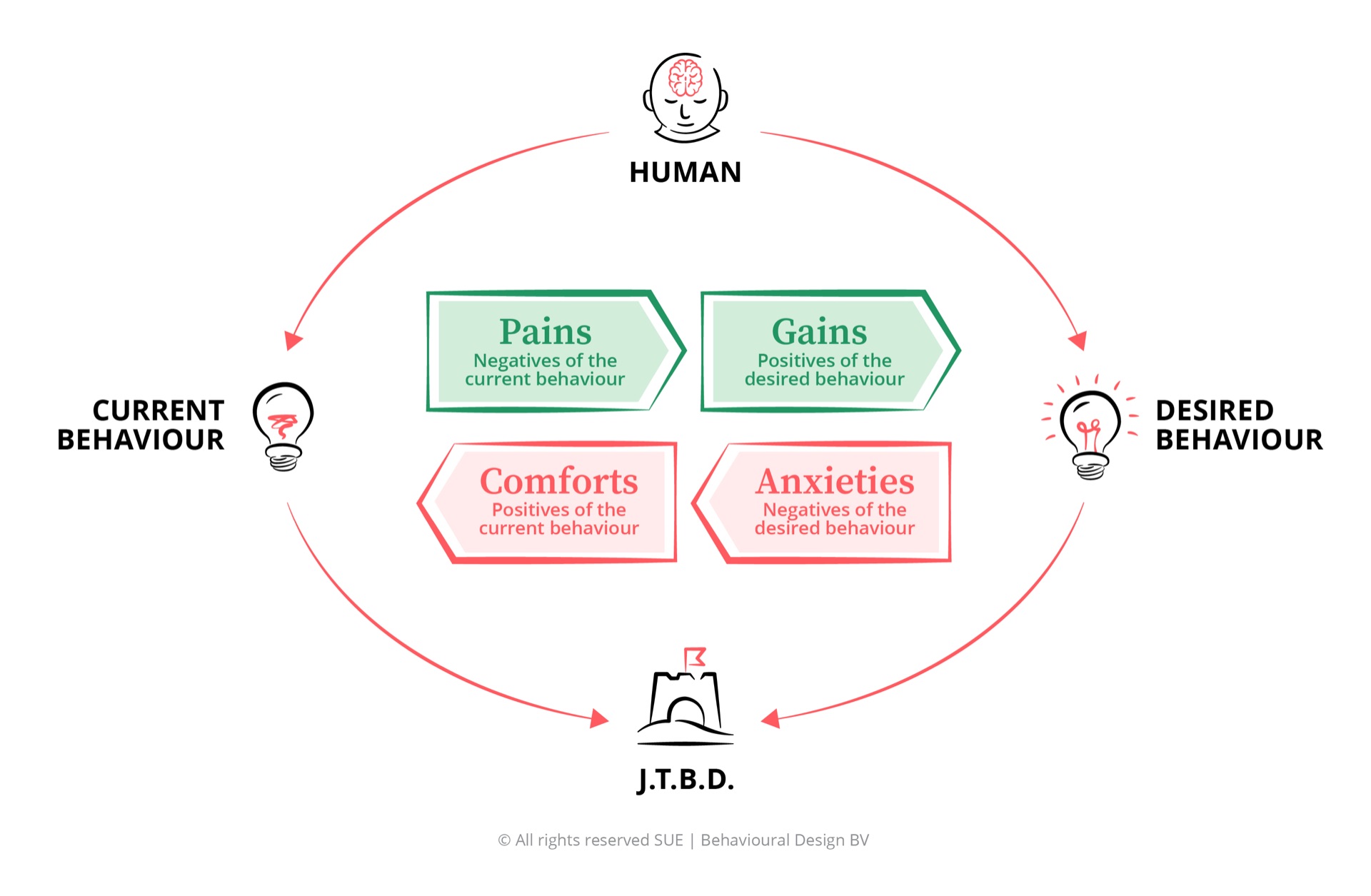
The six biases don't operate in isolation. They reinforce each other in a pattern made visible by the SUE Influence Framework. The Framework describes four forces that drive every behaviour: Pains, Gains, Anxieties and Comforts. In organisational change all four are in play, and all four weigh against change.
Comforts drive the system. The current way of working is familiar, automatic and mentally efficient. Changing requires learning new habits, understanding new systems, navigating new social dynamics. All of that costs cognitive energy. The Comfort of the familiar is the engine behind status quo bias.
Anxieties reinforce the pattern. Change brings uncertainty: will I still perform well in the new system? Will I keep my status? Will my team stay intact? Loss aversion makes these anxieties tangible long before the change actually happens. What's unknown gets framed mentally as loss.
Pains are the motivator to change. But the pain of the current situation must be big enough and visible enough to overcome the Comforts and Anxieties. In many change programmes the pain is abstract ('we must innovate to stay relevant') and therefore insufficiently motivating.
Gains are the reward after the change. But present bias means future gains are systematically underestimated relative to current Comforts.
The implication for change managers: a successful change programme must address all four forces simultaneously. Make the pain of the current situation tangible. Acknowledge anxieties explicitly and remove them. Create quick gains. And design the new situation so it becomes the new Comfort.
Eight interventions that make change programmes bias-resilient
The Behavioural Design line is clear: design the environment, not the communication. For organisational change this means eight concrete interventions that each neutralise or leverage a specific bias.
1. Make the new behaviour the default. Status quo bias works for you rather than against you when the new situation is the standard. A new HR system that automatically opt-ins employees and requires opt-out gets fundamentally higher adoption than one where they must actively choose.
2. Frame in terms of what's preserved and what's lost without change. Loss aversion is twice as powerful as gain attraction. 'Without this transition we lose X' works more strongly than 'with this transition we get X'. Acknowledge explicitly what employees give up, rather than ignoring it.
3. Design quick wins in the first 30 days. Present bias means future benefits are systematically underestimated. A change that delivers something concrete in week one (even just saving time on one daily task) builds momentum that a programme without quick wins never gets.
4. Reduce cognitive friction in new behaviours. Every extra step, every ambiguity, every decision costs adoption. Design the new behaviour so it costs less energy than the old. Not through training, but through interface, process and environment.
5. Acknowledge the endowment explicitly and give space for goodbyes. A team that formally bids farewell to an old system accepts the new one faster. Make letting go a ritual, not a casual announcement.
6. Make successful changes available in collective memory. Case studies of comparable organisations. Stories from pilot teams. Concrete examples of working transitions. Availability heuristic can be actively constructed by making the right stories easy to recall.
7. Separate retrospective evaluation from prospective decisions. Sunk cost fallacy arises when 'was this investment a good choice?' gets confused with 'is this the best choice now?'. The two questions deserve separate sessions, with different decision-makers where possible.
8. Run behavioural pilots instead of big bang implementations. A pilot in a team of 12 yields reliable data on what works and what doesn't, before you roll out to 1,200. The pilot simultaneously generates the available success stories that accelerate the broader rollout. Read more about this approach in behavioural design vs change management.
Cognitive biases in organisational change and the culture that enables them
The six biases this article lays out are not the fault of individual employees or managers. They are the mechanical consequences of a System 1 that under uncertainty falls back on the familiar. The crucial question for change managers is therefore not 'how do we overcome resistance', but 'how do we design an environment in which the new behaviour becomes the easiest choice'.
Culture plays a crucial role. Organisations with a culture of psychological safety, where employees can safely make mistakes while learning new behaviour, have fundamentally higher change probability than organisations where every mistake is politically loaded. Cultures that reward experimentation neutralise the availability heuristic (failures become learning experiences, not anti-change stories). Cultures that embrace vulnerability neutralise anxieties.
For change managers applying Behavioural Design for change management, this means a dual task. Design the processes that neutralise individual biases. And design the culture in which it's safe to try new behaviour. Culture change emerges from making behaviour possible, not from communicating values. And that's precisely where change management and behavioural design come together.

Frequently asked questions about cognitive biases in organisational change
What are cognitive biases in organisational change?
Cognitive biases in organisational change are the systematic, predictable thinking patterns that explain why employees and organisations resist change, even when that change is rationally better. The six most impactful in change management are status quo bias, loss aversion, present bias, sunk cost fallacy, availability heuristic and the endowment effect. Behavioural Design tackles them through behaviour design, not through communication.
Why do 70% of change programmes fail?
The McKinsey statistic that 70% of change programmes fail has been consistently replicated. The cause is almost never a poor strategy, but almost always a change method that doesn't account for cognitive biases. Classic change management focuses on communication and vision. Behavioural Design focuses on designing the environment so the new behaviour becomes the easiest choice. The first barely works, the second is measurably more effective.
What is status quo bias and why is it so powerful?
Status quo bias is the tendency to prefer the current situation over change, even when the change is objectively better. The mechanism is mentally efficient: under doubt, doing nothing costs no energy and no risk. In organisations this is reinforced by routines, existing processes and social expectations. The fix: make the new situation the default rather than the choice that must be actively made.
How do you address resistance to change?
Stop framing resistance as pathology or motivation problem. Recognise that resistance is a rational response to cognitive biases that protect people against change. Then: design the change so the biases work for you rather than against you. Make the new situation the default. Reduce friction in new behaviours. Frame the change in terms of preservation (loss aversion). Provide quick wins (present bias).
What's the difference between behavioural design and change management?
Classic change management assumes rational actors who adapt their behaviour given the right communication and vision. Behavioural Design recognises that the vast majority of behaviour is automatic and context-driven[4] and designs the environment so the new behaviour becomes the obvious choice. Communication is then a supporting tool, not the main intervention. Behavioural Design is measurably more effective because it accounts for how the brain actually works.
How do you use loss aversion to your advantage in change?
Loss aversion is twice as powerful as gain attraction. Frame the change in terms of what's lost if you don't change, not just what's gained by changing. 'Without this transition we'll lose our market position within 18 months' works more strongly than 'with this transition we can become market leader'. Combine with quick wins in the first 30 days to leverage present bias.
Conclusion: from fighting resistance to embracing behaviour design
The six biases this article lays out are not the fault of resistant employees. They are the mechanical consequences of a System 1 that under uncertainty falls back on the familiar. That realisation is both freeing and confronting. Freeing because change management no longer needs to be about motivation and buy-in. Confronting because the standard method of the past thirty years (vision + communication + town halls) is provably insufficient.
The Behavioural Design route is fundamentally different. Stop running change programmes that lean on communication and vision. Start running programmes that make the new behaviour the obvious choice. New defaults. Loss framing. Quick wins. Cognitive friction removed. Endowment explicitly acknowledged. Success stories made available. Sunk cost decoupled from prospective decisions. And behavioural pilots instead of big bang implementations.
Want to learn how to apply this fully in your own organisation? In the Behavioural Design Fundamentals Course you learn to apply the Influence Framework and the SWAC Tool to diagnose and redesign change programmes. Rated 9.3 by 10,000+ alumni from 45 countries, including hundreds of change managers who apply the same Framework daily to their programmes.