Customer Experience Training: What Actually Works
Organisations spend billions on customer experience. They commission journey maps, run NPS surveys and invest in CX software. Then they send their teams to customer experience training, hoping something will finally stick. And yet, according to Forrester Research, fewer than one in three CX programmes produce measurable improvement in customer loyalty.[1]
That is not a resource problem. It is a behaviour problem. Most CX training teaches people how to describe the customer experience. It rarely teaches them how to change it.
This article is about what good customer experience training actually contains, why the standard approach falls short, and how to find a CX course or programme that closes the gap between insight and behaviour change.
Customer experience training is a structured learning programme that equips professionals with the skills to understand, diagnose and improve the experiences customers have with an organisation. Effective CX training goes beyond journey mapping to include customer psychology, friction diagnosis and the design of concrete interventions that change actual behaviour, for both customers and the employees who serve them.
What is customer experience training?
Customer experience training covers a wide spectrum. At one end, you have one-day workshops that walk participants through customer journey maps and touchpoint inventories. At the other, you have multi-month learning programmes that combine research skills, behavioural science and intervention design with real organisational challenges.
Most CX training programmes sit closer to the first category. They teach a shared language and a visual format. Participants leave with a filled-in journey map and a clearer picture of where things go wrong for customers. That is not nothing. But it stops well short of the capability that actually moves customer satisfaction scores.
The skills gap in CX is not about frameworks. Professionals do not fail to improve customer experiences because they lack a template. They fail because they do not understand the psychology behind customer decisions, they cannot diagnose the root cause of friction, and they have no systematic method for designing interventions that change behaviour.
Good CX training closes all three gaps. It combines the analytical tools of customer research with the behavioural science of decision-making, and adds a practical design layer for creating and testing concrete improvements.
Why most CX training doesn't stick (the behaviour gap)
The failure mode of CX training is so consistent that there is a name for it: the knowing-doing gap. Participants understand the content. They can describe the customer journey, identify the pain points and articulate what a better experience would look like. Then they return to work, and nothing changes.
This is not a motivation problem. Most CX professionals genuinely want to improve things. The gap is structural. Three dynamics tend to cause it.
First, journey maps describe problems but do not explain them. Knowing that customers drop off at step three of onboarding tells you where the problem is. It does not tell you why customers do what they do at that moment, what fears or habits are active, or what an intervention at that point should look like. Without that causal layer, improvements tend to be cosmetic.
Second, CX training rarely teaches behavioural research. The most powerful source of insight in customer experience is direct conversation with customers, structured around their actual decision-making. Most CX programmes skip this entirely, or treat it as a generic skill rather than a specific method. Professionals leave knowing they should talk to customers, but not how to extract the insights that lead to behaviour change.
Third, implementation requires cross-functional buy-in that nobody taught them to build. CX improvements almost always span multiple teams. The people trained in CX rarely have the authority to implement changes unilaterally. Without skills for creating organisational support for change, even well-designed interventions stall.[2]
"The knowing-doing gap is not a knowledge problem. It is a design problem. The question is not whether your team understands good CX, it is whether your organisation is designed to produce it."
Effective customer experience training addresses all three dynamics. It teaches the psychology behind customer behaviour, a structured method for researching it, and practical tools for designing and implementing improvements in organisations where change is always contested.
The behavioural science behind great customer experiences
Great customer experience is not the absence of friction. It is the presence of moments that feel effortless, trusted and slightly better than expected. Understanding why some experiences feel that way requires a working model of how customers actually make decisions, which is rarely what they think they are doing.
The foundational insight from behavioural economics is that most customer decisions are driven by System 1 - the fast, automatic, emotional part of thinking - rather than its slower counterpart. Customers do not rationally evaluate each touchpoint. They respond to cues, defaults, social proof and the presence or absence of friction in ways that are largely unconscious.
This has direct consequences for CX design. If you design your onboarding process to be logically correct but cognitively demanding, customers will abandon it, not because they lack motivation but because effort is experienced as a signal. High effort implies high risk. Low friction implies safety and competence.
Friction in behavioural design is not just inconvenience. It is a force that shapes customer decisions at every touchpoint. The experience of filling in a form, waiting for a response, or navigating a service interface communicates something about the organisation behind it. Reducing friction is one of the highest-leverage CX interventions available, and it requires no budget increase, only a clear diagnosis of where friction lives and what is causing it.
A second concept that transforms CX work is the Jobs-to-be-Done framework. Customers do not buy products or use services because of feature lists. They hire solutions to make progress on something they care about. Understanding the job a customer is trying to get done reframes every CX challenge. The question shifts from "how do we make our service more pleasant?" to "what progress is this customer trying to make, and what is getting in the way?"
Choice architecture is a third lever. How options are presented, sequenced and defaulted shapes which choices customers make, often more than the content of the options themselves. CX professionals who understand choice architecture can redesign decision points, confirmation flows and service options in ways that reduce customer effort and increase satisfaction without changing the underlying offering.
What you actually learn in CX training, and what you should
There is a consistent gap between what most CX training programmes deliver and what professionals actually need. Here is how it breaks down across four capability areas.
Customer research: from surveys to behavioural interviews
Most CX professionals are trained to collect data through surveys, NPS scores and analytics dashboards. These tools are useful for tracking performance at scale. They are poor at explaining why customers behave as they do.
The research method that generates actionable CX insight is structured behavioural interviewing, combined with a framework for mapping the forces that drive customer decisions. The SUE Influence Framework is one such tool. It maps five forces that shape customer behaviour: the Job-to-be-Done (what customers are trying to achieve), Pains (frustrations with the current experience), Gains (benefits of the desired behaviour), Anxieties (fears and doubts that block action) and Comforts (habits that keep customers in the status quo).
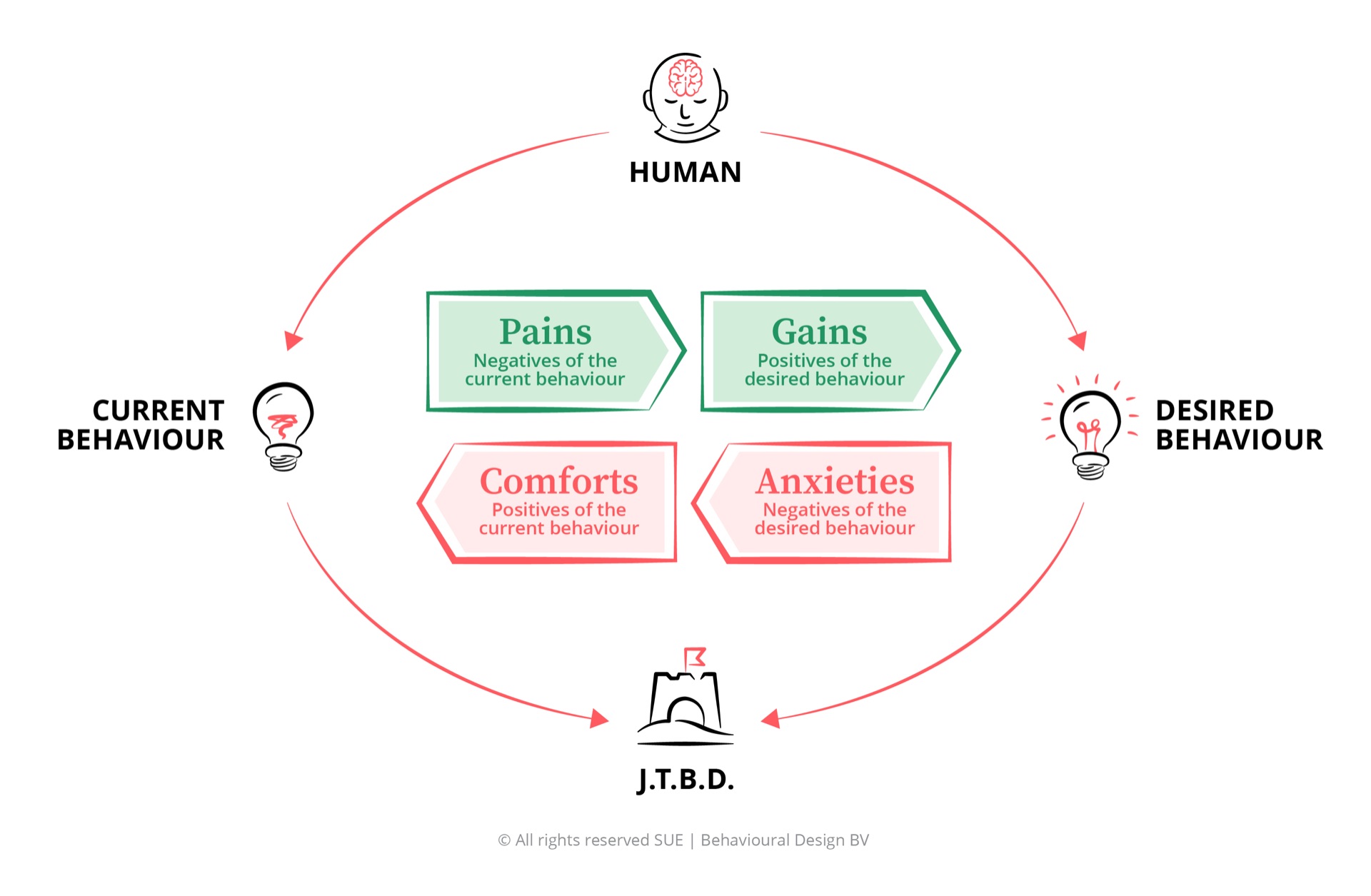
With six to eight structured interviews using this framework, a CX team can surface a depth of insight that months of survey data will not provide. Good CX training teaches this research method, not just the principle that talking to customers is important.
Journey mapping: from description to diagnosis
Journey mapping is the most widely taught skill in CX programmes. It is also the most frequently misused. Maps become beautiful artefacts that describe the as-is experience in loving detail, then get pinned to a wall and ignored.
The problem is that most journey maps are produced from internal assumptions rather than customer research. They describe what the organisation thinks the customer experiences, not what the customer actually feels at each step. The map looks accurate because it matches internal process flows, not because it matches the customer's psychological reality.
Effective CX training teaches a different approach: journey mapping built on behavioural research, focused specifically on the moments that matter most to customers and the moments where friction is highest. Rather than mapping every step, it concentrates effort on the decision points where customer behaviour is won or lost.
Intervention design: from insight to action
The biggest gap in most CX training is what happens after the research and mapping. Knowing what the problem is does not automatically generate a solution. Designing effective CX interventions requires a structured method for moving from diagnosis to action.
Behavioural design provides that method. The SWAC model asks four questions about any planned intervention: Does it create a SPARK at the right moment? Does it increase WANT by connecting to customer goals? Does it make the desired behaviour easy (CAN)? Does it create conditions for the behaviour to happen AGAIN?
The multiplicative logic of the model is its key contribution. All four elements must be present. A perfectly designed trigger (SPARK) at a moment when there is no motivation (WANT) produces nothing. A highly motivated customer facing high friction (CAN near zero) still abandons. Good CX training teaches professionals to diagnose which element is failing before designing the intervention.
The CX skills gap in organisations
Research by McKinsey suggests that organisations which integrate behavioural science into their customer experience programmes outperform peers on customer satisfaction by a significant margin.[2] The constraint is not knowledge of behavioural science at the executive level. It is the practical skill to apply it at the level of touchpoint design, content and service delivery.
This is the gap that quality CX training addresses. Not more awareness that behaviour matters, but the concrete capability to diagnose it, design against it and test what works.

How to choose the right customer experience training (buyer's guide)
The market for CX training has grown considerably in the past decade. This is good news for the field, but it makes the selection decision harder. Here are five questions worth asking before committing to any programme.
Does it teach customer research as a skill, not a concept?
Programmes that teach "the importance of customer empathy" without providing a structured method for generating it are training awareness, not capability. Ask specifically: what research methods will participants learn? Will they practise them during the programme? Will they leave with a method they can apply immediately?
Does it include behavioural science, not just journey mapping?
Journey mapping is a useful visualisation tool. But if the programme stops there, participants will produce better maps of the same underlying problems. Look for programmes that include decision psychology, friction diagnosis and an understanding of why customers do what they do at the level of automatic behaviour, not just conscious preference.
Does it work on a real case?
The transfer from training to workplace depends heavily on whether the learning is applied to a real challenge. Programmes that use generic case studies produce generic skills. The best CX training brings participants' actual work into the room and uses it as the primary material. This is uncomfortable and messy and it is also why it works.
Individual or team programme?
CX improvement is a team sport. A single trained individual returning to an untrained team faces the knowing-doing gap in amplified form. Where possible, train the team together, focusing on a shared challenge. This builds a common language, a shared method and the collective ownership that implementation requires. For individuals, an online Deep Dive is an efficient way to build the core diagnostic skills before advocating for wider team investment.
What is the format and duration?
Format matters more than duration. A three-day programme with generic cases may produce less transfer than a focused one-day session on a real problem. Look for programmes that balance input (frameworks and concepts) with application (working on real challenges), and that build in reflection on what participants will change when they return to work.
Frequently asked questions about customer experience training
What is customer experience training?
Customer experience training is a structured learning programme that teaches professionals how to understand, map and improve the experiences customers have with an organisation. Good CX training goes beyond journey mapping to include the psychology of customer decisions, methods for diagnosing friction and skills for designing interventions that change actual behaviour.
What skills does CX training teach?
Effective CX training teaches outside-in customer research, including how to conduct behavioural interviews and map customer jobs, pains, gains and anxieties. It also covers journey mapping with a focus on moments that matter, friction diagnosis using behavioural science principles, and intervention design using frameworks such as the SWAC model to create changes that shift customer behaviour.
How long does a CX training programme take?
CX training ranges from one-day workshops focused on specific skills to multi-month programmes. SUE's online Deep Dive Designing the 9+ Customer Experience is a course of 12 lessons that you follow at your own pace. The Behavioural Design Fundamentals Course delivers the full outside-in method in two days. Team programmes such as the Accelerator run over three months with six half-day sessions, building capability progressively on real organisational challenges.
What is the difference between CX training and UX training?
UX training focuses primarily on digital interfaces and product interactions. CX training covers every touchpoint across a customer's full relationship with an organisation, including service, communication, pricing and onboarding. Both benefit from behavioural science, but CX training tends to address broader organisational and strategic challenges rather than interface-level design decisions.
Who should attend CX training?
CX training is valuable for anyone who shapes the customer relationship: CX managers, marketers, product managers, service designers, UX professionals and team leads in customer-facing roles. It is particularly impactful when the whole team trains together on a shared challenge, since CX improvement rarely succeeds as a solo effort.
Conclusion
Customer experience training is only valuable if it changes what people do, not just what they know. The gap between CX insight and CX improvement is a behaviour problem, and the solution is training that teaches behavioural research, friction diagnosis and intervention design as practical skills rather than conceptual awareness.
The organisations that consistently improve customer experience are not the ones with the best journey maps. They are the ones whose professionals understand why customers behave as they do, and know how to design experiences that make the right behaviour easier.
That is a learnable skill. The question is whether the training you choose actually teaches it.
