Most market researchers are obsessed with the average consumer. The median respondent from a representative sample. Statistically significant, neatly centred on the mean. And nearly useless if you want to spot real innovation opportunities.
But there's a deeper problem. Even if you find the right people, traditional research methods systematically produce the wrong answers. Not because researchers are bad at their jobs, but because the method itself is flawed. Focus groups, surveys, and intention-based interviews reliably measure one thing: what people are willing to admit to in this moment. That is not the same as what they actually do.
This article is about two principles that fundamentally change how you conduct customer research. First: past behaviour is the only reliable source of insight. Second: the most interesting insights don't sit with average users - they sit at the extremes.
Customer research that works measures behaviour, not intentions. The core principle is the say-do gap: what people say they value differs systematically from what they actually do. Effective behavioural research asks about past behaviour, observes real context, and seeks insights from extreme users rather than the average consumer. More on Behavioural Design for managers →
Why traditional market research leads you astray
The problem with most market research is not the quality of the questions. It's the assumption behind the method. Surveys and focus groups start from the idea that people know what they want and can honestly report it. Neither assumption holds.
People don't know what they want. They know what they think they want, what feels socially acceptable to say, and what sounds most plausible in the context of a questionnaire. That is three different things from the behaviour you're trying to understand.
The research industry is so focused on statistical validity and representativeness that it forgets its actual purpose: finding interesting human problems. A representative sample of 1,000 people telling you their average opinion yields less than six conversations with people who experience the problem so acutely that they've already started inventing solutions.
 Heart of Amsterdam
The say-do gap: the distance between words and behaviour
Virgin Atlantic had a problem. Ticket sales were underperforming and nobody knew why. They did what every self-respecting company would do: they asked their customers what they valued. The answer was clear. Customers valued adventure, discovery and excitement. Virgin Atlantic was, after all, no ordinary airline.
But when researchers stopped asking customers about their intentions and started asking about their behaviour, the picture shifted entirely. What determined whether a flight was experienced as good? Whether the cabin crew solved a problem quickly. Whether the seat was clean. Whether the plane departed on time. Stress-free. Responsive. Reliable. Attributes that no customer would ever mention if asked "what do you value in an airline?" but which determined their loyalty completely.
Virgin Atlantic redesigned its service around the actual behavioural drivers. Result: one million pounds of extra profit compared to the same period the previous year. The most successful reframing exercise Virgin Atlantic had ever undertaken, in their own words.
Past behaviour never lies. Future intentions almost always do.
Clayton Christensen, the architect of Jobs-to-be-Done theory, found the same thing in real estate. Surveys with flat buyers pointed to kitchen, flooring and bedrooms as the deciding factors. Observing buyers in showrooms revealed something different: they lingered at the dining area. They imagined their family gathered there. The dining table was the real product. No survey had ever found that.
The milkshake study is the most cited example. Classical market research produced the finding that customers wanted bigger milkshakes or more chocolate. Behavioural observation showed that most milkshakes were purchased early in the morning, by people alone in their car. The job? Making the commute slightly less tedious and keeping hunger at bay until lunch. The relevant innovation was not more chocolate. It was a thicker consistency and a narrower straw, so the milkshake lasted the whole drive. No respondent ever said that. Behaviour said it unmistakably.
Past behaviour never lies
There is a simple reason why past behaviour is more reliable than intentions about the future. Intentions are hypothetical: people describe how they think they would respond to a situation they are imagining. Past behaviour is factual: it already happened, in a real context, with real circumstances and real counter-pressure.
The question "What would you do if...?" produces the ideal self. Rational, considered, socially responsible. The question "Tell me about the last time you..." produces the real self. With all the detours, rationalisations and contextual factors that actually drive behaviour.
This is the foundation of good behavioural research: replace future questions with past questions. Not "How much would you be willing to pay for...?" but "When did you last buy something similar, and how did that process go?" Not "Would you use a subscription?" but "How have you handled this over the past six months?"
Six such conversations, conducted well, yield more than a survey of five hundred respondents. Not because statistics don't work, but because in six conversations you are looking for interesting problems, while five hundred respondents confirm what you already knew.
There is an added benefit: when you ask about past behaviour, people fall out of their rationalisation mode. They describe what actually happened. And in the details of what actually happened, you find the real insights.
Extreme users: the overlooked gold mine
Imagine you're looking for innovation opportunities in a category. Who do you interview? The average user? Or someone whose pain is so acute that they've already started building their own solution?
The Earl of Sandwich was a gambling addict. So addicted to the card table that he instructed his servants to serve his lunch in a way that meant he never had to put his cards down. The result was meat between two slices of bread. The rest is culinary history. The sandwich was not invented by someone who "wanted something practical for lunch". It was invented by someone whose pain was extreme enough to force a solution.
In 1951, Theo Maertens, a regular at a snack bar in Antwerp, walked in and demanded a sandwich "with everything in the house". That turned out to be pili-pili, Tabasco, cayenne pepper, gherkins, ketchup, Worcestershire sauce and chopped onion. His companion tasted it and called out: "Give me the same as Martino." Today you can order a broodje Martino in any Belgian sandwich shop, following exactly that recipe. An extreme user, in possession of extreme pain and a lack of inhibitions, unwittingly launched a cultural institution.
HIIT training was developed by an ultramarathon runner whose marriage was threatening to fall apart due to the number of training hours per week. He searched for ways to train less with the same effect. His extreme need to stay fit without destroying his relationship led to a training method now practised worldwide.
Curves, the global fitness chain serving women exclusively, grew because its founder observed that a specific group of women felt deeply uncomfortable in ordinary gyms. Not mildly uncomfortable. So uncomfortable that they would rather not exercise at all. That extreme aversion pointed towards an entirely new product.

IDEO did the same in product design. They wanted to redesign a children's toothbrush. The classic approach: ask parents and children what they want. Parents said "more fun colours". IDEO did something different: they observed children while they brushed their teeth. And saw that a toothbrush designed as a shrunken adult brush was structurally wrong. Children have small, fat hands. They grip differently from adults. The design needed to be large and chunky, not small and refined. That brush became the world's best-selling toothbrush model.
The pattern is always the same. Everett Rogers described it in his Law of Diffusion of Innovations: every new product or service must first attract a group of early adopters at the margins before the broad majority follows. Without that first group being enthusiastic enough to spread the word, mass adoption never comes. Extreme users are not just a source of insight. They are your first proof that a need genuinely exists.
The principle has a name: scratching your own itch. The best products are often invented by people who took their own problem seriously enough to solve it themselves. And if an extreme user's problem is an amplification of an ordinary need, you have an innovation that works for everyone.
The 2-2-2 method: how to structure behavioural research
The problem with most interviews is not the structure. It's the selection. Companies interview their satisfied customers, their easiest conversation partners, the people who have already said yes. That confirms what you already know. It teaches you nothing about why people don't move.
The 2-2-2 method solves this with a simple structure. You always interview three groups of two people:
2 current users who already exhibit the behaviour. What works for them? Why did they start? What problem did it solve? Not "Why do you like this?" but "Tell me how you first came across this."
2 people who want to but haven't. This is the most valuable group. They are convinced of the value, but something is holding them back. What is that barrier? Not a theoretical resistance, but a concrete circumstance that is blocking the behaviour.
2 people who tried and stopped. Here is your gold. What was good enough to start? What caused them to stop? The moment of stopping reveals exactly which friction remained unresolved.
Six conversations. Two hours total, if you run them tightly. The analyses behind Christensen, IDEO and Virgin Atlantic all followed this pattern: observe behaviour in real context, ask about what actually happened, and find the discrepancy between the desired and actual path.
Alongside the interview structure, there is a second principle: exposure hours. Kurt Lewin, the founding figure of much modern behavioural science, observed that managers constantly project their own assumptions onto people. The defence against this is simple: spend at least two hours every six weeks with real people in their real context. Not in a boardroom. Not via an online panel. Where the behaviour actually happens.
Two hours every six weeks. It sounds minimal. But most managers and designers go months without speaking to a single real user. Exposure hours is the simplest way to destabilise your own assumptions before they produce the wrong design.
From insight to action: the SUE Influence Framework
Behavioural research without a structure for organising findings produces piles of interesting quotes that nobody knows how to use. The SUE Influence Framework provides that structure.
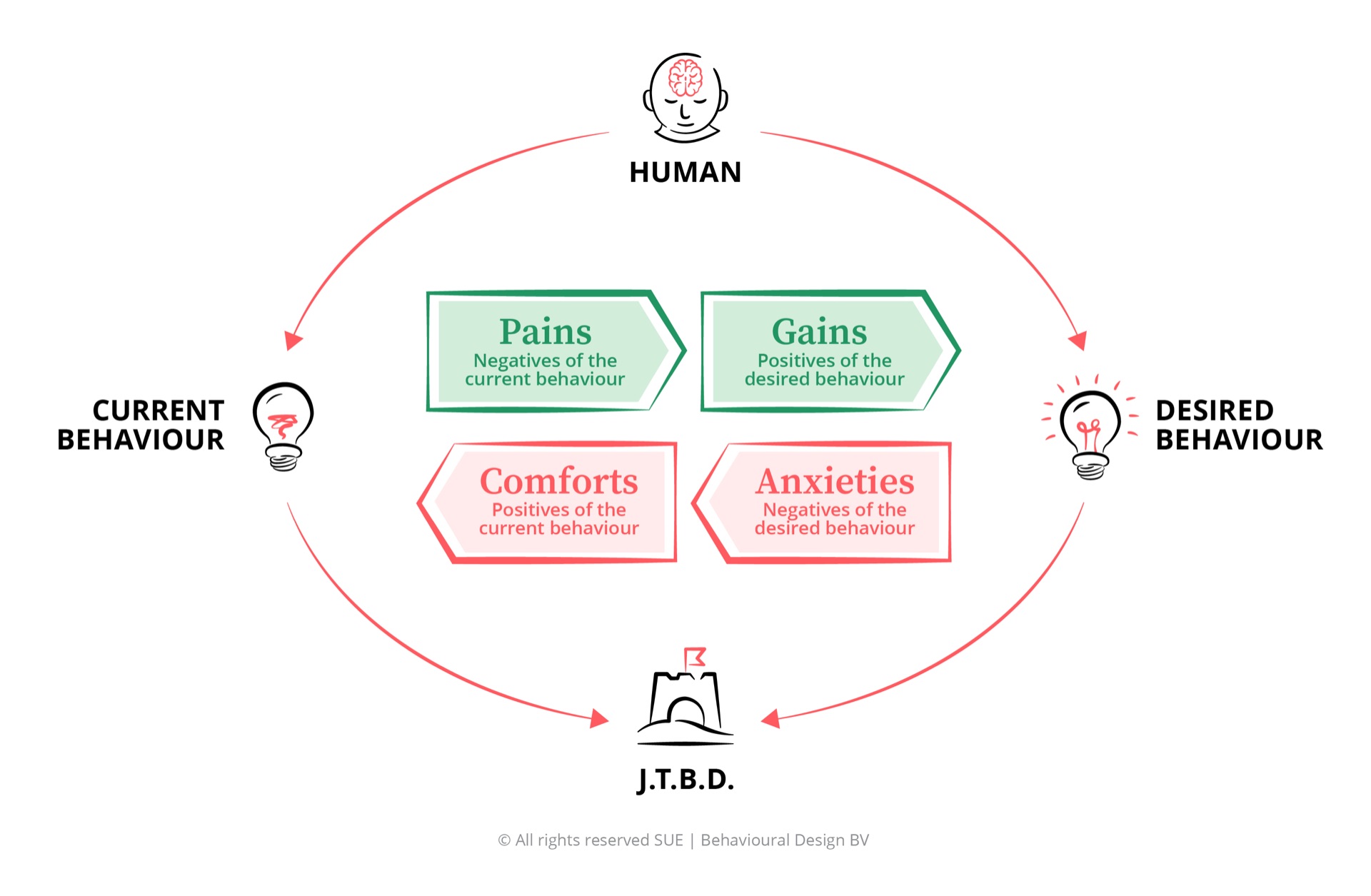
The framework distinguishes four forces that determine behaviour. Pains are the frustrations of current behaviour: what grates, costs energy, gets stuck. Gains are the desires that make the target behaviour attractive. What do people want to achieve, become or avoid? Comforts are the habits and routines that make current behaviour feel comfortable. Why change when things work well enough? Anxieties are the fears surrounding new behaviour. What could go wrong? Who will see it? What will it cost?
Most communication and marketing campaigns work exclusively on pains and gains. They emphasise the problem and promise the solution. But Lewin showed in 1948 that the most effective behaviour change comes not from strengthening driving forces, but from weakening blocking forces. Removing anxieties and comforts is more effective than adding gains.
Your customer research, conducted with the 2-2-2 method and a focus on past behaviour, fills this framework. Extreme users tell you the pains. People who want to but don't act tell you the anxieties. People who stopped tell you the comforts that the new behaviour couldn't match. With that overview, you know not just what people want, but what is holding them back. And it's that second part where most interventions fail.
You've read about it. But what if you could apply it yourself - to customers, colleagues, or stakeholders?
As Europe's #1 academy in Behavioural Design, we train professionals in analysing, predicting and influencing behaviour - live, online or in teams. Based in Amsterdam, with over 10,000 alumni from London to Sydney and Singapore to New York.



 EQAC
EQACCertified
Training
 Training for professionals
Frequently asked questions about customer research and behavioural interviews
What is the say-do gap in customer research?
The say-do gap is the systematic difference between what people say they want and what they actually do. Surveys and focus groups measure rationalisations, not real behaviour. Virgin Atlantic discovered this painfully: customers said they valued adventure and discovery, but loyalty was determined by whether the cabin crew solved problems quickly. See also our article on the SUE Influence Framework.
Why are extreme users valuable for customer research?
Extreme users have amplified versions of ordinary user pains. Where a typical user is mildly frustrated, an extreme user is frustrated enough to build their own solution. That self-built solution points exactly towards a real innovation need. HIIT training, the sandwich and the IDEO kids toothbrush were all invented by people solving their own extreme problem.
What is the 2-2-2 interview method?
The 2-2-2 method is an interview structure for behavioural research. You always interview three groups of two people: 2 current users (what works and why), 2 people who want to but haven't yet (what is the barrier), and 2 people who tried and stopped (why did they stop). Six conversations yield more actionable insights than a survey of 500 respondents.
How do you ask about past behaviour in a research interview?
Use concrete retrospective questions rather than hypothetical ones. Not "What would you do if?" but "Tell me about the last time you..." or "How did you handle this over the past month?" People can describe the past. They invent the future. Past behaviour is the only reliable predictor of future behaviour.
What are exposure hours in behavioural research?
Exposure hours is the principle that you should spend at least two hours every six weeks with real people in their real context. Not in a boardroom or via an online survey panel, but where the behaviour actually takes place. This protects you against the biggest pitfall in research: projecting your own assumptions onto your audience. More on the method at the SUE Influence Framework explained.
1.5 minutes of Influence
Every week I notice something: a sign, a form, a sentence in a meeting. Always something that shows exactly how context drives behaviour. I write it down. Every Thursday morning it lands in your inbox. In 90 seconds.
Read by 10,000+ professionals · Free · Unsubscribe anytime