Jobs-to-be-done explained: Why people really buy
You've done your customer research. Built personas. Sent out surveys. And still, nobody buys. Or they buy, but for reasons you never expected. This happens to every product team and every marketing department that thinks they know what their customers want.
The problem isn't the amount of data you're collecting. The problem is the question you're asking. You ask "what does the customer want?" when the better question is: "what job is this person trying to get done?"
That second question is the heart of Jobs-to-be-Done.
Jobs-to-be-Done (JTBD) is a framework by Harvard professor Clayton Christensen stating that people don't buy products but "hire" them to make progress in a specific circumstance. The real motivation behind behaviour is not the product, but the underlying task someone is trying to accomplish. At SUE, we use JTBD as the foundation of the Influence Framework. More on behavioural design for product management →
What is Jobs-to-be-Done?
Jobs-to-be-Done is a concept by Clayton Christensen, professor at Harvard Business School and author of The Innovator's Dilemma. Christensen asked a simple but radical question: why do people actually buy things?
His answer: people don't "buy" a product. They hire it to get a job done.
"A job-to-be-done is the progress that someone is trying to make in a given circumstance, what someone hopes to accomplish."
That sounds abstract. Let me make it concrete. You don't buy a drill because you want a drill. You buy a drill because you want a hole in the wall. And if you're honest: you don't want a hole in the wall either. You want to hang a painting. And if you're really honest: you want your living room to feel like home.
That last layer is the Job-to-be-Done.
A JTBD always has the structure of a verb + an objective. Not "I want a better product" but "I'm trying to make my morning commute less boring." Not "I want a gym membership" but "I want a reason to leave the house after retirement."
The milkshake problem: the most famous JTBD case
A fast-food chain in the US wanted to sell more milkshakes. They did what you'd expect: they asked customers what they wanted. Thicker? Thinner? More chocolate? More fruit? They adjusted the product based on the answers. Sales didn't budge.
Then Christensen's team arrived. They did something different. They stood in the restaurants and observed. They didn't look at what people said, but at what they did.
What they found: nearly half of all milkshakes were sold before 8.30am. To people who came alone. Who took the milkshake to the car. And who bought nothing else.
In interviews about their actual behaviour (not their preferences), the real story emerged. These morning customers had a long, boring car commute to work. They wanted something that kept their hands busy, fought boredom, and lasted the entire drive.
A doughnut? Too sticky, gone too fast. A banana? Done in two minutes. A bagel? Too dry, too many crumbs. But a thick milkshake? It fit the cup holder, lasted twenty minutes through the thin straw, and filled the stomach until lunch.
The job wasn't "I want something tasty." The job was: "make my morning commute bearable."
Clayton Christensen tells the milkshake case at Harvard Business School.
Once you see that, everything changes. The milkshake's competitor wasn't another milkshake. The competitor was a doughnut, a banana, silence and boredom. The innovation direction changed completely: make the milkshake thicker (so it lasts longer), or make the straw thinner, or add fruit chunks (for small surprises along the way).
"When you buy a product, you essentially 'hire' it to help you do a job. If it does the job well, you hire it again. If not, you 'fire' it and hire something else."
Why needs analysis alone doesn't work
Most organisations do needs analysis. They send surveys. They organise focus groups. They build personas with names like "Marketing Mary, 34, lives in London, enjoys yoga." And then they design products, campaigns and policies based on what those personas say they want.
The problem: people are terrible at explaining their own behaviour.
According to research at Virgin Atlantic, there was an enormous gap between what customers said they valued ("adventure", "excitement", "discovery") and what they actually valued ("stress-free", "responsive", "helpful"). When Virgin optimised for actual behavioural drivers instead of reported preferences, it produced £1 million in additional profit. They called it "the most successful reframing exercise Virgin Atlantic had ever undertaken."
This is the difference between needs and Jobs-to-be-Done.
Needs are what people say they want. They go straight to the customer: "what do you need?" and to the product: "how can we deliver that?" This is inside-out thinking.
Jobs-to-be-Done goes deeper. It doesn't ask what people want, but what they're trying to achieve. In what context do they use your product? What do they actually do, apart from what they fill in on a survey?
At SUE, we put it this way: human-centred thinkers look for problems to solve. Customer-centred thinkers look for a better way to sell their solution. The difference sounds subtle. It's enormous.
How to find someone's real Job-to-be-Done
At SUE, we use three methods to uncover Jobs-to-be-Done. None of them requires a survey.
1. The verb+objective method. Ask two questions. Question one: "What is this person currently trying to accomplish with this product, service or routine?" The answer is a verb. Question two: "What is the underlying task behind that verb?" The answer is the objective, your Job-to-be-Done.
I use this in every Behavioural Design Sprint we run. Say you're working for a pension fund. Someone opens the app. Verb: checking. Underlying task: seeking reassurance that I won't be in trouble later. The JTBD isn't "check my balance." The JTBD is: "feel safe about my future."
2. The 5 Whys. Ask "why?" five times behind a pain or a behaviour. You'll almost always arrive at the real Job-to-be-Done.
Why do you open LinkedIn in the morning? "To see what's happening." Why do you want to know what's happening? "So I don't fall behind." Why don't you want to fall behind? "Because my colleagues are always up to date on everything." Why does that matter? "Because I want to be taken seriously." Why do you want to be taken seriously? "Because I feel my position isn't guaranteed."
The JTBD isn't "read the news." The JTBD is: "protect my professional relevance."
3. The 2-2-2 interview structure. Talk to 2 people who actively use your product, 2 who want to but don't, and 2 who tried it and stopped. This structure reliably surfaces all four forces that determine behaviour, and the real Job-to-be-Done.
Two hours, every six weeks, with real people. That's the minimum. No desk research, no reports, no second-hand insights. Because as we say at SUE: you have to fall in love with the problem, not with your solution.
"Creating a working idea isn't about what you want; it is working out what the people you're trying to influence want."
And the most important rule across all these methods: ask about past behaviour (which is factual and true), never about future intentions (which is fiction). Intentions tell us nothing about real behaviour.
Jobs-to-be-Done and the SUE Influence Framework
At SUE, the Job-to-be-Done isn't a standalone concept. It's the starting point of everything.
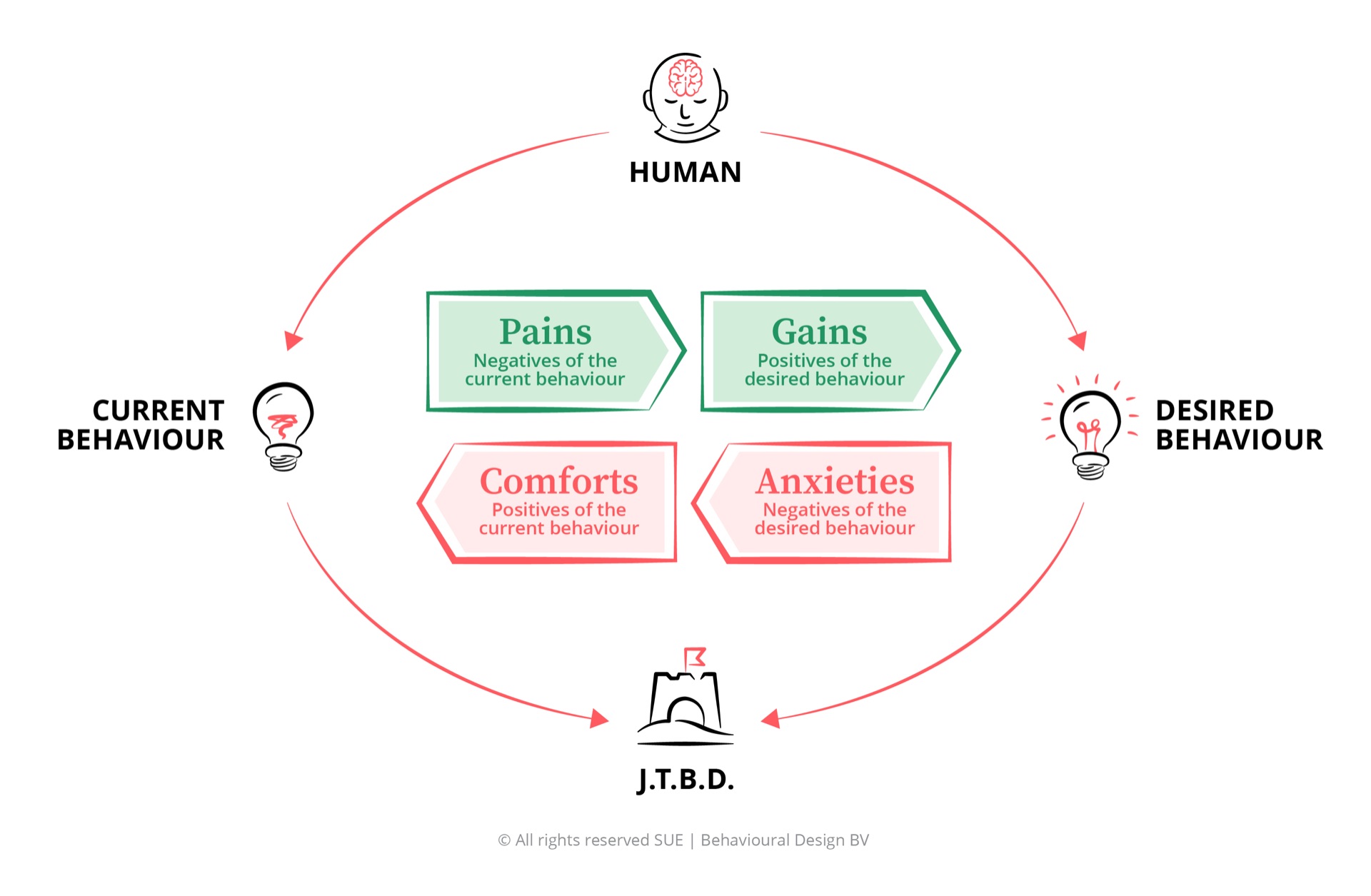
The SUE Influence Framework begins with one question: what progress is this person trying to make? That's the JTBD. From there, you map four forces:
- Pains: the frustrations and obstacles someone experiences in fulfilling the JTBD. Not "needs" but the human feelings and struggles behind them.
- Gains: how the desired behaviour brings someone closer to the JTBD. Not benefits or USPs, but real progress.
- Anxieties: everything that holds someone back from trying new behaviour. Doubt, uncertainty, bad experiences.
- Comforts: all the positives of current behaviour. The reasons someone keeps doing what they're doing, even when it's suboptimal.
Without knowing the JTBD, you're designing in the dark. You don't know which pains are relevant, which gains motivate, which anxieties block and which comforts you need to replace.
The framework is based on Kurt Lewin's Force Field Analysis from the 1940s: the insight that situations are maintained by an equilibrium between driving and restraining forces. Lewin's discovery, and our daily experience, is that you shouldn't push harder (more motivation, more arguments) but remove the restraining forces.
I always call this judo rather than karate. In karate, you try to overpower someone with your own strength. In judo, you use your opponent's force. You take the force coming at you and turn it in a direction that works in your favour. That's how the Influence Framework works too: you work with the forces that are already there.
Jobs-to-be-Done examples that change your perspective
The power of the JTBD framework is in the examples. Once you see it, you can't unsee it.
IKEA and the breakfast against loneliness. Why does IKEA offer a breakfast for two euros? Not because they want to make money from scrambled eggs. According to research, many older visitors eat breakfast alone at IKEA in the morning. Their Job-to-be-Done isn't "eat a cheap breakfast." It's: fight loneliness. IKEA doesn't sell breakfast. IKEA sells company.
The retired man at the gym. During research for a fitness chain, we discovered that a group of retired men faithfully came to the gym every morning. They barely worked out. They stood at the coffee machine. Their JTBD wasn't "get fit." It was: "have a reason to leave the house and meet people." The coffee machine was the product. The gym was the context.
The Miffy toy in debt counselling. A debt counsellor told us about a client who was deep in debt yet bought a 25-euro Miffy plush toy for her daughter. Irrational? From a budget perspective: yes. From a JTBD perspective: completely logical. Her Job-to-be-Done was: "give my child the carefree childhood I never had." That 25 euros wasn't an expense. It was the fulfilment of her deepest motivation as a mother.
IDEO and the children's toothbrush. IDEO was asked to design a better children's toothbrush. Traditional approach: take an adult toothbrush and make it smaller. IDEO did exposure hours. They observed children. What they found: children have fat little fingers that grip differently from adult hands. A shrunk-down adult toothbrush doesn't fit a child's hand. IDEO designed a thick, chunky toothbrush for a child's grip. It became the best-selling toothbrush brand in the world. The child's JTBD wasn't "brush my teeth." It was: "do something grown-ups do, but my way."
From insight to intervention: JTBD in practice
Knowing a Job-to-be-Done is valuable. But it only becomes useful when you do something with it. Three concrete applications.
Redefine the competition. If you understand the milkshake case, you understand that your competitors aren't who you think. The competitor of a gym isn't the gym down the road. It's Netflix on the sofa. The competitor of a leadership training isn't another training. It's the belief "I don't need training, I have 20 years of experience." Once you know which job your product fulfils, you know what alternative you're really competing against.
Steer innovation. Most product teams brainstorm from features. "What if we add X?" But if you know the JTBD, you ask a different question: "What makes fulfilling this job easier?" Behavioural Design teaches us that the best innovations don't require more willpower (WANT) but lower the threshold (CAN). Amazon discovered that account creation was blocking checkout. They removed the registration button, replaced it with "Continue", and saw a $300 million revenue increase in the first year. The customer's JTBD wasn't "create an account." It was: "get this product as fast as possible."
Sharpen your communication. If you know the JTBD, you write different copy. Not "our training teaches you behavioural design" but "after two days, you'll see exactly why people do what they do, even when it seems irrational." The first sentence describes the product. The second describes the job. Guess which one converts.
JTBD isn't a theory for a textbook. It's a lens you can use every day. In every conversation with a customer, in every briefing, in every product meeting. The question "what job does this fulfil?" changes how you think about everything you make.
PS
At SUE, we've been working with the Jobs-to-be-Done framework for over ten years. It's not a standalone concept for us. It's the first step in every Behavioural Design Sprint we run and the foundation of the Influence Framework we teach our participants. If you take one thing from this article: stop asking what people want. Start observing what they do. The rest follows.
 Training for professionals
Frequently asked questions about Jobs-to-be-Done
What is Jobs-to-be-Done?
Jobs-to-be-Done (JTBD) is a framework by Harvard professor Clayton Christensen. It states that people don't buy products but "hire" them to make progress in a specific circumstance. By uncovering which "job" someone is trying to accomplish, you discover the real motivation behind their behaviour.
What is the difference between Jobs-to-be-Done and needs analysis?
Traditional needs analysis asks customers what they want. Jobs-to-be-Done observes what customers actually do and why. Needs analysis measures attitudes (what people say). JTBD measures behaviour (what people do). According to research at Virgin Atlantic, this difference can lead to over £1 million in missed revenue.
How do you find someone's Job-to-be-Done?
Use the verb+objective method. Question one: "What is this person trying to accomplish with this product or routine?" (verb). Question two: "What is the underlying task?" (objective = JTBD). Combine this with the 5 Whys and talk to real people about their actual behaviour, never about intentions. Also read: customer research that works.
What is Christensen's milkshake case?
A fast-food chain wanted to sell more milkshakes. Surveys didn't help. Christensen's team observed that morning customers "hired" the milkshake to make a long car commute less boring. Doughnuts were too sticky, bananas too quick. The milkshake fit the cup holder and lasted the whole drive. The job wasn't "quench my thirst" but "fight boredom."
How does Jobs-to-be-Done fit in the SUE Influence Framework?
The JTBD is the foundation of the SUE Influence Framework. The framework starts with the JTBD, then maps four forces: pains, gains, comforts and anxieties. Without knowing the JTBD, you're designing in the dark.
Is Jobs-to-be-Done only for product innovation?
No. JTBD is applicable to marketing, HR, policy, UX design, change management and any situation where you want to understand or influence behaviour. The question "what job is this person trying to accomplish?" works just as well for an employee who doesn't attend training as for a customer who doesn't buy.
Want to learn how to apply behavioural science to your work? In the Behavioural Design Fundamentals Course you learn to apply the Influence Framework and JTBD to any behaviour challenge you face. Rated 9.7/10 by 10,000+ professionals.

1.5 minutes of Influence
Every week I spot something: a hospital sign, a supermarket shelf, a sentence in a meeting. Something that shows exactly how context shapes behaviour. I write it down. Every Thursday morning, it lands in your inbox. In 90 seconds.
Read by 10,000+ professionals · Free · Unsubscribe anytime