For whom Learning & Development
Behavioural Design for Learning & Development

Learning interventions that actually change behaviour. Every programme, every training, every change project has one goal.

As an L&D professional you know how to design learning processes. But knowledge is not the same as behaviour change. Behavioural Design gives you the science behind the choice, so what you design actually sticks on the job.

10,000+
trained
9.3/10
rating
EQAC
accredited
€1,190
from ex VAT
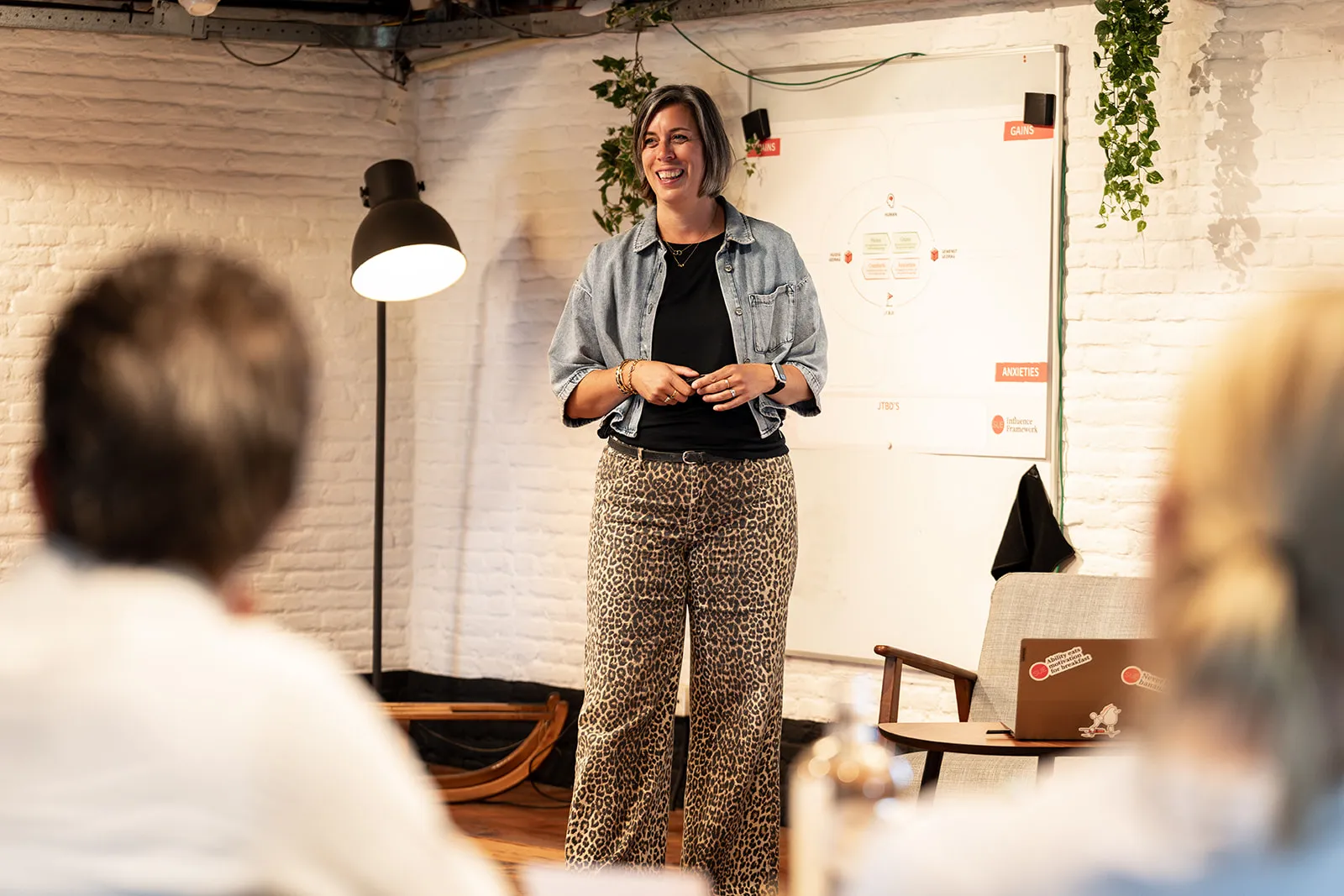
L&D professionals working on learning interventions during the Behavioural Design training at SUE Amsterdam
Familiar challenges for L&D professionals

"How do I design a learning programme that actually changes how people behave on the job?"

10,000+ professionals trained, including people from

Heineken ING Bank KPN Randstad Achmea Adyen Eneco ANWB Roche European Commission City of Amsterdam DPG Media Sony eBay Heineken ING Bank KPN Randstad Achmea Adyen Eneco ANWB Roche European Commission City of Amsterdam DPG Media Sony eBay
The core of the problem

Recognise these L&D challenges around behaviour change?

Click on a situation you recognise.

01
The training with a high evaluation score and no behaviour change afterwards
Participants are enthusiastic. The trainer was excellent. The evaluation is positive. Two weeks later nothing has changed on the job. Because feeling good after a training and actually changing behaviour are two fundamentally different things.
02
The leadership development programme that changes nothing about leadership behaviour
Weeks of coaching, assessments, workshops. The managers say the right things. But in practice they fall back into old behaviour, because the context that triggers that behaviour was never changed.
03
The wellbeing offering that nobody uses
Platform available, budget allocated, communication sent. Adoption: 4%. You are considering more communication. But the problem isn't that people don't know about it. It's that the barrier to start is too high and the habit isn't there yet.
04
The change project with lots of buy-in and little behaviour change
The kick-off went well. People agree with the change. But new behaviour doesn't materialise. Because agreeing with change and actually behaving differently are fundamentally different processes that require a different design.
05
The ROI debate you can't win
The board wants proof of learning impact. You have evaluation data, reaction data, maybe knowledge tests. But you can't demonstrate behaviour change on the job because the programme was never designed to measure that.
Behavioural Design
Behavioural Design is the missing layer.

Why traditional L&D programmes don't change behaviour

Behavioural Design for L&D is the application of behavioural science to learning interventions: from programme design and transfer to leadership development and culture change. The method helps you understand why people don't automatically behave differently after a training, and how to design the learning environment so that desired behaviour on the job becomes the logical choice.

1
96% of behaviour is automatic. Most learning interventions address the conscious mind. The Behavioural Design Method teaches you to read the unconscious, and to design the learning environment so that new behaviour becomes the logical choice.
2
Six forces drive all behaviour. Goals, fears, habits, context, friction and triggers. The Behavioural Design Method teaches you to recognise and use them to design learning interventions that genuinely stick.
3
Behaviour is designable. The method gives you a step-by-step process to change the context around learning so that the desired behaviour becomes the logical choice, not merely the most communicated one.
Behavioural Design × AI

What makes you an indispensable L&D professional in the age of AI?

Understanding, predicting and changing human behaviour is the skill that AI amplifies, but cannot replace.

The context

AI is changing how L&D professionals work, from programme design to learning analytics.

But AI only makes you more effective if you understand how people actually make behavioural decisions. Without that foundation, you use AI to build learning programmes faster that still don't stick. The technology amplifies what you already understand, not what you don't yet see.

Behavioural Design × AI

AI gives you speed. Behavioural Design gives you direction.

The L&D professional who understands behaviour gets more out of AI than the professional who only masters AI. All SUE trainings have AI application built in as standard.

Read our vision on Behavioural Design and AI →
Why the SUE Behavioural Design Method

Behavioural science made actionable for L&D professionals who are not behavioural scientists.

Most behavioural science knowledge is locked away in academic papers and consultancy reports. SUE built its own method, the Influence Framework, that translates that knowledge into a practical step-by-step process any L&D professional can apply, without a scientific background.

SUE Influence Framework
No academic theory — you work on your own L&D case during the training and leave with a worked-out intervention plan you can apply the very next day
Built on Kahneman, Cialdini and Thaler — scientifically grounded but accessible for practitioners
Proprietary method — the Influence Framework can only be learned here, described in the bestselling management book The Art of Designing Behaviour
16 years of experience — from ING to Heineken to the Dutch government: proven on the largest behaviour change challenges in Europe
Springest
9.3/10
★★★★★
Google
4.8/5
★★★★★
Bloomville
5.0/5
★★★★★
Accredited by
EQAC accredited
What L&D professionals say after the training

10,000+ professionals have taken a SUE Behavioural Design Training.

The L&D professionals among them have one thing in common: they design learning programmes that genuinely change behaviour afterwards.

The best first step

Understanding behaviour change is the skill that changes everything.

The Behavioural Design Fundamentals is the training that teaches you exactly that. In two days, or 33 online lessons, you learn the method that fundamentally changes how you approach learning interventions, programmes and change projects.

Behavioural Design Fundamentals training for L&D professionals
Most popular
9.3/10
rating
EQAC
accredited
Max 16
participants
Behavioural Design Academy

Behavioural Design Fundamentals for L&D professionals

You learn the complete Influence Framework, the JTBD method and all core Behavioural Design tools. You work on your own L&D case and leave with a worked-out intervention plan you can apply the very next day.

Three ways to learn
Live in Amsterdam, 2 intensive days, max 16 participants Online self-paced, 33 lessons at your own speed With your team, in-company at your location or in Amsterdam
View the Fundamentals → See start dates

Want to explore which format fits you best? Choose the path that suits you →

How can you learn?

Choose the Behavioural Design programme that fits your L&D role

Individual, with your L&D team, or as an organisation-wide learning programme. All formats work on a real L&D challenge.

After the training

What L&D professionals do differently after the Behavioural Design training

Not abstract knowledge. Concrete changes in how you design and evaluate learning interventions.

You diagnose why L&D interventions don't stick

You use the Influence Framework as a diagnostic tool: which behavioural barriers stand in the way of transfer? What drives the learner, what holds them back, and what context determines whether new behaviour sticks?

You design L&D for behaviour change, not just knowledge transfer

You know how to design the learning environment and the post-training context so that the desired behaviour becomes the logical choice, not just the most communicated option.

You speak the language of the business in L&D decision-making

You translate learning effects into business results: adoption rate, time-to-performance, demonstrable behaviour change on the job. L&D becomes a strategic partner, not just a training budget.

Frequently asked questions

Frequently asked questions about Behavioural Design for L&D

Most participants start without any prior knowledge. The training gives you the behavioural science you need, directly linked to your own L&D practice. No academic theory — just actionable insights you can apply the very next day in your learning programmes, intervention design and change projects.

Absolutely. L&D professionals understand learning processes well, but most learning models pay little attention to how people actually make behavioural decisions. Behavioural Design fills exactly that blind spot: you learn why habit, social context and environmental cues determine whether learning outcomes stick. That makes your approach fundamentally more effective.

Especially for experienced L&D professionals, this is the most valuable. You have the practical experience — you know how to design learning processes. The training gives you the scientific framework that explains why some programmes work and others don't. Many participants say afterwards: I was already doing some of this, but now I understand the mechanism behind it.

Deliberately in a mixed group: L&D managers, HR professionals, change managers, coaches and leaders together. Maximum 16 participants. That mix is valuable: you learn not only from the content, but also from how people in other roles deal with similar behavioural challenges.

Yes. We invoice to company name and the training is EQAC accredited, which makes reimbursement easier. Get in touch if you need a quote or additional information for your request.

Start with the Fundamentals. It gives you the complete Behavioural Design framework: the Influence Framework, the JTBD method and all core tools. The Behavioural HR Deep Dive builds on this with specific applications for learning, behaviour change and HR interventions. Without Fundamentals, the Deep Dive lacks its foundation.

You leave with a worked-out intervention plan for your own L&D challenge: a diagnosis of the behavioural barriers blocking learning outcomes, a redesign of your approach based on the Influence Framework, and concrete tools you can apply directly in your next programme or change project.

Ready to design learning interventions that actually change behaviour? View the next start date or ask your question.

View start dates → Ask a question

10,000+ professionals trained · 9.3/10 rating · EQAC accredited

Further reading

Insights for L&D professionals: the most-read articles

1
Behaviour change
Engaging employees in change
2
Employee wellbeing
Happiness at work: what it is and how to design it
3
Change management
Why change programmes fail
View all articles on L&D and HR → The Art of Designing Behaviour
Book by Astrid Groenewegen
The Art of Designing Behaviour
The complete practical guide to using behavioural science to change behaviour.
#1 Management Book · The standard work in behavioural design
Astrid Groenewegen
Astrid Groenewegen
Co-founder, SUE Behavioural Design
Weekly newsletter

1.5 minutes of Influence

Every week I notice something: a hospital sign, an onboarding that isn't working, a meeting that goes differently than planned. Always something that shows exactly how context drives behaviour. I write it down. Every Thursday morning it lands in your inbox. In 90 seconds.

Read by 10,000+ professionals · Free · Unsubscribe anytime

Next edition
Behavioural Design Fundamentals · 21 & 22 May 2026 5 spots remaining
Enrol now →