
Nudging in practice means adjusting the environment so that the desired behaviour becomes the path of least resistance, without restricting options or changing financial incentives. An effective nudge starts with analysing which barrier is blocking the desired behaviour. Only then do you choose the intervention that removes that barrier.
Everyone has talked about nudging in a meeting at some point. Those conversations usually end with enthusiasm and an idea that turns out not to be a nudge at all. Writing a better email is not a nudge. Putting up a poster asking people to save water is not a nudge. And a campaign highlighting how many people wear cycling helmets when the real barrier is the price of a helmet is a nudge that will not work.
The difference between nudging as a buzzword and nudging as a useful instrument comes down to analytical discipline. Below: how to identify the right barrier, design the intervention, and avoid the most common mistakes.
What exactly is a nudge?
For those less familiar with the concept: a nudge is any adjustment to choice architecture that changes people's behaviour in a predictable way, without restricting options or significantly altering financial incentives.[1] The term was introduced by behavioural economist Richard Thaler and legal scholar Cass Sunstein in their book Nudge in 2008. Thaler received the Nobel Prize in Economics in 2017, partly for this work.
A fuller introduction is in the article what is nudging. This article focuses on the question that follows: how do you apply nudging effectively?
 Central Amsterdam
When does nudging work - and when doesn't it?
Nudges work best on behaviour that happens on autopilot: habitual behaviour, routine decisions, situations where people are not actively thinking about their choice. Behavioural economists call this System 1 behaviour: fast, associative, low-effort.
For complex, deliberate decisions, such as buying a house or carefully comparing insurance policies, the impact of a nudge is much smaller. There, System 2 is active: slow, reasoned, effortful. A nudge designed for the automatic system does little when someone is consciously evaluating their options.
Nudging also fails when the real barrier lies outside the reach of the environment. If people do not wear cycling helmets because they cannot afford one, no nudge will help. If people miss a tax deadline because the form is incomprehensible, a reminder sent at the wrong moment solves nothing. Adjusting the environment only makes sense when the environment is actually the problem.
A nudge designed for the automatic system does little when someone is consciously evaluating their options.
Five steps to designing a nudge
Most failed nudges are the result of skipping step 1. Here is the process that works.
Step 1: Define the desired behaviour as concretely as possible
Not "make people eat more healthily," but "people choose the salad over chips at lunch more often." Not "encourage more cycling," but "increase the share of commuters who cycle for trips between 3 and 8 kilometres." The more concrete the target behaviour, the better you can analyse what is blocking it and what would help.
Step 2: Analyse the barriers and drivers
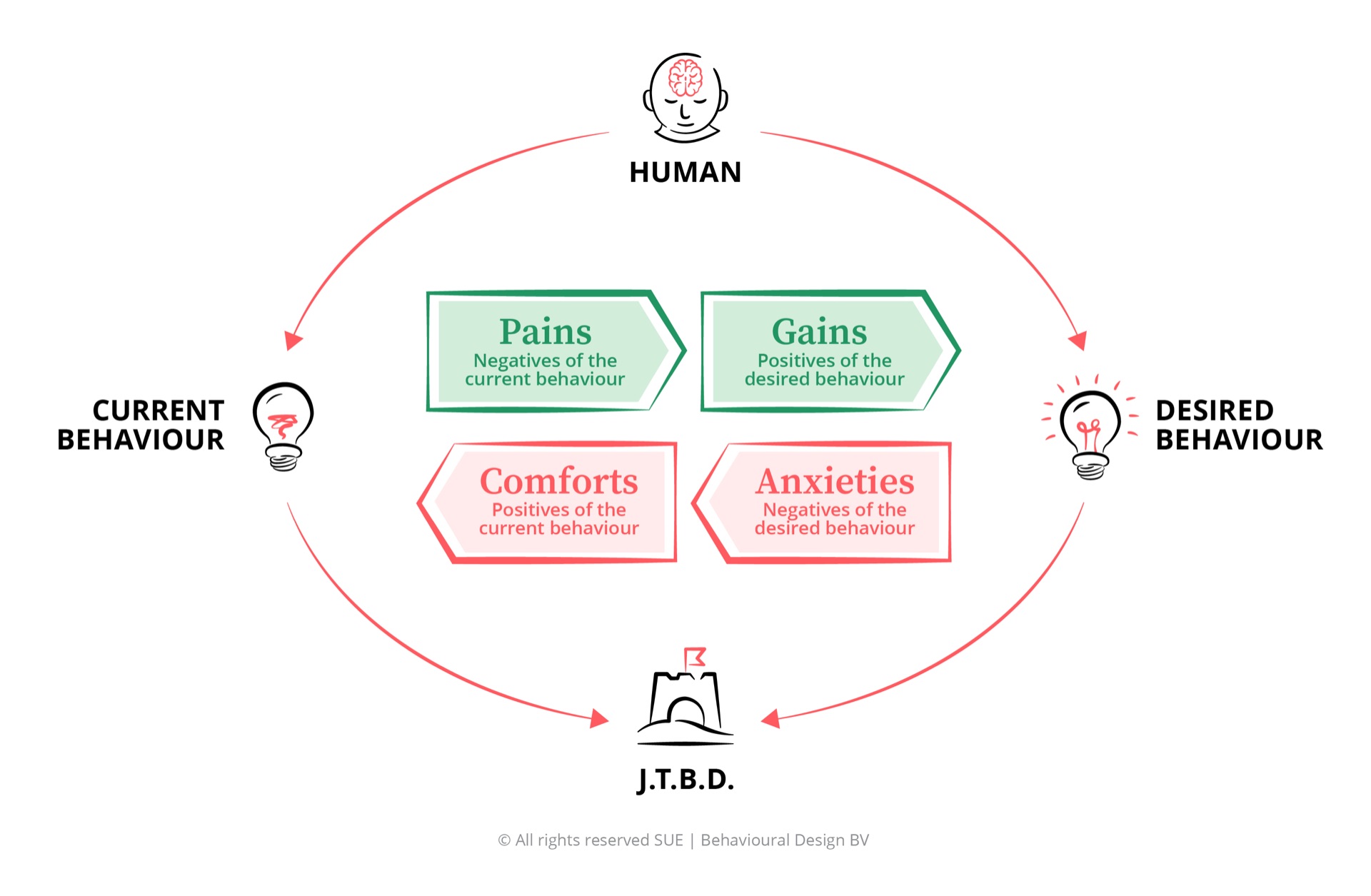
This is where we use the SUE Influence Framework©. This framework helps you answer four questions about the people whose behaviour you want to change:
- Pains: what pain or frustration does the person experience in the current situation?
- Gains: what benefit does the person want to achieve?
- Anxieties: what fears or doubts are keeping the person from the new behaviour?
- Comforts: what existing habits or routines are keeping the person stuck in the current behaviour?
Only when you understand which specific barrier is blocking the behaviour can you choose the right nudge. A nudge aimed at social norms will not work if the real barrier is lack of time. A default adjustment will not work if the real barrier is distrust.
Step 3: Choose the right type of nudge
Nudges are not a homogeneous category. Different mechanisms exist, each working through a different behavioural principle:
- Default nudges: make the desired behaviour the standard option. Works via status quo bias. Example: opt-out organ donation, double-sided printing as default.
- Social norm nudges: show what the majority does. Works via conformity. Example: "8 out of 10 people in your area have already submitted their tax return."
- Saliency nudges: make the right option more visible or accessible. Works via attention and availability. Example: placing fruit at eye level in a canteen.
- Framing nudges: present the same information in a different frame. Works via reference points and loss aversion. Example: "This product contains 10% fat" versus "This product is 90% fat-free."
- Commitment nudges: have people make a small, explicit commitment. Works via consistency bias. Example: ask people to confirm they will attend an appointment rather than just sending a reminder email.
- Implementation intentions: help people make a plan for when and how they will carry out the behaviour. Works by closing the intention-behaviour gap. Example: "When are you going to see your doctor? Enter a date below."
Step 4: Design the intervention at the right moment and place
Nudges only work when they appear at the right moment in the decision journey. A nudge that comes too early has no effect because the behaviour has not yet occurred. A nudge that comes too late reaches people who have already decided. The most effective nudges are placed at the moment of decision, at the point where the behaviour actually happens.
The difference between a poster in the hallway saying "eat more vegetables" and a sign on the vegetable section in the canteen showing a social norm is not just creativity. It is the moment of intervention.
Step 5: Test and measure the effect
A nudge is only proven effective once you have tested it. Use an A/B setup where possible: one group that receives the nudge and a control group that does not. Measure the behaviour directly, not people's opinion of the nudge. People are notoriously bad at predicting their own behaviour.
If the nudge does not work, go back to step 2. The barrier you thought you were addressing was probably not the real barrier.
You're reading about it. But what if you could apply it yourself, to customers, colleagues, citizens or stakeholders?
As Europe's #1 academy in Behavioural Design, we train professionals to analyse, predict and influence behaviour, live, online or as a team. Based in Amsterdam, with more than 10,000 alumni from London to Sydney and Singapore to New York.



 EQAC
EQACCertified
Training
Nudging in practice: four application areas
What does this look like concretely per field? Here are four sectors with their specific nudge logic.
Government and policy
Governments have built the most nudge experience. The UK's Behavioural Insights Team (BIT), founded in 2010, has run hundreds of nudge experiments in collaboration with government agencies. Two findings are worth noting for public sector professionals.[2]
First: social norms work in policy. When HMRC added the line "9 out of 10 people in your area pay their taxes on time" to payment reminders, the response rate increased by 15 percentage points compared to the standard letter. No new law. No higher fine. Just a different sentence.
Second: implementation intentions close the intention-behaviour gap. When patients in a hospital were asked to write down when and how they would do their rehabilitation exercises, adherence increased significantly compared to the group that received instructions only. The intention existed in both groups. The plan to convert that intention into action was missing in one of them.
The core for government professionals: nudging is not a replacement for regulation or public information campaigns, but a complement. It works best when people already know what the right choice is but are not consistently making it. For further reading, see our article on libertarian paternalism: the philosophical foundation behind government use of nudges.
Marketing and communications
In marketing, nudging is not new. Effective marketers have been applying behavioural psychology insights for decades, sometimes without calling it that. But systematically designing nudges requires more than intuition.
The most underused nudge in marketing is loss aversion. People respond on average twice as strongly to the idea of loss as to an equivalent gain. "Don't miss this offer" works differently from "Take advantage of this offer," provided it is credible and not overdone. This applies to product copy too: "Protect your skin" lands differently from "Improve your skin," even when describing the same product.
A second nudge that gets underused in marketing: social proof at the right moment. Not generic ("Thousands of satisfied customers") but specific and placed at the moment of doubt. When someone is about to abandon their shopping cart, reviews that specifically address the purchase process are more effective than general satisfaction scores. The nudge is most effective at the moment when the Anxiety is highest.
A third application: choice architecture within the offer itself. The sequence, visual hierarchy and naming of options all influence which option people choose. A subscription labelled "Most popular" converts significantly better than the same subscription without that label. More on how to apply this is in the article on choice architecture.
HR and organisations
In organisations, nudges are particularly effective for behaviour that employees already want to show but consistently fail to: eating more healthily in the canteen, exercising more, contributing to a pension, submitting feedback forms on time. All examples of intention-behaviour gaps you can close by redesigning the environment.
Google's People Analytics team did this in their own canteens: by placing fruit and vegetables at eye level and moving less healthy options further away, vegetable consumption among employees rose by more than 30% without any communication campaign. The message stayed the same, the architecture was different.
Pension saving is a classic case. The SMarT programme (Save More Tomorrow) by Thaler and Benartzi asked people to agree in advance that future salary increases would automatically go to their pension. The result was a quadrupling of the average contribution over four years, without anyone being asked to save more right now.[3]
UX and digital environments
In digital environments, the power of the default is most measurable in the design of forms, onboarding flows and sign-up processes. Every form is a series of choice-architecture decisions: which options are pre-checked, which question comes first, how the progress indicator is set up.
Adding a simple progress bar to a form increases completion rates in most A/B tests by 10 to 30%. The increase has nothing to do with greater motivation, but with the goal gradient effect: the closer to the finish, the harder we push.
An important distinction: nudging in UX sits on an ethical boundary with dark patterns. A pre-checked newsletter at checkout is a nudge. A pre-checked paid upgrade in small print at the bottom of a page is a dark pattern. The difference lies in transparency and whether the nudge serves the user's interest.
The five most common nudge mistakes
Across hundreds of nudge projects, in government, brands and organisations, the same five mistakes come up again and again.
- Not analysing the barrier. The nudge is designed based on what seemed logical, not on what the real obstacle was. Result: a well-designed nudge for the wrong problem.
- Thinking a nudge replaces a campaign. A nudge changes the context. But if there is no underlying intention and people have no idea why the desired behaviour is good for them, there is nothing to activate.
- Placing the nudge at the wrong moment. A poster in the waiting room saying "Please arrive on time for your appointment" reaches people who are already late. A text reminder 24 hours before with an implicit commitment question works.
- Not testing. Nudges are hypotheses. They may seem obvious, but a nudge's effectiveness is context-dependent and not always predictable. Always test.
- Forgetting the ethical frame. A nudge that is transparent and serves the user's interest is defensible. A nudge that is hidden or works against someone's interest is a dark pattern. The difference is not in the technique but in the intent.
Nudging as part of Behavioural Design
Nudging is one tool in the Behavioural Design toolbox, not more than that. A nudge can influence a specific behavioural moment, but broader behaviour change requires a diagnosis of the full system: drivers, barriers, social context and choice architecture at every point in the customer journey or policy implementation.
That is what the Behavioural Design method does: systematically analyse and redesign the behavioural layer. The approach always starts with the same question, whether you are dealing with citizens, customers or employees: why is the current behaviour rational from the perspective of the person themselves?
 Training for professionals
Frequently asked questions
How do you apply nudging in practice?
Nudging in practice starts with defining the desired behaviour concretely, then analysing which barrier is blocking it. Once you know the right barrier, you choose the type of nudge that addresses it. Then you design the intervention at the right moment in the decision journey, test on a small scale, and measure the behavioural effect directly.
What are concrete examples of nudging in practice?
The fly in the urinal at Schiphol (visual targeting), opt-out organ donation in Belgium (default), social norms on energy bills (social proof), smaller plates in canteens (environmental design), and the SMarT pension programme (advance commitment). In marketing: loss framing in product copy, social proof at the moment of doubt, and "most popular" labels in pricing tables.
When does nudging not work?
Nudging does not work when the target behaviour is complex and deliberate, when the real barrier is financial or situational rather than environmental, or when there is no underlying intention. Nudges also fail when placed at the wrong moment in the decision journey or when the type of nudge does not match the actual barrier.
How does nudging differ from manipulation?
Nudging is transparent, leaves all options available, and works in the person's interest. Manipulation is hidden, restricts choices, or works against the person's interest. The same psychological techniques can be either, depending on intent and execution. A dark pattern is a nudge that has crossed the line into manipulation.
To conclude
Nudging in practice is more precise than most meeting-room conversations suggest. It is not a creative exercise but an analytical process: start with the behaviour, analyse the barrier, choose the nudge that addresses that barrier, test, and measure. Anyone who follows that process will find nudging to be one of the most effective and underused instruments available to professionals whose work depends on influencing behaviour.
If you want to learn how to apply this process systematically to your own challenges, the Behavioural Design Fundamentals Course is the starting point. You will learn the full method, from behavioural diagnosis to intervention design, and apply it directly to a real case from your own work.

1.5 minutes of Influence
Every week I notice something: a hospital sign, a supermarket shelf, a sentence in a meeting. Always something that shows exactly how context shapes behaviour. I write it down. Every Thursday morning it lands in your inbox. In 90 seconds.
Read by 10,000+ professionals · Free · Unsubscribe anytime